Jazz Crazy Records

An Archive of Early Jazz on 78 RPM

Category: Jazz

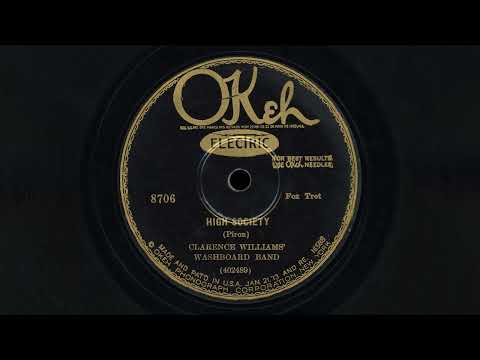
  • “High Society” – Clarence Williams’ Washboard Band (1929) – OKeh 8706 (take A)

    “High Society” – Clarence Williams’ Washboard Band (1929) – OKeh 8706 (take A)

    Clarence Williams recorded the Porter Steele composition “High Society” a few times during his long career – and today and tomorrow I’ll be sharing a few of my favorite versions of this tune.

    First up we have a version recorded during the summer of 1929 for the OKeh label. Curiously, it is played in a higher key (C/F) than the one it is normally played in (Bb/Eb) – and also does not include the turnaround section after the first 32 bars.

    The identity of the reed player has been hotly debated – with many educated guesses from Ben Whittet or Arville Harris to Cecil Scott.

    While “High Society” was originally composed by Porter Steele in 1901, he let the copyright lapse in 1929, leading A.J. Piron + Clarence Williams’ music publishing company to file a copyright under A.J. Piron’s name on his arrangement of the composition in May of 1929 – a few months before this recording was made. Hence the credit to Piron on this record.

    Also – is it me or does sound like Ed Allen flubbed a note at 1:04?

    Two issued takes were recorded and released – this is take A.

    Recorded in New York City on July 2, 1929.
    Released as OKeh 8706 (take A).

    Credits:
    Ed Allen – cornet
    Unknown Artist – clarinet, alto sax
    Clarence Williams – piano
    Floyd Casey – washboard

    Take C from this same session can be heard at:
    https://youtu.be/fP39_YQVlao
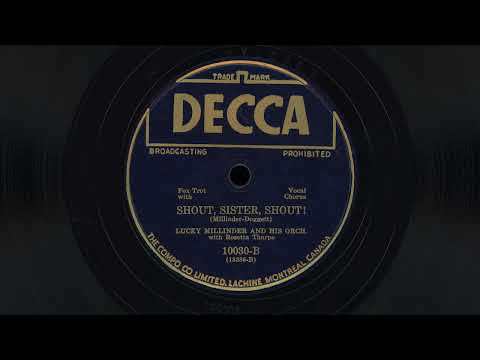
  • “Shout, Sister, Shout!” – Lucky Millinder and his Orchestra featuring Rosetta Tharpe (1941)

    “Shout, Sister, Shout!” – Lucky Millinder and his Orchestra featuring Rosetta Tharpe (1941)

    Working at the Kansas City Art Institute as a student in the late 1980s, my supervisor in the photo-video checkout area was Rev. Dwight Frizzell, who also employed a delightful curmugeon named Morris Martin. Reverend Dwight was constantly playing jazz music while we worked and Martin saw that I was interested in learning more. He made me a mix tape of Fletcher Henderson and Lucky Millinder that he recorded from his vinyl collection.

    This tune was one that I really loved from that tape. Fast forward 30 years and I have this very nice Canadian Decca pressing on 78 rpm.

    While Millinder got his start in the world of jazz and swing leading the Mills Blue Rhythm Band in the 1930s, his own orchestra that started in 1941 leaned more into rhythm and blues. Here we have an expressive anthem written by Millinder and pianist Bill Doggett – joyfully sung by the up-and-coming gospel singer Rosetta Tharpe.

    Recorded in New York City on September 5, 1941.
    Released in the U.S. as Decca 18386.
    Here we have the Canadian issue – Decca 10030.

    Credits:
    Lucky Millinder, vocals, director
    William Scott, Archie Johnson, Nelson Bryant – trumpet
    George Stevenson, Floyd Brady, Edward Morant – trombone
    Ted Barnett, George James – alto sax
    Stafford Simon – tenor sax
    Ernest Purce – baritone sax
    Bill Doggett – piano
    Trevor Bacon, Rosetta Tharpe – guitar, vocals
    Abe Bolar – bass
    Panama Francis – drums

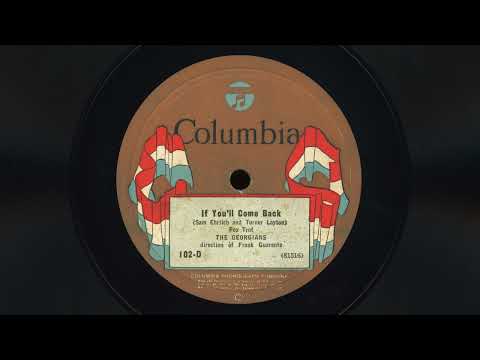
  • “If You’ll Come Back” – The Georgians (1924)

    “If You’ll Come Back” – The Georgians (1924)

    The Georgians are one of those underrated acoustic-era jazz bands that often get overlooked – though Italian-born trumpeter Frank Guarente had been playing in New Orleans – the epicenter of early jazz – starting in 1914. It was said that he was friends with Joe Oliver – and that the two traded tips and techniques.

    Guarente is a marvel on these early Georgians records, playing advanced hot solos for the time – and leading a very elegant group of ensemble players.

    Here we have a fine tune on a record in excellent condition – “If You’ll Come Back”. At 1:15, the trumpet takes a solo, and we hear Guarente launch into an ornery muted melody that begins and ends with a growl.

    Recorded in New York City on March 6, 1924.
    Released as Columbia 102-D

    Credits
    Frank Guarente – trumpet, director
    Archie Jones – trombone
    Johnny O’Donnell – clarinet, bass clarinet, alto sax
    Dick Johnson – clarinet, alto sax, tenor sax
    Arthur Schutt – piano
    Russell Deppe – banjo
    Chauncey Morehouse – drums

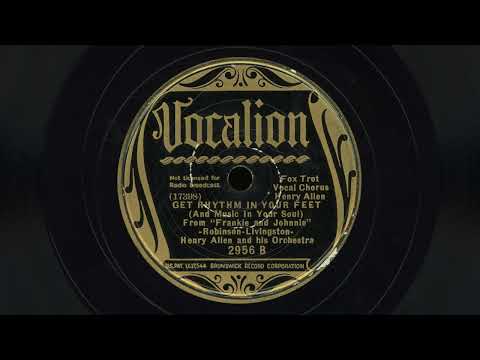
  • “Get Rhythm in your Feet” – Henry Allen and his Orchestra (1935)

    “Get Rhythm in your Feet” – Henry Allen and his Orchestra (1935)

    An upbeat tune to get some rhythm in your feet and music in your soul.

    Featuring solos by Henry Allen on trumpet, Chu Berry on tenor sax, and Horace Henderson on piano.

    Recorded in New York, April 29, 1935.
    Released as Vocalion 2956.

    Credits
    Henry Allen – trumpet, vocals, director
    Dicky Wells – trombone
    Cecil Scott – clarinet
    Chu Berry – tenor sax
    Horace Henderson – piano, arranger
    Bernard Addison – guitar
    John Kirby – bass
    George Stafford – drums

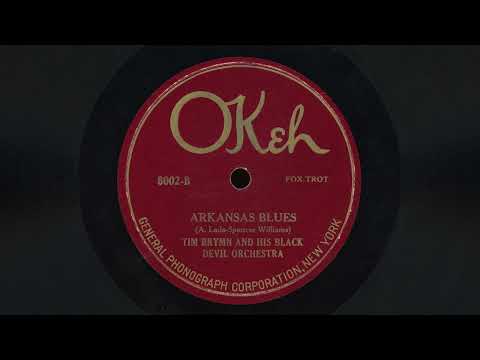
  • “Arkansas Blues” – Tim Brymn and his Black Devil Orchestra (1921)

    “Arkansas Blues” – Tim Brymn and his Black Devil Orchestra (1921)

    Lieutenant Tim Brymn served as band leader in the U.S. Army’s 350th Field Artillery regiment in 1918-1919. By October 1918, his band was comprised of over 100 musicians – including sergeant Drum Major William H. Smith (aka “Willie the Lion”).

    The regiment served with distinction in several battles during World War I. After the war’s end, they toured the front by order of General Pershing – and also special engagements across France. Upon return to the U.S. they toured the country, appearing at events across New England, Pennsylvania, and Ohio. Over the next three years, the band shrank to fewer and fewer members – and they found work playing hotels and nightclubs.

    In the early part of 1921, the band did a number of sessions for OKeh records – including this delightful and well-recorded tune: “Arkansas Blues”, which features relatively straightforward but quite compelling ensemble playing. In particular, the many brief sliding interjections from the trombone serve as a kind of punctuation that keeps the listener on their toes.

    It was the second release in the outstanding 8000 “race” series for OKeh – a series that would run through 1927 and include many seminal jazz and blues records by luminaries such as Mamie Smith and her Jazz Hounds, Bennie Moten’s Kansas City Orchestra, Louis Armstrong and his Hot Five, Clarence Williams, and many others.

    Recorded in New York City in April-May, 1921.
    Released as OKeh 8002

    Credits:
    Tim Brymn – piano, director
    Unknown or Unconfirmed Artists – cornet (2), trombone, clarinet & alto sax (2), clarinet & tenor sax, banjo, tuba, drums

    Biographical information about Lt. Brymn from “Chronology and Itinerary of the Career of J. Tim Brymn Materials for a Biography” by Peter M. Lefferts
    https://digitalcommons.unl.edu/musicfacpub/64/

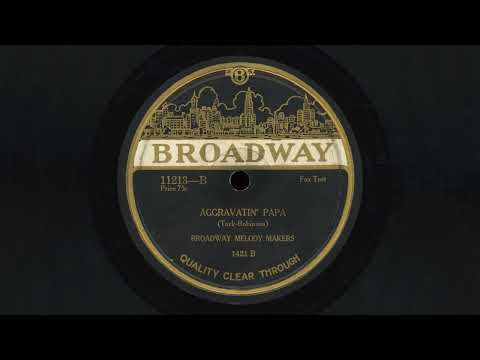
  • “Aggravatin’ Papa” – Broadway Melody Makers (1923)

    “Aggravatin’ Papa” – Broadway Melody Makers (1923)

    Join me in an investigation to discover who this mystery band is!

    When I first saw the catalog number on this release, it looked like the numbering of a Puritan or Triangle release. My first suspicion was that it could be a Paramount master. While Puritan 11213 did not seem to be a match, Puritan 11222 (Mx 837) is a version of “Aunt Hagar’s Blues” by Lanin’s Southern Serenaders licensed from Paramount and issued as Paramount 20068 with “Shake It Break It”.

    However, upon listening to Puritan 11222, this is not the same recording at all. Hear for yourself:
    https://www.youtube.com/watch?v=hnSH7STLke0

    Triangle 11213 and Belvedere 11213 both feature the same coupling credited to the Broadway Melody Makers. So that got me looking in a different direction. The matrix (1421) led me to an entry in Rust’s American Dance Band Discography for the Olympic Dance Orchestra (Instrumentation and personnel unknown).

    The Olympic Discography by Allan Sutton lists Olympic 1421 with the same coupling, but credits it to the Mobile Syncopators, noting that this is likely a pseudonym. It further adds to the confusion by citing an issue of Talking Machine World that listed Olympic 1421 as credited to the Olympic Dance Orchestra in the Advance Bulletin section. It also notes that this coupling was released on the super scarce LaBelle, Majestic labels in addition to the labels already mentioned.

    So who were the Mobile Syncopators? I can find no record of that band outside of the reference in the Olympic Discography. Now you know everything I know. Anyone have any ideas, citations, educated guesses, or possibilities? Or is this one of those unsolvable mysteries of early jazz that will likely never be resolved?

    Recorded circa January 1923.
    Issued as Broadway 11213.
    Originally released as Olympic 1421.

    The CLUES:

    The other side of this record can be heard at:
    https://youtu.be/Jj9G_17OU8w

    Olympic Discography
    https://adp.library.ucsb.edu/pdfs/Olympic-Discography.pdf

    Popsike Listing for the Belvedere issue:
    https://www.popsike.com/78-RPM-Broadway-Melody-Makers-Belvedere-11213-V-Jazz-Rare-label/234935638779.html

    Gripsweat listing for the Triangle issue:
    https://gripsweat.com/item/394435660339/jazz-broadway-melody-makers-aunt-hagars-blues-rare-and-hot-1923-triangle-78

    78Discography listing for the Triangle label
    https://www.78discography.com/Tri11000.htm

    78 Discography listing for the Paramount 20000 series
    https://www.78discography.com/PMT20000.htm

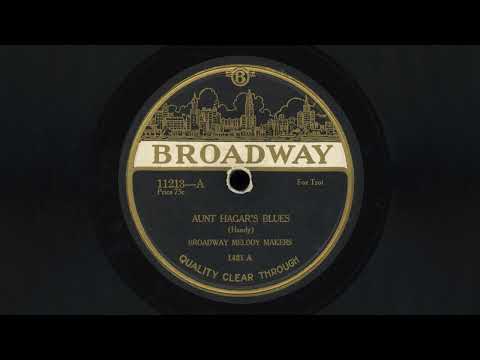
  • “Aunt Hagar’s Blues” – Broadway Melody Makers (1923)

    “Aunt Hagar’s Blues” – Broadway Melody Makers (1923)

    Join me in an investigation to discover who this mystery band is!

    When I first saw the catalog number on this release, it looked like the numbering of a Puritan or Triangle release. My first suspicion was that it could be a Paramount master. While Puritan 11213 did not seem to be a match, Puritan 11222 (Mx 837) is a version of “Aunt Hagar’s Blues” by Lanin’s Southern Serenaders licensed from Paramount and issued as Paramount 20068 with “Shake It Break It”.

    However, upon listening to Puritan 11222, this is not the same recording at all. Hear for yourself:
    https://www.youtube.com/watch?v=hnSH7STLke0

    Triangle 11213 and Belvedere 11213 both feature the same coupling credited to the Broadway Melody Makers. So that got me looking in a different direction. The matrix (1421) led me to an entry in Rust’s American Dance Band Discography for the Olympic Dance Orchestra (Instrumentation and personnel unknown).

    The Olympic Discography by Allan Sutton lists Olympic 1421 with the same coupling, but credits it to the Mobile Syncopators, noting that this is likely a pseudonym. It further adds to the confusion by citing an issue of Talking Machine World that listed Olympic 1421 as credited to the Olympic Dance Orchestra in the Advance Bulletin section. It also notes that this coupling was released on the super scarce LaBelle, Majestic labels in addition to the labels already mentioned.

    So who were the Mobile Syncopators? I can find no record of that band outside of the reference in the Olympic Discography. Now you know everything I know. Anyone have any ideas, citations, educated guesses, or possibilities?

    Recorded circa January 1923.
    Issued as Broadway 11213.
    Originally released as Olympic 1421.

    The CLUES:

    The other side of this record can be heard at:
    https://youtu.be/J8MqWoZdYH4

    Olympic Discography
    https://adp.library.ucsb.edu/pdfs/Olympic-Discography.pdf

    Popsike Listing for the Belvedere issue:
    https://www.popsike.com/78-RPM-Broadway-Melody-Makers-Belvedere-11213-V-Jazz-Rare-label/234935638779.html

    Gripsweat listing for the Triangle issue:
    https://gripsweat.com/item/394435660339/jazz-broadway-melody-makers-aunt-hagars-blues-rare-and-hot-1923-triangle-78

    78Discography listing for the Triangle label
    https://www.78discography.com/Tri11000.htm

    78 Discography listing for the Paramount 20000 series
    https://www.78discography.com/PMT20000.htm

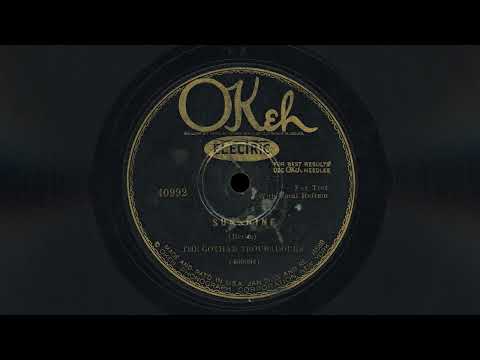
  • “Sunshine” – The Gotham Troubadours (1928)

    “Sunshine” – The Gotham Troubadours (1928)

    Found a very nice copy of this Sam Lanin recording of an Irving Berlin tune. If Brian Rust’s American Dance Band Discography is to be trusted, I believe Red Nichols and Jimmy Dorsey may be playing on it.

    In any case, the quality of the musicians is high and the tune “Sunshine” had just been published. Paul Whiteman’s orchestra has the honor of being the first to record the song (having knocked it out in the studio just four days earlier on February 13, 1928). But this Gotham Troubadours version has a fresh energy that matches the humor and optimism of the Berlin composition – which is a sunny panacea that advises a little sunshine to solve most of life’s problems:

    “Pay your doctor bills
    Throw away his pills
    You can cure your ills
    with sunshine.”

    In addition to this Lanin version, several others recorded the tune that same year, including Irving Kaufman, Little Jack Little, Nick Lucas, Jack Smith, and Seger Ellis. Lanin himself re-recorded it with his Ipana Troubadours the very next week.

    Recorded in New York City on February 17, 1928.
    Released as Okeh 40992.

    Credits:
    Sam Lanin – director, drums
    Red Nichols (?) – trumpet
    Sam Lewis (?) – trombone
    Jimmy Dorsey (?) – clarinet, alto sax
    Unknown Artist – piano
    Tony Colucci (?) – banjo
    Joe Tarto (?) – tuba
    Scrappy Lambert – vocals

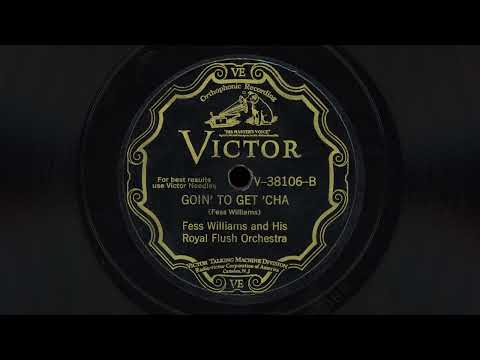
  • “Goin’ To Get ‘Cha” – Fess Williams and his Royal Flush Orchestra (1929)

    “Goin’ To Get ‘Cha” – Fess Williams and his Royal Flush Orchestra (1929)

    Stanley “Fess” Williams was a clarinetist and bandleader whose style, showmanship, and raw energy won many fans while holding residence with his Royal Flush Orchestra at the Savoy Ballroom in Harlem during the late 1920s.

    This self-penned energetic dance number from late 1929 features two sides that showcase his wild style of playing. From the first few notes – his alto sax howls and squeals! Williams’ raw energy and acrobatic glissandos seem to push the music toward its dramatic conclusion.

    Recorded in New York City on December 6, 1929.
    Released as Victor V-38106.

    Credits
    Fess Williams – clarinet, alto sax, director
    George Temple, John Brown – trumpet
    David “Jelly” James – trombone
    Bobby Holmes, Ralph Brown or Felix Gregory – clarinet, alto sax
    Perry Smith – clarinet, tenor sax
    Henry Duncan – piano
    Ollie Blackwell or Andy Pendleton – banjo
    Emanuel Casamore – tuba
    Ralph Bedell – drums

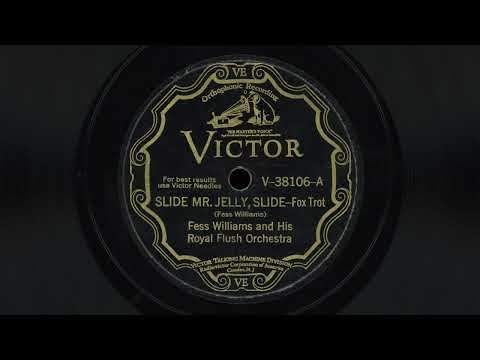
  • “Slide, Mr Jelly, Slide” – Fess Williams and his Royal Flush Orchestra (1929)

    “Slide, Mr Jelly, Slide” – Fess Williams and his Royal Flush Orchestra (1929)

    When I first say “Mr. Jelly”, I immediately thought of Doctor Jazz himself, Jelly Roll Morton – but here the reference is to trombonist David “Jelly” James, who opens this track with a sliding trombone line that repeats at intervals throughout the song – and takes a leading role throughout.

    Williams takes many hot breaks and eventually takes a solo – as does the trumpet and piano.

    Recorded in New York City on December 6, 1929.
    Released as Victor V-38106.

    Credits:
    Fess Williams – clarinet, alto sax, director
    George Temple, John Brown – trumpet
    David “Jelly” James – trombone
    Bobby Holmes, Ralph Brown or Felix Gregory – clarinet, alto sax
    Perry Smith – clarinet, tenor sax
    Henry Duncan – piano
    Ollie Blackwell or Andy Pendleton – banjo
    Emanuel Casamore – tuba
    Ralph Bedell – drums