Jazz Crazy Records

An Archive of Early Jazz on 78 RPM

Category: Jazz

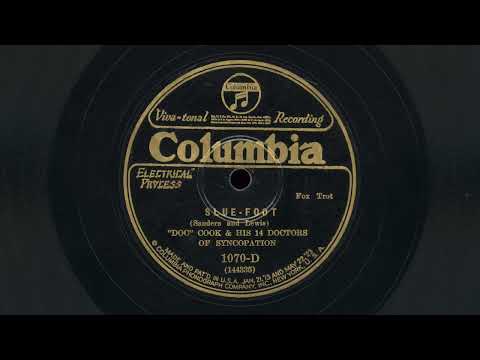
  • “Slue Foot” – Doc Cook and his 14 Doctors of Syncopation (1927)

    “Slue Foot” – Doc Cook and his 14 Doctors of Syncopation (1927)

    Kentucky-born Charles “Doc” Cook led his first band at age 15 in Louisville. He moved to Chicago in 1922 and formed “Cook’s Dreamland Orchestra” which featured cornetist Freddie Keppard and recorded many excellent sides at a recording session for Gennett in 1924.

    While “Doc” was a common nickname for The nickname was legit: as Cook earned his Doctor of Music degree from the Chicago College of Music in 1926.

    He led this Chicago band full of New Orleans musicians during the late 1920s that played a dance hall at the White City amusement park. After the entire orchestra’s instruments were stolen off the bandstand after a dance marathon, the band broke up and Cook moved to New York City, where he worked as an arranger for Radio City Music Hall and RKO.

    This tune is a jaunty toe-tapper, with lots of syncopated moments (as advertised) to keep dancers on their feet. At a key moment in the composition, the band enthusiastically shouts out “Slue Foot! Do That Step!”

    Recorded in Chicago on June 15, 1927.
    Released as Columbia 1070-D.

    Credits:
    Doc Cook (Charles L. Cooke) – director
    George Mitchell, Elwood Graham – cornet
    Bill Dawson, Fayette Williams – trombone
    Jimmie Noone – clarinet
    Joe Poston – alto sax
    Billy Butler – alto sax, violin
    Clarence Owens – tenor sax
    Jerome Carrington – piano
    Johnny St. Cyr – banjo
    Bill Newton – tuba
    Andrew Hilaire – drums
  • “Charleston” – Ben Selvin and his Orchestra (1925)

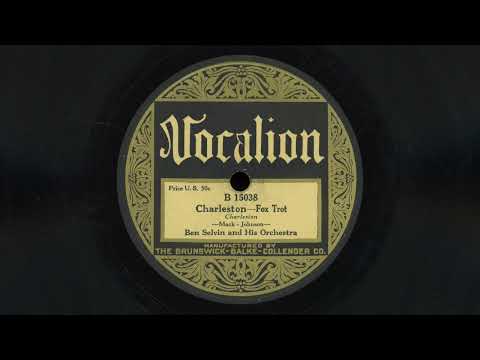
    “Charleston” – Ben Selvin and his Orchestra (1925)

    “Charleston” was composed by James P. Johnson for the production of “Runnin’ Wild”, a musical that opened in October of 1923 at the New Colonial Theatre at 1887 Broadway at 62nd St in New York City. The first published version of the tune was recorded that same month by Arthur Gibbs and his Gang.

    Fast forward a year and a half – To this excellent early recording of “Charleston” by Ben Selvin and his Orchestra. The band had recorded “The Original Charleston” under the pseudonym “The Knickerbockers” for the Columbia label on April 10 – and came into the studio to record a second version for Vocalion under the Ben Selvin name.

    This second recorded version has tighter orchestration and a more elegant feel to my ears – and some of that comes from the lively arrangement by William Covington Perry (The Perry in Perry’s Hot Dogs), who “doctored up the stock arrangement by Walter Paul Duzet.”

    Quite an enjoyable dance tune! Lots of energetic playing by Earl Oliver on trumpet throughout with some hot clarinet and trombone solos to boot. A real treat to listen to!

    Recorded in New York City on May 13, 1925.
    Released as Vocalion 15038.
    Released in the U.K. as Duotone B-5076.

    Credits:
    Ben Selvin – violin, director
    Earl Oliver, Tommy Gott – trumpet
    Sammy Lewis – trombone
    Larry Abbott, Lucien Smith – clarinet, alto sax, soprano sax
    Jimmy Johnston – bass sax
    Harry Reser – banjo
    Lew Cobey – piano
    Milton Sands – drums
    William Covington “Bill” Perry – arranger

    Thank you to @jslas2-590 for the additions and corrections to the original description!

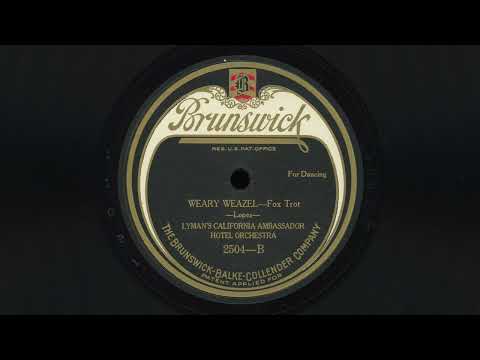
  • “Weary Weazel” – Abe Lyman’s California Ambassador Hotel Orchestra (1923)

    “Weary Weazel” – Abe Lyman’s California Ambassador Hotel Orchestra (1923)

    In the summer of 1923, Brunswick sent a recording crew to Los Angeles where, over the course of two weeks, they recorded 15 tracks by a popular local orchestra that had made a name for itself at the Cocoanut Grove ballroom in the Ambassador Hotel. They were led by drummer Abe Lyman, originally from Chicago, who had been playing out west for a number of years.

    “Weary Weazel” composed by trumpeter Ray Lopez, sounds to my ears like a loose homage to “Tiger Rag” by the Original Dixieland Jazz Band, which Lopez, being a New Orleans native, was no doubt familiar with. Interesting also because Lopez was sued by ODJB after he copyrighted “Livery Stable Blues”, which ODJB had recorded but failed to secure a copyright for. Nick LaRocca is reported to have admitted in court that “Livery Stable Blues” was based on a Ray Lopez song called “More Power Blues” and the suit was dismissed.

    This was only the second recording the band made – and captures the influence, vis-à-vis Ray Lopez, of early New Orleans “jass” in this Los Angeles ballroom orchestra.

    Recorded in Los Angeles, California on July 27, 1923.
    Released as Brunswick 2504.

    Credits
    Abe Lyman – drums, director
    Ray Lopez, Howard Fenimore – trumpet
    Orlando “Slim” Martin (or possibly Vic Smith on some of the earlier sides) – trombone
    Jim Welton, Al Baker (or possibly Gus Mueller on some titles) – clarinet, alto sax
    Horace “Zip” Keyes – clarinet, tenor sax
    John Schonberger, Charles Kaley – violin
    Gus Arnheim – piano
    Charlie Pierce – banjo
    Jake Garcia – tuba

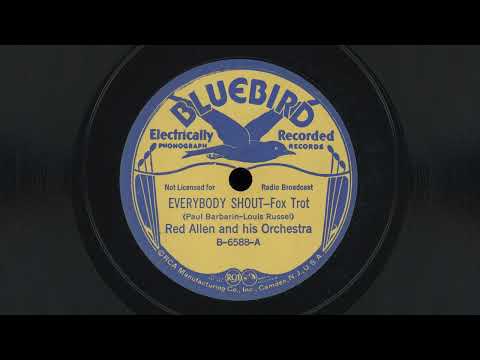
  • “Everybody Shout” – Red Allen and his Orchestra (1930)

    “Everybody Shout” – Red Allen and his Orchestra (1930)

    The outstanding orchestra of Henry “Red” Allen master pressed and reissued on the Bluebird label. What a sound!

    Originally released on the Victor V-38000 series in the early 1930s – this big swingin’ sound certainly must have still sounded fresh and crisp even when it was reissued on Bluebird in 1937. If you’re “feeling drowsy”, this oughta wake you right up!

    Features an all-star cast of great performances and the legendary rhythm section of Pops Foster and Paul Barbarin.

    Recorded in New York on February 18, 1930.
    Originally released on Victor V-38121 (as Henry Allen Jr. and his New York Orchestra).
    Reissued as Bluebird B-6588 in 1937.

    Credits
    Henry Allen – trumpet, director
    Otis Johnson – trumpet
    J. C. Higginbotham – trombone
    William Thornton Blue – clarinet, alto sax
    Charlie Holmes – clarinet, soprano sax, alto sax
    Teddy Hill – clarinet, tenor sax, baritone sax
    Luis Russell – piano
    Will Johnson – banjo
    Pops Foster – bass
    Paul Barbarin – drums

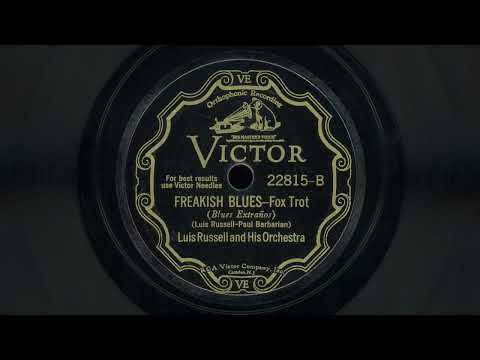
  • “Freakish Blues” – Luis Russell and his Orchestra (1931)

    “Freakish Blues” – Luis Russell and his Orchestra (1931)

    A deep depression cut from Luis Russell and his Orchestra from the summer of 1931. This beautiful record had the misfortune to be released during a tough time for the music biz. The record industry was on the skids and sales had plummeted from 100 million records sold in 1929 to only 6 million in 1932. Radio was taking over as a free source of continuous music, news, and entertainment.

    Luis Russell was a pianist born in Panama who spent time in both New Orleans and Chicago before coming to New York and forming his own band.

    This record is full of great players – such as Henry “Red” Allen, Albert Nicholas, Pops Foster and Paul Barbarin. They showcase their abilities on this record through a mastery of control, restraint, and emotional resonance.

    The tune begins with a languid and almost pastoral vibe. The rhythm section trots gently along as the soloists seem to float past us as though walking on air.

    An alto sax (Albert Nicholas?) begins. Dicky Wells follows on trombone. Then a trumpet (Henry Allen?). Each interspersed with ensemble playing and ending with a call and response between a lone sax and the rest of the band. A trumpet starts plaintively growling toward the end, but the sun sets before it can make its full argument.

    Evocative and beautiful – almost a kind of programme music in the classical sense. One senses something new being born.

    Recorded in New York City on August 28, 1931.
    Released as Victor 22815.
    Only 2,460 copies of this record were sold.

    Credits
    Luis Russell – piano, director
    Henry Allen, Robert Cheek, Gus Aiken – trumpet
    Dicky Wells – trombone
    Albert Nicholas- clarinet, alto sax
    Henry Jones – alto sax
    Greely Walton – tenor sax
    Will Johnson – guitar
    Pops Foster – bass
    Paul Barbarin – drums, vibraphone

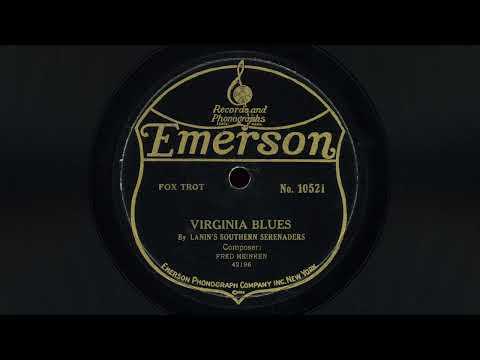
  • “Virginia Blues” – Lanin’s Southern Serenaders (1922)

    “Virginia Blues” – Lanin’s Southern Serenaders (1922)

    One of my favorite versions of “Virginia Blues” – and ironically recorded within a week of the Ladd’s Black Aces session with Cliff Edwards. The difference is that here, we lose Cliff Edwards’ eefin’ vocalizations for the alto sax of Loren McMurray. This trade is more than fair and results in a very interesting comparison between these versions produced on the same week by largely the same band.

    It should be noted that this Emerson copy is probably in a bit better shape than the Ladd’s Black Aces’ Gennett record and that factor should be taken into consideration.

    Recorded in New York City on February 15, 1922.
    Released as Emerson 10521 and Regal 9200.

    Credits:
    Phil Napoleon – trumpet
    Miff Mole – trombone
    Jimmy Lytell – clarinet
    Loren McMurray – alto sax
    Frank Signorelli – piano
    Jack Roth – drums

    If you’re interested in comparing these recordings – here are links to the other transfers from my collection:

    1. “Virginia Blues” – Superior Jazz Band
    https://youtu.be/DBf3buba9-A

    2. “Virginia Blues” – Ladd’s Black Aces (featuring Cliff Edwards aka “Ukulele Ike”)
    https://youtu.be/5hr-_9LwhhM

    3. “Virginia Blues” – The Benson Orchestra of Chicago
    https://youtu.be/zdqQ9C5m-yM

    4. “Virginia Blues” – Lanin’s Southern Serenaders
    https://youtu.be/uwP8JeaMNYg

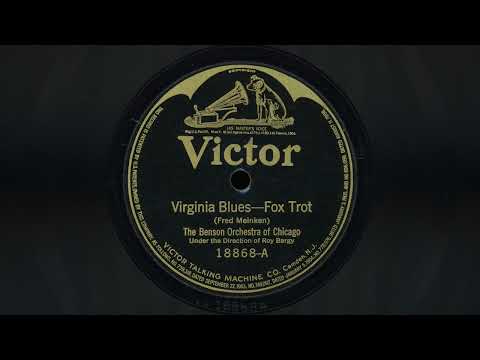
  • “Virginia Blues” – The Benson Orchestra of Chicago (1922)

    “Virginia Blues” – The Benson Orchestra of Chicago (1922)

    To continue my incessant listening-to of “Virginia Blues” that I started yesterday, here we have a version by the Benson Orchestra of Chicago from early 1922 under the direction of pianist Roy Bargy.

    The Benson Orchestra was a very popular dance orchestra in Chicago who recorded countless records for Victor from 1920 – 1925. Under Bargy’s leadership the Benson band put out many great records – and these are fun to hunt for because they sold well and supply seems to be plentiful.

    Five takes of this tune were attempted on January 28, we don’t know what happened at this session but all takes were destroyed. The band came back at it to try again on February 2 and recorded four more takes. The 9th take ended up being the winner – and it was pressed and released to the public in April of 1922.

    This version begins in an almost stately manner – and you quickly notice the skill of the musicians, who were all top-notch, and the precision of the arrangement. All of which makes you wonder if the eight failed takes of this tune can be attributed to Bargy’s high standards and perfectionism in his craft.

    While there are no heated improvised solos to be found here, it is clear that the objective here is getting people on the dance floor. The banjo is quite forward in the mix, and provides a real stomp to the rhythm. Bargy’s bouncy piano starting around 1:36 is quite fun and animated.

    You can imagine the dance floor at Marigold Gardens in Chicago was always full when the Benson Orchestra was in the house.

    Recorded in Chicago on February 2, 1922.
    Released as Victor 18868.

    Credits:
    Roy Bargy – piano, director
    Rick Adkins – trumpet
    Guy Carey – trombone
    Matthew Amaturo – clarinet, alto sax
    Thomas Thatcher – tenor sax
    Joe Baum – violin
    Joe Miller – banjo
    William Foeste – tuba
    Arthur Layfield – drums

    If you’re interested in comparing these recordings – here are links to the other transfers from my collection:

    1. “Virginia Blues” – Superior Jazz Band
    https://youtu.be/DBf3buba9-A

    2. “Virginia Blues” – Ladd’s Black Aces (featuring Cliff Edwards aka “Ukulele Ike”)
    https://youtu.be/5hr-_9LwhhM

    3. “Virginia Blues” – The Benson Orchestra of Chicago
    https://youtu.be/zdqQ9C5m-yM

    4. “Virginia Blues” – Lanin’s Southern Serenaders
    https://youtu.be/uwP8JeaMNYg

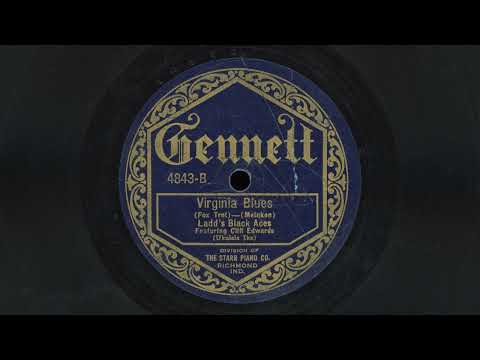
  • “Virginia Blues” – Ladd’s Black Aces (1922) f/ Cliff Edwards “Ukulele Ike”

    “Virginia Blues” – Ladd’s Black Aces (1922) f/ Cliff Edwards “Ukulele Ike”

    In a continuation of my Virginia-Blues-a-palooza, here we have the Original Memphis Five performing as Ladd’s Black Aces – and unlike the Superior Jazz Band recording I posted yesterday, here the personnel is a bit more nailed down.

    You can immediately sense an energy and confidence missing from the Superior record. There’s a festive quality to the record that gives it a relaxed sense of fun.

    We even get treated (or haunted, depending on your love of Cliff Edwards’ Eefin’ vocal technique) by the guest appearance of Ukulele Ike himself – Cliff Edwards – who musters up a hot vocal improvisation starting at 1:23.

    All in all, this record feels fresher and less stiff than the Superior record – and though my tolerance for Eefin’ can wane at times, it is a well-performed improvisation that breaks up the ensemble playing.

    What do you think of this one?

    Recorded in New York City on February 24, 1922.
    Released as Gennett 4843, Connorized 3059 (as Connorized Jazzers), Cardinal 517 and Starr 9229.

    Phil Napoleon – trumpet
    Miff Mole – trombone
    Jimmy Lytell – clarinet
    Frank Signorelli – piano
    Jack Roth – drums
    Cliff Edwards (“Ukulele Ike”) – vocal effects (Rust lists “Kazoo” but as @lukeholladay9596 astutely pointed out, this is a stylized vocal technique that Edwards developed called Eefin’. Kind of a combination of humming and scatting that mimics a kazoo using the voice alone. Edwards apparently claimed that he “learned it from street singers in his hometown of St. Louis.”)

    If you’re interested in comparing these recordings – here are links to the other transfers from my collection:

    1. “Virginia Blues” – Superior Jazz Band
    https://youtu.be/DBf3buba9-A

    2. “Virginia Blues” – Ladd’s Black Aces (featuring Cliff Edwards “Ukulele Ike”)
    https://youtu.be/5hr-_9LwhhM

    3. “Virginia Blues” – The Benson Orchestra of Chicago
    https://youtu.be/zdqQ9C5m-yM

    4. “Virginia Blues” – Lanin’s Southern Serenaders
    https://youtu.be/uwP8JeaMNYg

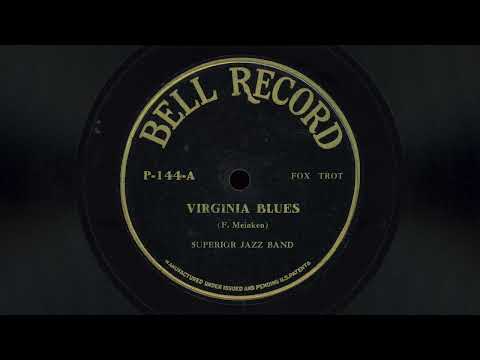
  • “Virginia Blues” – Superior Jazz Band (1922)

    “Virginia Blues” – Superior Jazz Band (1922)

    For some reason this past week I’ve been listening to various versions of “Virginia Blues” composed by Fred Meinken so thought I’d post a few and have fun comparing them.

    First up is a quaint recording from April of 1922 by a mysterious band called “Superior Jazz Band” on the Bell label. A fairly straightforward version of the tune – though the clarinetist seems a bit more adventurous than the other band members.

    Recorded in New York City on April 18, 1922.

    The only thing we know for certain about the personnel is that we don’t know who they are. We know the session was booked and directed by Ed Kirkeby – but that is where the conjecture begins.

    Rust lists no definitive personnel, but guesses the clarinetist could be Jimmy Lytell and pianist could be Frank Signorelli. Based on what evidence we’ll have to guess.

    A number of years ago on a message board someone suggested it could be an early incarnation of Original Memphis Five, but this seems to have been vigorously refuted by multiple knowledgable parties, including Mark Berresford and Ralph Wondraschek.

    In any case, give it a listen and check out some of the other versions I’ve posted. I find it quite instructive to listen to various versions back-to-back in order to really hear the differences between arrangements, bands, and players.

    If you’re interested in comparing these recordings – here are links to the other transfers from my collection:

    1. “Virginia Blues” – Superior Jazz Band
    https://youtu.be/DBf3buba9-A

    2. “Virginia Blues” – Ladd’s Black Aces (featuring Cliff Edwards “Ukulele Ike”)
    https://youtu.be/5hr-_9LwhhM

    3. “Virginia Blues” – The Benson Orchestra of Chicago
    https://youtu.be/zdqQ9C5m-yM

    4. “Virginia Blues” – Lanin’s Southern Serenaders
    https://youtu.be/uwP8JeaMNYg

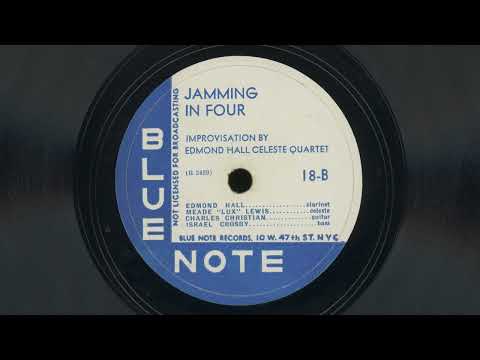
  • “Jamming in Four” – Edmond Hall Celeste Quartet (1941)

    “Jamming in Four” – Edmond Hall Celeste Quartet (1941)

    Early Blue Note 78s get a bad rap. Fans of later Blue Note hard bop on vinyl dismiss it as the label’s juvenilia and fans of early jazz find it too modern. Truth is – there’s some great music on early Blue Note – like this amazing record by the Edmond Hall Celeste Quartet.

    The celeste was sometimes used in 20s jazz recordings to add certain ornamental flourishes – often on the last chord of a song. And on rare occasion, we might even get to hear a short celeste solo, such as in Tiny Parham’s “Cathedral Blues”.

    Tiny Parham “Cathedral Blues”
    https://www.youtube.com/watch?v=FpKWOlsVsWk

    But here we get a full four minutes and twenty seconds of the rapturous Meade “Lux” Lewis playing a driven improvised blues on the celeste – jamming along with bandleader Edmond Hall on clarinet, the immortal Charlie Christian on guitar, and an energized Israel Crosby on bass. It’s a hedonistic romp that is a joy to listen to.

    Like many of Blue Note’s early records on 78 rpm, this was pressed on 12″ shellac, resulting in slightly longer run time.

    Recorded in New York City on February 5, 1941.
    Released as Blue Note 18.

    Credits:
    Edmond Hall – clarinet
    Meade Lux Lewis – celeste
    Charlie Christian – guitar
    Israel Crosby – string bass