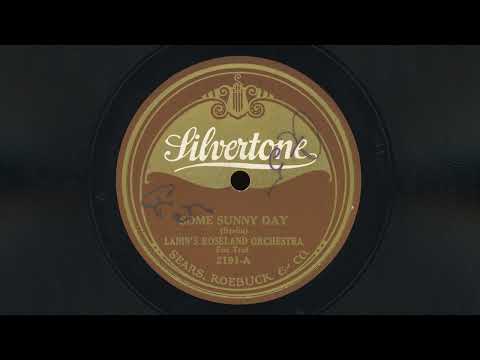
By request from one of my Discogs friends, a session originally released on the Federal label by Sam Lanin’s Roseland Orchestra that was reissued by the Silvertone label.
“Some Sunny Day” has a runout matrix of 2-1377 and was from a session in February 1922 that included “Do It Again” (Mx 2-1375) and “Every Day” (Mx 1-1371, 2-1372, and 3-1373).
It is believed that the tune “California” (Mx 2-1380) is from an entirely different orchestra altogether.
On “Some Sunny Day” we get a special treat: at 2:06 – an alto sax and trumpet duet featuring the excellent Loren McMurray laying on the heat.
Later this year, the Federal label suffered a catastrophe – their record factory burned down in a fire. They held on for a few years outsourcing to other manufacturers – but went out of business in 1925. Luckily, many Federal titles were reissued on the Silvertone label.
Recorded in mid-February, 1922 in New York City. Released as Federal 5191 and Silvertone 2191.
Credits for “Some Sunny Day” Sam Lanin – director Phil Napoleon – trumpet Miff Mole – trombone Bernhard “Doc” Berendsohn – clarinet, tenor saxophone Loren McMurray – alto saxophone Joe Gold (?) – piano Unknown Artist – violin, drums
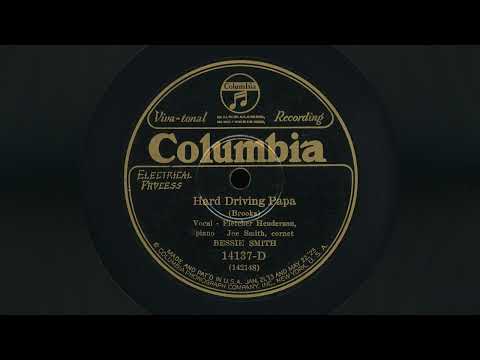
One of the cleanest Bessie Smith records in my collection – demonstrating how amazing 78 rpm records can sound when they are great shape.
Ms. Smith is accompanied by top-talent musicians from the NYC jazz scene who lend a mournful elegance to her powerful vocal performance. Mahalia Jackson once described the impact of Bessie’s voice: “Her music haunted you even when she stopped singing.”
Henderson and Smith recorded this session with Ms. Smith in between their Dixie Stompers session of April 14 (Dynamite, Jack-ass Blues, and Static Strut) and the Henderson orchestra session for Columbia of May 14 (The Stampede, Jackass Blues).
Recorded in New York City on May 4, 1926. Released as Columbia 14137-D
Credits: Bessie Smith – vocals Joe Smith – cornet Fletcher Henderson – piano
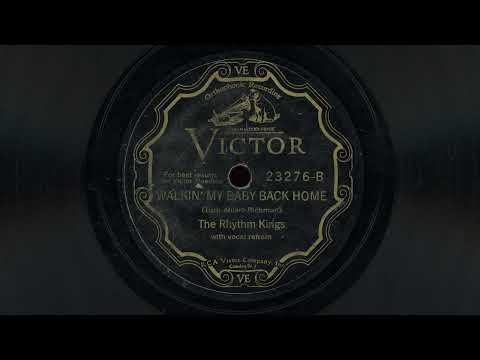
A delightful deep depression cut from an early incarnation of a band that later became known as the Washboard Rhythm Kings. Quite a rare disc, as the original release sold poorly when it came out in 1931.
In issue #19 and #20 of the British Jazz magazine Storyville, writer Theo Zwicky noted that during the period 1930-35, this group recorded around 140 titles – more sides than Louis Armstrong or Duke Ellington during the same period. This could, in part, be due to the immediate proximity of the musicians in the band (who Kaiser Marshall says were from Philadelphia) – and the location of Victor’s recording studio in Camden – right across the Delaware River.
Zwicky goes on to write that the WRK played “some of the most completely enjoyable jazz ever made. Driving along wildly and breathtakingly and yet relaxed and easy-going, scatting and humming through charming ditties as well as romping and stomping through distinctive jazz numbers, all overlaid with an innate sense of good taste, a flair for humour and a bright happy sound.”
Unfortunately, even Zwicky, who counted himself as a veritable WRK unofficial historian, many of the identities of the members of this group at the time of this session proved elusive – and not much is known about the performers outside of Teddy Bunn and the vocalist Buck Franklin.
In any case, I’ve always had a love for the gents in the Washboard Rhythm Kings ever since I heard their hot firecracker take of “Tiger Rag” complete with a raucous bull roarer. I gravitated to their fun unpretentious performances – often more of an impromptu celebratory jam session than a carefully rehearsed orchestration.
Recorded on May 8, 1931 in Camden, New Jersey. Released as Victor 23276 on June 19, 1931. Only 1,333 copies were sold.
To celebrate jazz saxophonist Loren McMurray, about whom there is a resurgence of interest following Archeophone Records recent CD release “The Moaningest Moan of them All: The Jazz Saxophone of Loren McMurray (1920-1922) – this is the last of three transfers from my own collection that I’m posting this week.
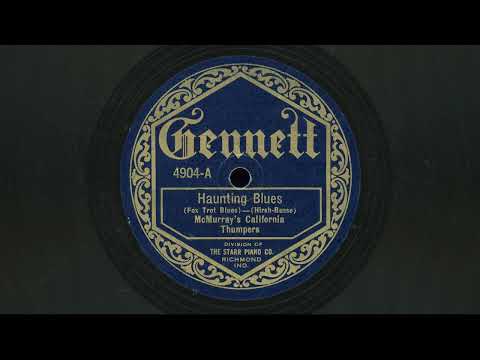
Here we find Loren McMurray at a high point in his career: fronting his own band and recording for the Gennett record label. We also hear him at the top of his game: his bold melodic lines connecting and weaving through the harmonies effortlessly like no other recorded saxophonist at the time.
Listening to him still feels fresh and surprising – a wonderful example of an early improvised solo. It’s no wonder this record sold well.
As I learned from Colin Hancock, a great tragedy of jazz was McMurray’s untimely passing a week before he had scheduled his third recording session with the Thumpers. If the four songs we have are any indication of what might have been, I concur with Mssrs Hancock and Berresford that McMurray is deserving of more recognition and credit for his contribution to jazz.
Rest in Peace, Mr. McMurray.
Recorded in New York City on June 8, 1922. Released as Gennett 4904.
Credits: Loren McMurray – alto saxophone Joseph Colling – Trumpet George Crozier – trombone Thomas Swift – piano Matt Grogan – banjo
Be sure to check out my interview with producer Colin Hancock about his Loren McMurray CD release on Archeophone Records – “The Moaningest Moan of them All: The Jazz Saxophone of Loren McMurray (1920-1922)” – which was recently nominated for a GRAMMY award for Best Historical Album. https://youtu.be/j6WxtLP8PWM
To celebrate jazz saxophonist Loren McMurray, about whom there is a resurgence of interest following Archeophone Records recent CD release “The Moaningest Moan of them All: The Jazz Saxophone of Loren McMurray (1920-1922) – this is the second of three transfers from my own collection that I’m posting this week.
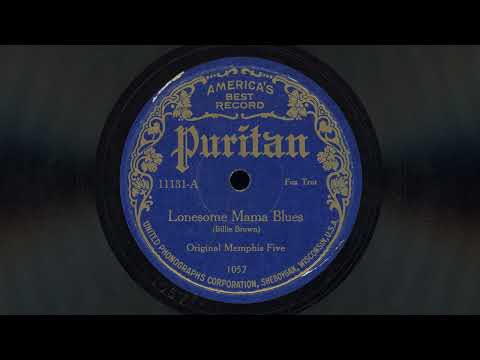
Here we have Loren McMurray joining a very early OM5 session. Mac had already recorded “Lonesome Mama Blues” twice earlier that year with both the Virginians and Markels Orchestra and was quite familiar with the tune.
This peppy version features lively ensemble playing with plenty of interesting solos and breaks by McMurray.
Recorded on May 10, 1922 in New York City.
Released as Puritan 11131, Paramount 20131, Banner 1068, Broadway 11129, Famous 3125, and Regal 9301.
Credits: Loren McMurray – alto sax, tenor sax Phil Napoleon – trumpet Miff Mole – trombone Jimmy Lytell – clarinet Frank Signorelli – piano Jack Roth – drums
Be sure to watch my interview with producer Colin Hancock about the Loren McMurray CD release on Archeophone Records – which was recently nominated for a GRAMMY award for Best Historical Album. https://youtu.be/j6WxtLP8PWM
To celebrate jazz saxophonist Loren McMurray, about whom there is a resurgence of interest following Archeophone Records recent CD release “The Moaningest Moan of them All: The Jazz Saxophone of Loren McMurray (1920-1922) – this is the first of three transfers from my own collection that I’m posting this week.
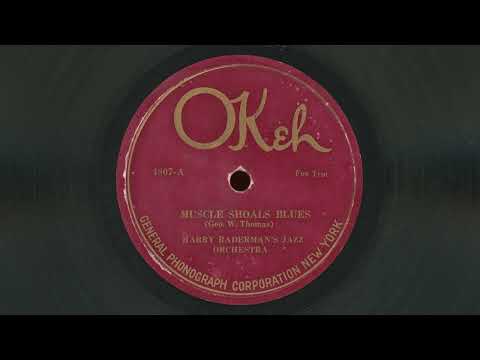
New Orleans-born clarinetist Doc Berendsohn comes storming out of the gates on this one, sounding like an outcast coyote furiously demanding entry to the jazz club. Throughout, Doc and McMurray weave and circle around one another, sometimes with an interjection from Raderman’s trombone.
Where Doc howls, sometimes careening the melody nearly off kilter, Mac’s lines are clean and flowing – always bringing the band back together. It’s an interesting look at how McMurray held his own alongside such a flamboyant and expressive player.
Recorded on November 2, 1921 in New York City. Released as Okeh 4807 and 4477.
Be sure to check out my interview with producer Colin Hancock about his Loren McMurray CD release on Archeophone Records – which was recently nominated for a GRAMMY award for Best Historical Album. https://youtu.be/j6WxtLP8PWM
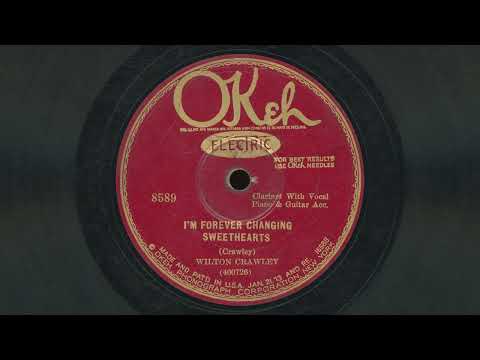
Wilton Crawley was a clarinetist known for his aggressive gaspipe style playing who recorded a number of records for Okeh and Victor from 1927-1930.
While detractors belittle this style as all screeches and laughing effects – here we can hear some of the subtleties of his playing – especially at the end of this track – that show Crawley’s sensitive attention to tone and his almost vocalized or sung delivery.
This tune “I’m Forever Changing Sweethearts”, an original composition by Mr. Crawley, gives us the crooning pillow talk of a would-be Don Juan to his latest conquest explaining his polyamorous nature.
The last line is a ice cold knife-twister yet is delivered with such a charmingly gentle melancholy that one can see how his paramour would be unfazed by its impact.
“I’m forever changing sweethearts by and by I’ll change you too.”
As an extra bonus, we get the wonderful accompaniment of Eddie Lang on guitar throughout.
Recorded in New York City on May 31, 1928. Released as Okeh 8589.
Credits: Wilton Crawley – clarinet, vocals Eddie Heywood – piano Eddie Lang – guitar
A very clean and enjoyable transfer of a pristine record.
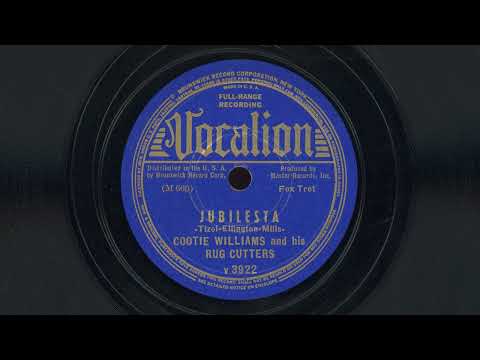
“Jubilesta” was a hot and moody composition by Puerto Rican trombonist Juan Tizol, who had found success the previous year with his composition “Caravan”, which he sold outright to Irving Mills for $25.
The track was recorded with a smaller combination of players from the Duke Ellington band. Ellington himself is credited on the session – though his piano is not audible on this track to my ears.
Excellent solos and a solid rhythm section make this record a real gem.
0:00 Intro and Clarinet solo (Bigard) 0:58 Trombone solo (Tizol) 1:47 Trumpet solo (Williams)
Recorded in New York City on October 26, 1937. Released as Vocalion 3922.
Cootie Williams – trumpet Juan Tizol – valve trombone Otto Hardwick – alto sax Barney Bigard – clarinet, tenor sax Harry Carney – baritone sax Duke Ellington – piano Billy Taylor – string bass Sonny Greer – drums
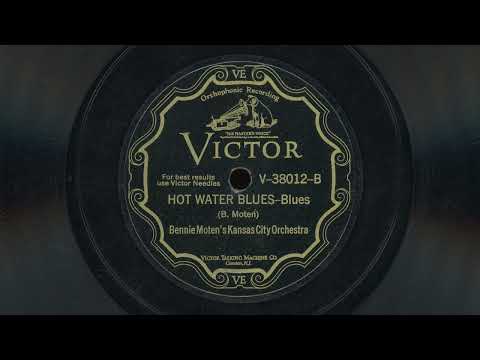
While some jazz historians have pooh-poohed the Moten band of 1928 for its lack of flashy soloists, it is important to remember: this is the band (and this is the session) that also yielded “South” – a title so popular that stayed in print until the 1950s and even was released as a 45 rpm 7″ single! There is staying power in this band’s craft, execution, rhythm, and bouncy performances!
Here we hear an excellent blues number filled with disciplined solos and a swingin’ beat that seems to literally bounce with the help of Vernon Page’s pulsing lyrical tuba lines.
Recorded in Camden, New Jersey on September 7, 1928. Released as Victor V-38012.
Credits: Bennie Moten – piano, director Ed Lewis, Booker Washington – cornet Thamon Hayes- trombone Harlan Leonard – clarinet, soprano sax, alto sax Jack Washington – clarinet, alto sax, baritone sax Woody Walder – clarinet, tenor sax Leroy Berry – banjo Vernon Page – tuba Willie McWashington – drums
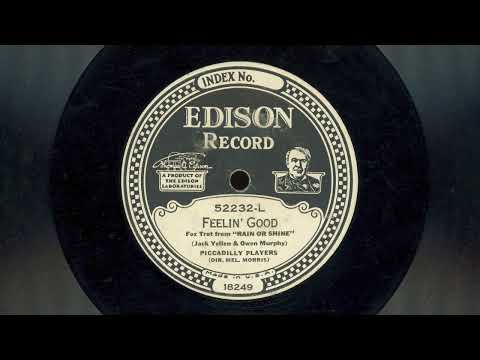
A real pick-me-up tune by Mel Morris’ Piccadilly Players which was electrically recorded for the Edison label. Please forgive that my copy has some slight warps in the laminate – and as a result, a slight “whooshing” can be heard for the first 30 seconds or so.
While Rust’s discographies do not list performers for Piccadilly Players outside of Director Mel Morris, cornetist Irving Peskin kept detailed records of the recording sessions he worked on and has been confirmed as the cornetist on the Piccadilly Players’ Edison records.
In a 2003 interview on the WFMU show “Thomas Edison’s Attic”, the 95-year-old Peskin was interviewed by telephone after listening to this very tune sent to him on CD.
Peskin says: “That is a good recording – You hear that the style is there – the refined jazz style! The saxophone solo – that style is about as forward-looking as existed at that time. It wasn’t wild the way they are these days. It stuck with a refined pattern.”
Peskin was asked if he knew who the sax player was and said that he did not. “No – sorry. I can only say this – I never took the time – I was so busy trying to do a good job that I wasn’t much on socialization.”
When asked what it felt like to hear the song 75 years after it was recorded, Peskin said: “I listen to this and I hear… the precision and quality of the instruments and playing – no mistakes – just about as top as you can get in precision playing wherever that is required… I call it articulation – there’s no flubs – no dubs – no ragged ends.”
Of his solo on this record, Peskin says “I was playing in the style of Bix, my idol of all the best jazz players in the world! Bix was a composer of absolutely fascinating beautiful music – [his playing] was so clear.”
Peskin had glowing words for director Mel Morris who he said he got along very well with.
Peskin also discussed the logistics and mechanics of how recording sessions worked at the time. He said he would get a call 1-2 days before the recording session to book him for the date – or would be asked in person at the musician’s union. He would travel to the recording session by subway alone. The musicians would sit down, run through the music once – and then do the recording. The money came after five days by post. The average pay was $20 for a three-hour session. However – the big money was playing what Peskin called “the society jobs” – where he could make $100 for a couple sets over the course of an evening.
Recorded in New York City on February 20, 1928. Released as Edison 52232. Directed by Mel Morris. Irving Peskin – cornet Don Murray – clarinet, alto sax, tenor sax Jimmy Dorsey (?) – clarinet