Jazz Crazy Records

An Archive of Early Jazz on 78 RPM

Category: Jazz

  • Nobody’s Sweetheart – Georgia Washboard Stompers (1933)

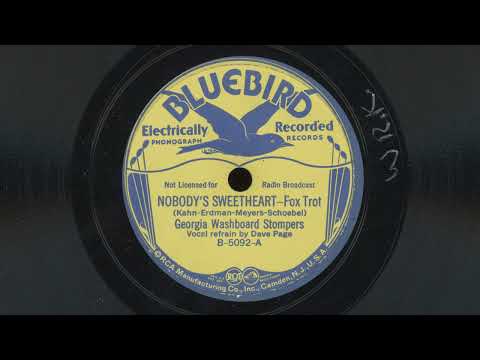
    Nobody’s Sweetheart – Georgia Washboard Stompers (1933)

    The Washboard Rhythm Kings were a studio band active during the heart of the Great Depression (1931-1933) made of a rotating retinue of players. As such, they went by a variety of pseudonyms, including this one: Georgia Washboard Stompers.

    Here we have “Nobody’s Sweetheart”, a tune that first surfaced in 1923 in a Broadway revue played by Ted Lewis. It was covered by a number of notable jazz orchestras in the late 20s and early 30s, including Red Nichols, Paul Whiteman, Cab Calloway, and Fred Elizalde. It appeared in the Rudy Vallée film “Vagabond Lover” in 1929 and was a featured song in a Betty Boop cartoon in 1932 (sung by Ukulele Ike imatator “Red Pepper Sam”) – which also featured some scat verses.

    The Washboard Rhythm Kings give it some pep straightaway, followed by a smooth trombone solo by John Haughton. Dave Page gives us the title line, followed by several crooned scat choruses. The ensemble comes back together and we hear short choruses from the saxes, clarinet, and piano. Throughout, the bass in the rhythm section keeps the joint jumpin’. Though Rust is not 100% sure if it is Ghost Howell on bass – it sure sounds like Ghost Howell to my ears!

    Recorded in Camden, New Jersey on June 1, 1933.
    Released as Bluebird B-5092.

    Credits:
    Dave Page – trumpet, vocals
    John Haughton – trombone
    Ben Smith – clarinet, alto sax
    Jerome Carrington (?) – alto sax
    Carl Wade – tenor sax
    Clarence Profit (?) – piano
    Steve Washington (?) – guitar
    Ghost Howell (?) – string bass
    Unknown Artist – washboard
  • I’m Just A Vagabond Lover – Ben Selvin and his Orchestra (1929)

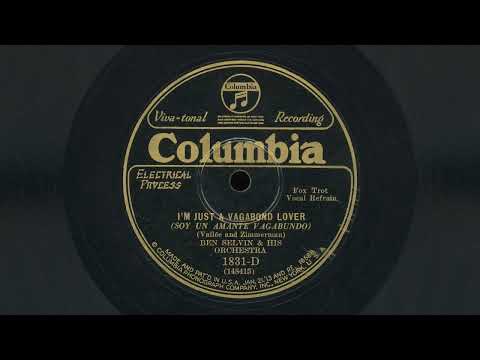
    I’m Just A Vagabond Lover – Ben Selvin and his Orchestra (1929)

    A Monday night classic dance band tune to start the week off.

    Written and recorded by Rudy Vallée earlier in 1929, this version of “I’m Just A Vagabond Lover” by Ben Selvin and his Orchestra is a bit more peppy and sweet. The vocalist delivers a studied performance that trades Vallée’s haunted melancholy for a more theatrical rendition.

    No hot solos or breaks on this one – just a good memorable tune to fill the dance floor full of fox trotters with mischievous bedroom eyes.

    I first heard this tune rather recently at the Bix Lives! Festival in Davenport, Iowa sung by the excellent @TJMullerMusic – and found this record the next day.

    Recorded in New York City on May 3, 1929.
    Released as Columba 1831-D.

    Ben Selvin was a prolific bandleader whose performers at this time included such notables as Tommy Dorsey, Manny Klein, Mike Mosiello, Tommy Gott, Andy Sannella, Arthur Schutt, Rube Bloom, Dick McDonough, Carl Kress, Joe Tarto, and Tony Colucci. Unfortunately, I don’t have a confirmed list of credits for this particular session.

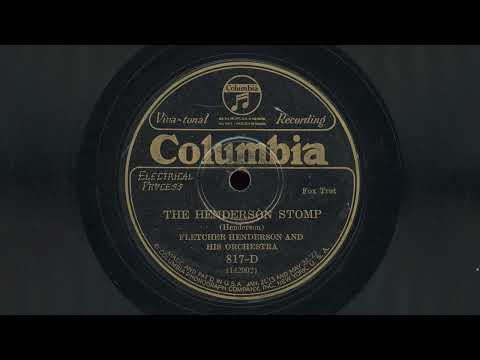
  • “Henderson Stomp” – Fletcher Henderson and his Orchestra (1926)

    “Henderson Stomp” – Fletcher Henderson and his Orchestra (1926)

    You’ve no doubt heard of the Moten Stomp, the Whiteman Stomp, and the Casa Loma Stomp. Well before those compositions came into being, there was the Henderson Stomp!

    This original tune was first recorded in 1926 – and Henderson later recorded it with the Benny Goodman Orchestra in November of 1940 when he was working as an arranger.

    Originally titled “Top and Bottom”, it was arranged by Don Redman and had what some have called tricky and difficult passages.

    This recording session was also the first in which Fats Waller performed with the Henderson band – and he takes a jaunty solo in mid-tune.

    0:00 Intro (Clarinets)
    0:42 Chorus (Brass)
    0:58 Piano solo (Fats Waller)
    1:15 Trumpet solo (Joe Smith)
    1:51 Clarinets
    2:20 Coda

    Recorded in New York City on November 3, 1926.
    Released as Columbia 817-D

    Credits:
    Fletcher Henderson – director
    Russell Smith, Joe Smith, Tommy Ladnier – trumpet
    Benny Morton – trombone
    Buster Bailey – clarinet, soprano sax, alto sax
    Don Redman – clarinet, alto sax, arranger
    Coleman Hawkins – clarinet, tenor sax
    Fats Waller – piano
    Charlie Dixon – banjo
    June Cole – tuba
    Kaiser Marshall – drums

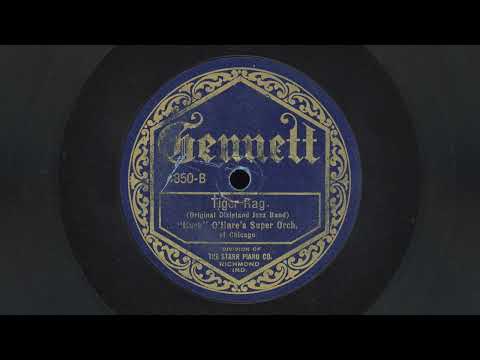
  • “Tiger Rag” – “Husk” O’Hare’s Super Orch. of Chicago (1922)

    “Tiger Rag” – “Husk” O’Hare’s Super Orch. of Chicago (1922)

    Husk O’Hare was a young Chicago promoter and bandleader in the early 1920s. His “super orchestra” traveled to Gennett studios in Indiana in early 1922 for a recording session.

    Of the tracks recorded on March 9 session, three were unissued. Only “Boo Hoo Hoo” was released (on the flip side of this record). On the following day, March 10, they successfully recorded three additional issued tracks: “Tiger Rag” (as we hear here), San, and Russian Love Song.

    Their version of “Tiger Rag” is a cacophonous rag-a-jazz romp, with energetic ensemble playing all around. The lively clarinet is the star of the show – though the tuba player merits special commendation for putting the band through a speed trial.

    It’d be nice to know who the players were – but once again, a mystery of early jazz.

    Recorded in Richmond, Indiana on March 10, 1922.
    Released as Gennett 4850, Cardinal 512, and Silvertone 9237.

    Credits:
    Husk O’Hare dir:
    Unknown Artists – trumpet, trombone, clarinet, alto sax, tenor sax, violin (2), piano, banjo, tuba, drums

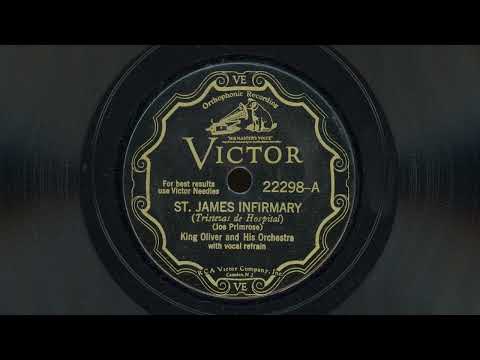
  • “St. James Infirmary” – King Oliver and his Orchestra (1930)

    “St. James Infirmary” – King Oliver and his Orchestra (1930)

    King Oliver, one of the pioneers of New Orleans jazz, made his name in New Orleans and Chicago with his Creole Jazz Band and Dixie Syncopators. He finally made the move to New York in 1929 at the age of 44.

    Louis Armstrong felt that Oliver waited too long to make the move to New York – and that the innovations he had pioneered had since become commonly imitated by the time he hit the town. Regardless – he began in January of 1929 a prolific series of sessions with Victor that resulted in a large number of releases recorded with pick-up bands featuring a rotating retinue of excellent players, including trumpeters Henry “Red” Allen and Bubber Miley who could solo in place of the King himself, who was having dental issues that made playing more difficult.

    “St. James Infirmary” is a song with a rich history – and is perhaps best known in a jazz context for Louis Armstrong’s 1928 version and Cab Calloway’s 1930 version which was featured in the Betty Boop cartoon “Snow White” that featured a rotoscoped Calloway providing dance moves for the animation.

    The King Oliver version was recorded amidst a flurry of recorded versions in 1930 – Gene Austin recorded a version for Victor on the same day – and Duke Ellington’s version was recorded on the following day. Rube Bloom and his Bayou Boys, Carl Fenton’s Orchestra, Chick Bullock and Alphonse Trent and his Orchestra all recorded versions within a month or two. Calloway’s version was recorded later in the year.

    Recorded at 46th Street Studio, New York City on January 28, 1930.
    Released as Victor 22298. Reissued as Bluebird B-5466.

    Credits:
    Carroll Dickerson – violin, director
    King Oliver, Henry Allen, Bubber Miley – trumpet
    Jimmy Archey – trombone
    Bobby Holmes – clarinet, alto sax
    Glyn Paque – alto sax
    Walter Wheeler (?) – tenor sax
    Don Frye – piano
    Arthur Taylor – banjo
    Jean Stultz – guitar
    Clinton Walker – tuba
    Frank Marvin – vocals
    Unknown Artist – chimes

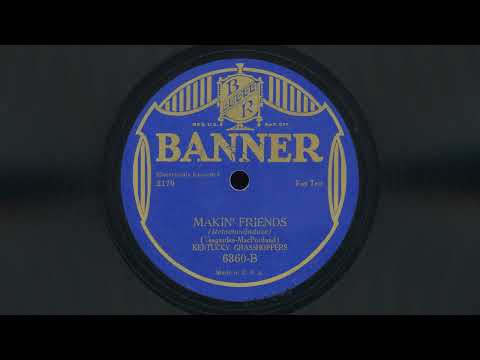
  • “Makin’ Friends” – Kentucky Grasshoppers (1929)

    “Makin’ Friends” – Kentucky Grasshoppers (1929)

    A slow burner from Irving Mills and his musical clowns using the hilarious pseudonym Kentucky Grasshoppers.

    Irving Mills was famously Duke Ellington’s manager from 1925 to 1939 but also led studio groups in recording sessions starting with the “Hotsy Totsy Gang” in 1928. He sometimes sang but to my knowledge did not play an instrument.

    After a brief and somber intro, Jack Teagarden’s trombone kicks us off – as my friend Terry will appreciate. His mournful solo is quite beautiful – and leads us to a more hopeful bluesy cornet solo by Jimmy McPartland.

    In addition to his trombone performances, Teagarden often took on vocal duties, and here after an initial verse, we also hear him scat a few choruses.

    In any case – a real gem.

    Recorded in New York City on April 4, 1929.
    Released as Banner 6360, Challenge 999, Domino 4322, Columbia 36010, Jewel 5569, Oriole 1537, and Regal 8768

    Credits
    Jimmy McPartland – cornet
    Tommy Thunen (?) – trumpet
    Jack Teagarden – trombone, vocals
    Jimmy Dorsey – clarinet, alto sax
    Gil Rodin – alto sax
    Larry Binyon – tenor sax
    Vic Breidis – piano
    Dick Morgan – banjo, guitar
    Harry Goodman – tuba, string bass
    Ray Bauduc – drums

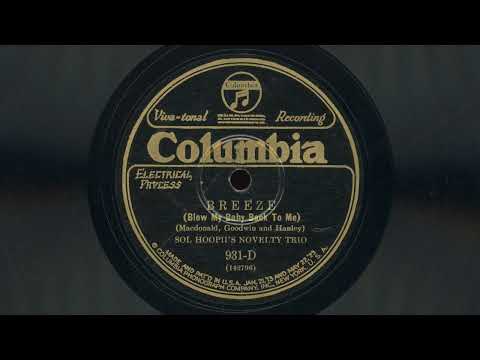
  • “Breeze (Blow My Baby Back To Me)” – Sol Hoopii’s Novelty Trio (1926)

    “Breeze (Blow My Baby Back To Me)” – Sol Hoopii’s Novelty Trio (1926)

    By request from one of my Instagram followers: A disc featuring the Hawaiian steel guitar of Sol Hoopii.

    This one is interesting for a few reasons: Firstly, this tune has been played by many jazz bands, including the Synco Jazz Band (1919), Ford Dabney (1919), Clarence Williams (1929 and 1933), Willie “The Lion” Smith (1935), and Andy Kirk (1938).

    Sol Hoopii also recorded a number of other jazz standards such as Tin Roof Blues, Singin’ the Blues, Stack O Lee Blues, and even Fascinating Rhythm. Sadly, this is the only one of his records in my collection.

    Secondly, this Hawaiian record also features a lovely vocal harmony which complements the tune quite well. Hope you enjoy.

    If you have requests – hit me up. I might not have it, but if I do, I’ll post it for you.

    Recorded in Los Angeles on October 19, 1926.
    Released as Columbia 931-D

    Credits:
    Sol Hoopii – steel guitar
    Lani McIntire – guitar
    Glenwood Leslie – ukulele

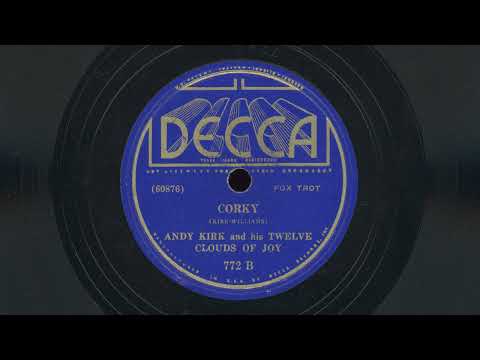
  • “Corky” – Andy Kirk and his Twelve Clouds of Joy (1936)

    “Corky” – Andy Kirk and his Twelve Clouds of Joy (1936)

    The Great Depression caused many jazz acts to call it quits – but Andy Kirk and his Twelve Clouds of Joy were able to keep working throughout the early 1930s in the thriving dance halls of Kansas City.

    Though they recorded a total of nine sessions in 1929-1930, they did not record at all from 1931 – 1935. When they finally got back into the studio in March of 1936, they recut two tunes from their very first 1929 session – “Froggy Bottom” and this one. It’s interesting to hear the differences (and similarities) that a little over six years could make.

    Ross Russell, in his “Jazz Style in Kansas City and the Southwest” found the new Decca version of “Corky Stomp” to be a “fresh and superior version.” The Decca version does swing pretty hard – but I think which version you prefer depends greatly on whether your overall jazz preferences tend toward the hotter 20s style or refined 30s swing style.

    In the new Decca recording, the tune’s title is cut to simply “Corky”. There’ll be no stomping in this version. Also cut is the ensemble introduction. Instead, we open affably with a immediately charming clarinet delivering the melodic head. Noticeably backed by the new combination of bass and guitar in the rhythm section. While there is some ensemble playing – it is more structured and syncopated, with fewer overlapping instruments. After a brief clarinet solo, Mary Lou still takes a piano solo, albeit a little shorter than the 1929 version. Next, a jaunty sax solo spills forward – and we end with a brief clarinet reprise and tightly arranged ending.

    Listen to the 1929 version here:
    https://youtu.be/L_8ibeX7DgQ

    Take a listen to both versions – tell me what you think in the comments.

    Recorded in New York City on March 7, 1936.
    Released as Decca 772.

    Andy Kirk – bass saxophone, director
    Harry Lawson, Paul King, Earl Thomson – trumpet
    Ted Donnelly, Henry Wells – trombone
    John Harrington – clarinet, alto sax, baritone sax
    John Williams – alto sax, baritone sax
    Dick Wilson – tenor sax
    Mary Lou Williams – piano, arranger
    Ted Robinson – guitar
    Booker Collins – string bass
    Ben Thigpen – drums

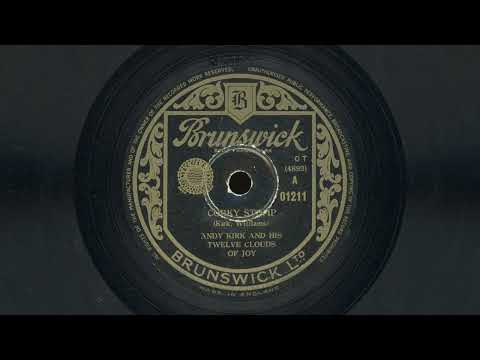
  • “Corky Stomp” – Andy Kirk and his Twelve Clouds of Joy (1929)

    “Corky Stomp” – Andy Kirk and his Twelve Clouds of Joy (1929)

    One thing that is always interesting to me is to listen to different recordings of the same tune by different jazz bands – or in this case, different recordings of the same tune by the same band that were recorded several years apart.

    Here we have a 1929 recorded version of “Corky Stomp”, a tune written by pianist Mary Lou Williams. The lead melody is played by Durham’s trombone. The rhythm section includes the banjo and tuba/bass sax that were more common in 20s jazz. In the middle of the tune, we get a brief hot trumpet solo followed by a delightful extended piano solo from Mary Lou Williams. The coda is marked by ensemble playing.

    The 1936 version of “Corky” can be heard here:
    https://youtu.be/Xna8W_dus7w

    Take a listen to both versions – tell me what you think in the comments.

    Recorded in Kansas City, Missouri on November 11, 1929.
    Originally released in the U.S. as Brunswick 4893.
    Released in the U.K. as Brunswick 01211 (master pressing).

    Credits:
    Andy Kirk – bass saxophone, tuba, director
    Gene Prince, Harry Lawson – trumpet
    Allen Durham – trombone
    John Harrington – clarinet, alto sax
    John Williams – alto sax, baritone sax
    Lawrence Freeman – tenor sax
    Claude Williams – violin
    Mary Lou Williams – piano, arranger
    William Dirvin – banjo, guitar
    Edward McNeil – drums

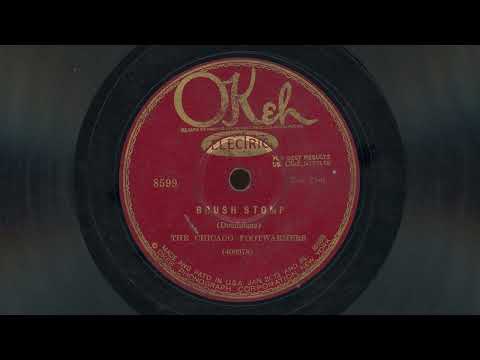
  • “Brush Stomp” – The Chicago Footwarmers (1928)

    “Brush Stomp” – The Chicago Footwarmers (1928)

    Forgive the rough start on this one – the grooves on the first few seconds of this hot number seem to be a bit beat.

    Getting past that, we hear some hot New Orleans jazz by way of Chicago: “Brush Stomp”, a number penned by cornetist Natty Dominique, as performed by The Chicago Footwarmers – featuring a hall of fame lineup.

    0:00 Intro – Cornet (Natty Dominique)
    0:25 Ensemble
    0:58 Trombone solo (Kid Ory)
    1:31 Piano solo (Jimmy Blythe)
    1:47 Clarinet solo (Johnny Dodds)
    2:19 Ensemble Coda

    Recorded in Chicago, Illinois on July 2, 1928.
    Released as Okeh 8599.

    Credits:
    Natty Dominique – cornet
    Johnny Dodds – clarinet
    Kid Ory – trombone
    Jimmy Blythe – piano
    Bill Johnson – string bass
    Baby Dodds – washboard