Jazz Crazy Records

An Archive of Early Jazz on 78 RPM

Category: Jazz

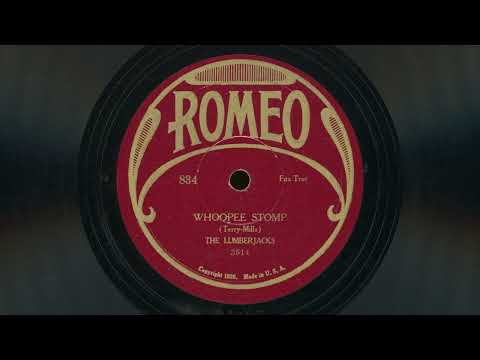
  • “Whoopee Stomp” – The Lumberjacks (1928)

    “Whoopee Stomp” – The Lumberjacks (1928)

    A rousing bit of hot jazz on a dime store label courtesy of a group from Ben Pollack’s orchestra, who went by a variety of pseudonyms such as The Whoopee Makers, Goody’s Good Timers, Mills’ Musical Clowns, and the Lumberjacks.

    The Pollack Orchestra’s Victor output felt restricted and “hidebound” to band members compared to their high-spirited live sets – where long hot solos running late into the evening were common. In contrast, their recording sessions were led by Victor executives who dictated the material that was to be cut – often with only one or two run-throughs before making the final recording. Jimmy McPartland complained, “It was no better than sight-reading.”

    Recording under pseudonyms for dime store labels was one way the band could let off some steam with material they had already mastered and knew sounded great. Listening to “Whoopee Stomp”, one can get a glimpse of what the Pollack band must have sounded like in their live performances.

    0:00 Intro
    0:22 Trumpet
    0:43 Reeds
    1:01 Sax solo
    1:19 Clarinet solo (Benny Goodman)
    1:37 Trombone solo (Jack Teagarden)
    1:58 Trumpet solo (Jimmy McPartland)
    2:20 Coda

    NewYork, c. November 23, 1928.
    Released as Romeo 834, Cameo 9030, and Lincoln 3059.

    Credits:
    Jimmy McPartland, Al Harris – trumpet
    Jack Teagarden – trombone
    Benny Goodman – clarinet, alto sax
    Gil Rodin – alto sax
    Larry Binyon – tenor sax
    Vic Breidis – piano
    Dick Morgan – banjo
    Harry Goodman – tuba
    Ben Pollack – drums
  • “The Duck’s Yas Yas Yas” – Johnson’s Cracker Jacks (1932)

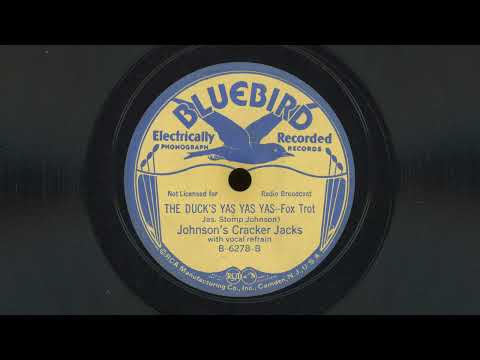
    “The Duck’s Yas Yas Yas” – Johnson’s Cracker Jacks (1932)

    Last week I attended the Bix Jazz Festival in Davenport, Iowa (which was wonderful) and heard the wonderful T.J. Muller and his Arcadia Dance Orchestra do a set featuring the music of St. Louis, Missouri bands and composers.

    One baudy number he performed was a tune written by St. Louis pianist and composer James “Stump” Johnson, who recorded the first version on the QRS label in 1928.

    As luck would have it, I found this fine record by Eddie Johnson’s Cracker-Jacks the next day. This is a Bluebird buff reissue of an original Victor release from 1932. The Cracker Jacks were from St. Louis – formed from the remnants of Oliver Cobb and his Rhythm Kings (who also recorded an outstanding version of the tune) after Cobb tragically drowned in the Mississippi near Davenport, Iowa in 1930.

    The tune’s folksy humor and Rabelaisian surrealism are quite infectious – and if you don’t know what a “yas” is, as T.J. Muller put it: “You’re sitting on one.”

    “Mama bought a rooster and she thought it was a duck
    put him on the table with his legs sticking up.
    In steps sister with a spoon and a glass
    to stir the gravy from his yas yas yas.”

    Recorded in Atlanta, Georgia on February 25, 1932.
    Originally released as Victor 23329.
    Reissued as Bluebird B-6278.

    Credits
    Eddie Johnson – piano, director
    Harold Baker, James Talphy – trumpet
    Winfield Baker – trombone
    Fred Martin, Walter Martin – alto sax
    Chick Franklin – tenor sax
    Benny Jackson – banjo, guitar, v
    Singleton Palmer – tuba
    Lester Nichols – drums
    The Crackerjacks – vocals

    @TJMullerMusic

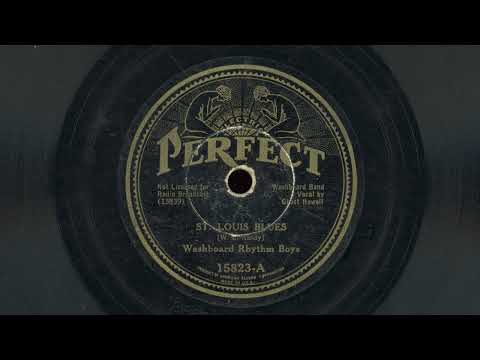
  • “St. Louis Blues” – Washboard Rhythm Boys (1933)

    “St. Louis Blues” – Washboard Rhythm Boys (1933)

    Wow – a red hot version of W.C. Handy’s “St. Louis Blues” as you’ve never heard it played by the Washboard Rhythm Kings (here using the name variation “Washboard Rhythm Boys”).

    Ghost Howell brings it (as he always does) and the driving energy of the band is apparent from the first few bars. A wild and joyful ride!

    This wonderful track is from one of their last recording sessions after a marvelous run of records released in the deep depression years of 1931-1933.

    Recorded in New York City on August 19, 1933.
    Released as Perfect 15823, Banner 32867, Domino 145, Melotone M-12794, Oriole 2763, Romeo 2136, Vocalion 2688, and Brunswick A-86013.

    Credits:
    Unknown Artists – trumpet
    John Haughton – trombone
    Ben Smith, Jerome Carrington (?) – alto sax
    Carl Wade – tenor sax
    Unknown Artist – p
    Unknown Artist – banjo
    Ghost Howell, string bass, vocals
    Unknown Artist – wb

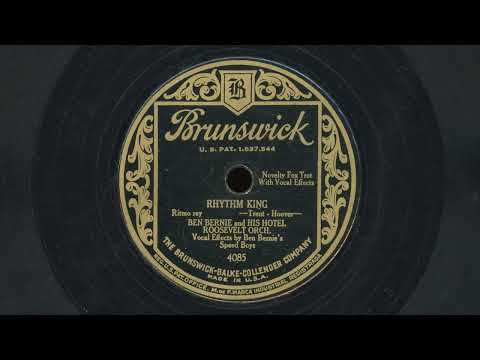
  • “Rhythm King” – Ben Bernie and his Hotel Roosevelt Orchestra (1928)

    “Rhythm King” – Ben Bernie and his Hotel Roosevelt Orchestra (1928)

    A wonderful late 20s pop tune from Ben Bernie and his Hotel Roosevelt Orchestra featuring Jack Pettis and the vocal harmonies and scatted stylings of “Ben Bernie’s Speed Boys”.

    “Listen to the Rhythm King
    Listen to him play that thing
    Oh! He’s some sensation!”

    Recorded in New York City on September 25, 1928.
    Released as Brunswick 4085

    Credits:
    Ben Bernie – violin, vocals, director
    Donald Bryan, Phil Hart – trumpet
    Paul Weigan – trombone
    Len Kavash, Dick Stabile – clarinet, alto sax
    Jack Pettis – clarinet, C melody sax, tenor sax
    Nick Gerlach – violin
    Al Goering – piano
    Clay Bryson – banjo
    Merrill Kline – tuba, string bass
    Dillon Ober – drums, xylophone
    J. Kenn Sisson – arranger
    Scrappy Lambert, Billy Hillpot, Frank Luther – vocals

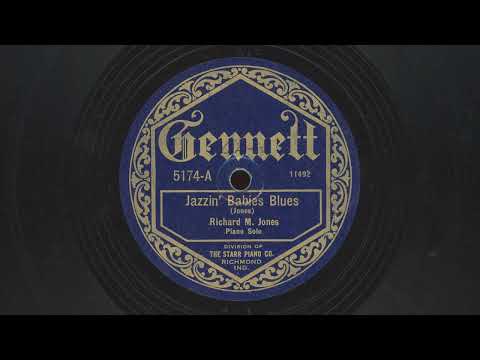
  • “Jazzin’ Babies Blues” – Richard M  Jones (1923)

    “Jazzin’ Babies Blues” – Richard M Jones (1923)

    Richard M. Jones’ first and only solo piano record.

    Recorded in Richmond, Indiana on June 1, 1923.
    Released as Gennett 5174.

    Credits:
    Richard M Jones – piano

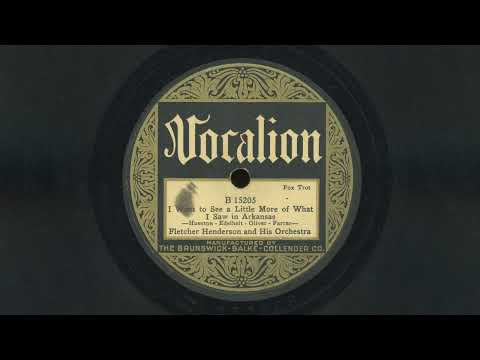
  • “I Want to See a Little More of What I Saw in Arkansas” – Fletcher Henderson & his Orchestra (1926)

    “I Want to See a Little More of What I Saw in Arkansas” – Fletcher Henderson & his Orchestra (1926)

    After late 1925, when both lead trumpet soloist and jazz catalyst Louis Armstrong and longtime trumpeter Elmer Chambers left the Henderson band, it was a time of re-calibration.

    To shore up the trumpet section, Henderson added 35-year-old Russell “Pops” Smith, brother of trumpeter Joe Smith. This was the cause of some friction in the band, as Smith had been previously married to Leora Henderson – who was now married to Fletcher.

    The band was playing regularly at the Roseland at Broadway & 51st St in Manhattan – and in the first week of January, 1926 was booked at the Roseland with an orchestra led by B.A. Rolfe.

    This recording session at the end of that week featured the full Henderson band and resulted in four sides that were released on both Vocalion and Brunswick. Three takes of “I Want to See a Little More of What I Saw in Arkansas” were recorded.

    This tune no doubt was a popular dance number at the Roseland – but we hear many excellent soloists throughout to retain a sense of jazz vitality. The Hawk and Charlie Green figure most prominently, and Joe Green’s shorter trumpet solos perhaps remind us that the trumpet section is still adjusting to the loss of Armstrong.

    0:00 Intro – Saxes
    0:40 Tenor Sax solo (Coleman Hawkins)
    1:00 Trumpet solo (Joe Smith)
    1:09 Tenor Sax solo (Coleman Hawkins)
    1:16 Ensemble
    1:33 Trombone solo (Charlie Green)
    2:08 Trumpet solo (Joe Smith)
    2:28 Outro

    Recorded in New York City on January 6, 1926.
    Released as Vocalion 15205.

    Credits:
    Fletcher Henderson – piano, director
    Russell Smith, Joe Smith, Luke Smith (?) – trumpet
    Charlie Green – trombone
    Buster Bailey – clarinet, alto sax
    Don Redman, clarinet, alto sax
    Coleman Hawkins – clarinet, tenor sax
    Charlie Dixon – banjo
    Ralph Escudero – tuba
    Kaiser Marshall – drums

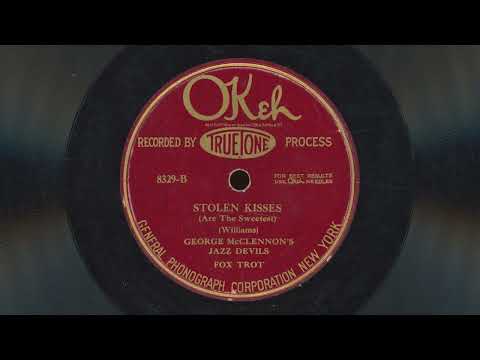
  • “Stolen Kisses (Are the Sweetest)” – George McClennon’s Jazz Devils (1926)

    “Stolen Kisses (Are the Sweetest)” – George McClennon’s Jazz Devils (1926)

    Yesterday I posted the A side of this great record – but the B side is equally intriguing so I shall include a transfer of it as well!

    By title, we see it is a “sweet” number – but McClennon’s Jazz Devils add some spice into the tune – with ensemble playing that gives it more energy than your typical sweet dance number from this period.

    A cornet solo drives us onward starting around 0:35 – and at 1:30 the banjo leads a syncopated breakdown. Toward the conclusion we hear McClennon’s clarinet wailing in the background like a fire alarm as the temperature rises ever hotter.

    A very exciting addition to the Jazz Crazy archive from the collection of Joe Bussard.

    And if you missed the A side of Okeh 8329 that I posted yesterday, here’s a link:
    https://www.youtube.com/watch?v=zV2kd89AiWo

    Recorded in New York City on June 18, 1926.
    Released as Okeh 8329.

    Credits
    George McClennon, clarinet
    Eddie Heywood (?) – piano
    Unknown Artist – cornet
    Unknown Artist – trombone
    Unknown Artist – alto sax
    Unknown Artist – banjo
    Unknown Artist – tuba
    Unknown Artist – drums

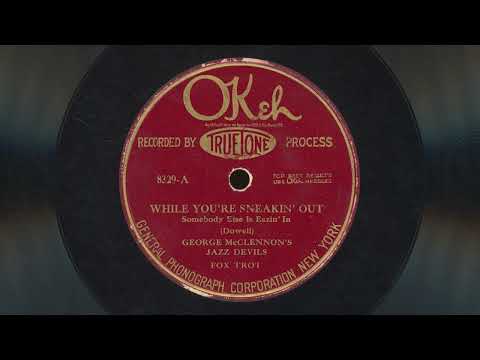
  • “While You’re Sneakin’ Out (Somebody Else Is Eazin’ In)” – George McClennon’s Jazz Devils (1926)

    “While You’re Sneakin’ Out (Somebody Else Is Eazin’ In)” – George McClennon’s Jazz Devils (1926)

    A rollicking hot number with a hilarious title from clarinetist George McClennon and his Jazz Devils from 1926. Wonderful ensemble playing and solos – has an intriguing energy that is both relentlessly vivacious and laid back at the same time.

    What sounds like a tenor or baritone sax kicks in around the 0:52 mark and a rousing cornet drives it home at the 1:20 mark. I’ve been listening to this all afternoon and just love it!

    Recorded with Okeh’s Truetone process – which in this case sounds pretty good to my ears!

    A very exciting addition to the Jazz Crazy archive from the collection of Joe Bussard.

    Recorded in New York City on June 18, 1926.
    Released as Okeh 8329.

    Credits
    George McClennon, clarinet
    Eddie Heywood (?) – piano
    Unknown Artist – cornet
    Unknown Artist – trombone
    Unknown Artist – alto sax
    Unknown Artist – banjo
    Unknown Artist – tuba
    Unknown Artist – drums

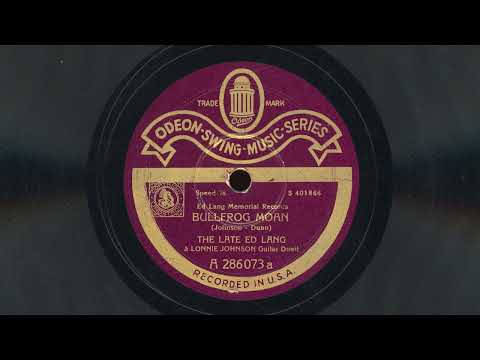
  • “Bullfrog Moan” – Eddie Lang and Lonnie Johnson (1929)

    “Bullfrog Moan” – Eddie Lang and Lonnie Johnson (1929)

    Eddie Lang and Lonnie Johnson were arguably the two most important jazz guitar players of the 1920s. Fans of both artists are fortunate that the two recorded several sessions together in 1928 and 1929 for the Okeh label.

    “Bullfrog Moan” begins with a croaking rhythmic riff repeated throughout that serves as the foundation of a bluesy duet between the two great masters.

    This German reissue was released on the curious “Odeon Swing Music Series” label sometime between 1938 and 1942. While some Nazi party leaders had banned jazz dancing outright – and others felt it was an “alien” music that should be rejected or prohibited, jazz found ways to survive.

    The series was not listed in the main Odeon catalog – only via typewritten lists that interested parties could order from. The record stores that fulfilled the orders were not allowed to play the records in the stores. There were also Swiss and Italian pressings of this series.

    A short history of this series and full discography can be found at:
    https://www.swingtime.de/swings/odswen.html

    Recorded in New York City on May 7, 1929.
    Originally released as Okeh 8695.
    Reissued as Odeon Swing Music Series A 286073.

    Credits
    Eddie Lang – guitar
    Lonnie Johnson – guitar

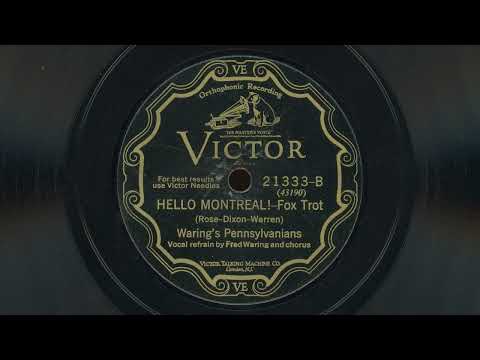
  • “Hello Montreal!” – Waring’s Pennsylvanians (1928)

    “Hello Montreal!” – Waring’s Pennsylvanians (1928)

    As someone who remembers when you wanted a drink in Williamsburg, Brooklyn other than at the Turkey’s Nest, you had to take the L train into Manhattan, it is quite astonishing that there was a time during prohibition-era America where if you wanted a drink in Manhattan, taking a train to Montreal was one of your better options.

    Regular listeners to this channel will forgive my occasional forays into non-jazz territory, and today we have what really was more of a novelty song by a popular dance band that would contain what Brian Rust might have called “little of jazz interest”. That said – it is a song about the jazz age in America, and certainly, the relationship between alcohol, speakeasies, and jazz has been well-documented.

    Waring’s Pennsylvanians were an early collegiate dance band that was formed at Penn State University. Their prolific recorded output tended to feature popular tunes – often with college themes such as “Freshie”, “Collegiate”, “Collegiana”, “The Yale Blues” and “Collegiate Blues”.

    This song reveals a plan to quietly escape the alcohol-free New York City to spend the summer and early fall drinking in Montreal.

    “Speak easy, speak easy, I’m leaving town.
    I’m going right away – everything up there’s okay.
    Take it easy, take it easy – we’ve got a hunch.
    You won’t go east, you won’t go west, well, we’ll all go in a bunch!
    We’ll be leaving in the summer, and we won’t come back ’till fall.
    Goodbye Broadway, hello Montreal!
    There’ll be no more orange phosphates –
    You can bet your Ingersoll.
    Goodbye Broadway, hello Montreal!”

    Later in the tune, clinking glasses are heard and punch-drunk voices devolve into a cartoonish scene of faux revelry.

    This popular tune was also recorded during March and April of 1928 by Ted Lewis and his Band, Harry Reser’s Jazz Pilots, Arthur Fields and his Assassinators, The Happiness Boys, and Ben Selvin’s Harmonians.

    Recorded in New York City on March 29, 1928.
    Released as Victor 21333.

    Credits
    Fred Waring – director, vocals
    Nelson Keller, George Culley – trumpet
    Jim Gilliland – trombone
    Fred Campbell – clarinet, alto sax
    Will Morgan – clarinet, alto sax, vocals
    Earl Gardner – alto sax
    Elton Cockerill – clarinet, tenor sax
    Bill Townsend, Francis Foster, Fred Culley – violin
    Tom Waring – piano, vocals
    Fred Buck – banjo
    Ed Radell – tuba
    Poley McClintock – drums