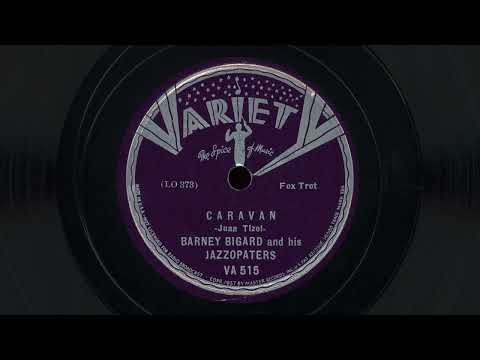
Recorded in Hollywood, Calilfornia on December 19, 1936. Released as Variety VA 515.
Credits: Cootie Williams – trumpet Juan Tizol – valve trombone Barney Bigard – clarinet Harry Carney – baritone sax Duke Ellington – piano Billy Taylor – bass Sonny Greer – drums
To hear the full Ellington orchestra record this tune a few months later, take a listen to: https://youtu.be/mG2WkIfQipE
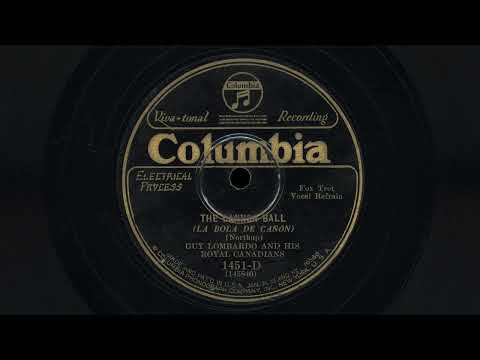
While known for his sweet dance music, Guy Lombardo and his Royal Canadians had a number of hot jazzy sides on the Gennett and Columbia labels in the mid to late 1920s.
Here we have “The Cannon Ball” – one of the harder of his early Columbias to find. Guy’s brother Lebert takes the lead on trumpet throughout this one – which also includes lots of reed section goodness, both piano and trombone solos, and a brief scatted vocal section.
Recorded in Chicago, Illinois on March 26, 1928. Released as Columbia 1451-D.
Credits: Guy Lombardo – director Lebert Lombardo – trumpet, vocals Jim Dillon – trombone Carmen Lombardo – clarinet, alto sax, vocals Larry Owen – clarinet, alto sax, vocals Fred Higman – tenor sax Victor Lombardo – baritone sax Bernard Davis – tuba Fred Kreitzer – piano Francis Henry – banjo George Gowans – drums
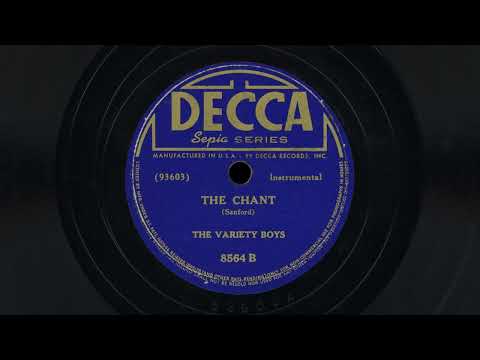
One of the reasons I love 78 rpm records is that sometimes you stumble across something brilliant when you weren’t expecting to. This 1941 recording must have flipped some lids upon its release – sounding inspired by a minimalist version of Django and Grappelli filtered through a film noir nightmare sequence. I love this twisted avant garde jam!
I couldn’t find much out about The Variety Boys from this time period – though it seems to be led by tenor saxophonist George Oldham.
From 1943 onwards, they added vocalist Ethelene Dinsmore and were known as a lounge act at cocktail clubs such as A1 Simmon’s Brown Derby in Washington, the Sky Club in Chicago, Flame Club in Duluth, Beachcomber in Omaha, Black and Tan in Seattle, and the Club Royal in San Diego.
Recorded in Chicago, Illinois on March 15, 1941. Released as Decca 8564.
Credits: George Oldham – tenor sax Bill Sanford – bass Clarence Black – violin Kenneth Henderson – guitar (as per “History of Jazz Tenor Saxophone Black Artists” by Jan Evensmo)
This earlier version is from an Okeh session recorded two months earlier in January. A third session for Victor yielded another version that was recorded at the end of March, 1928.
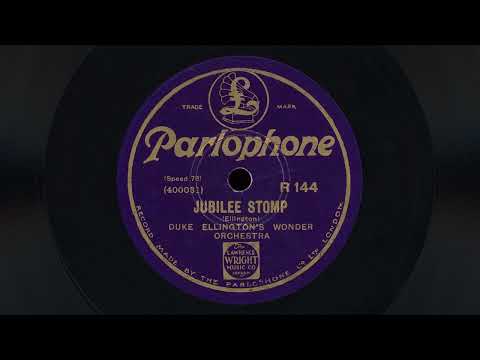
This very clean Parlophone master pressing presented the Ellington band as “Duke Ellington’s Wonder Orchestra” – one of only a very small number of releases to give the band that particular pseudonym. Great performances all around on this version – including hot trumpet, clarinet, trombone, and piano solos.
Recorded in New York City on January 19, 1928. Originally released as Okeh 41013. Released in the U.K. as Parlophone R-144 (master pressing).
Credits: Duke Ellington- piano, arranger, director Bubber Miley, Louis Metcalf – trumpet Joe Nanton – trombone Otto Hardwick – soprano sax, alto sax, baritone sax Harry Carney – clarinet, alto sax, baritone sax Barney Bigard – clarinet, tenor sax Fred Guy – banjo Wellman Brand – string bass Sonny Greer – drums
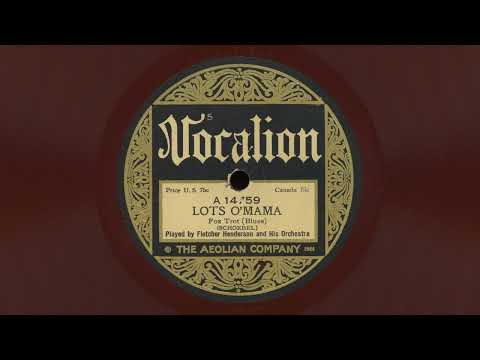
These early Fletcher Henderson Red Vocalions are gorgeous and always contain great music.
Hendersonia by Walter C. Allen recounts a curious episode from around this time: “Don Redman has recalled that he and Coleman Hawkins were once surreptitiously approached by a young man who had a pair of clarinets for sale. They were all apart, in a sack, and had to be put together. A deal was concluded: ten dollars for the two. Don thought it best not to ask any questions, but he and Hawk always referred to them as their ‘hot’ clarinets! These ‘hot clarinets’ are heard jointly on a number of Henderson records, one of the first being Vocalion 14759.”
So enjoy the “hot” clarinets on this record – along with cornet and trombone solos in this jaunty arrangement of an Elmer Schoebel tune “Lots O’Mama” – which was also recorded the very same month by the California Ramblers, Ladd’s Black Aces, and the Original Memphis Jazz Band.
0:00 Intro 0:28 Cornet solo (Howard Scott) 1:05 Trombone solo (Teddy Nixon) 1:42 Clarinet solo (Redman? or Hawkins?) 2:00 Clarinet solo (Don Redman) 2:18 Outro
Recorded in New York City on January 29, 1924. Released as Vocalion 14759.
Fletcher Henderson – piano, arranger, director Elmer Chambers, Howard Scott – cornet Teddy Nixon – trombone Don Redman – clarinet, alto sax Charlie Dixon – banjo Ralph Escudero – tuba Kaiser Marshall – drums
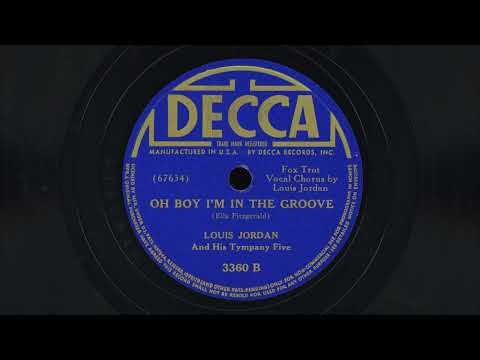
An early Ella Fitzgerald tune recorded by Louis Jordan early in his career – before his widespread popularity which came later in the decade. Jordan had played with Fitzgerald as part of Chick Webb’s band in 1937.
A swingin’ toe-tapper with vocals by Jordan – followed by sax and trumpet solos – and a final vocal chorus. A perfect tune to get yourself “in the groove” this Monday morning.
Recorded in New York City on April 29, 1940. Released as Decca 3360.
Credits Louis Jordan – alto sax, vocals, director Courtney Williams – trumpet Kenneth Hollon – tenor sax Arnold Thomas – piano Charlie Drayton – string bass Walter Martin – drums
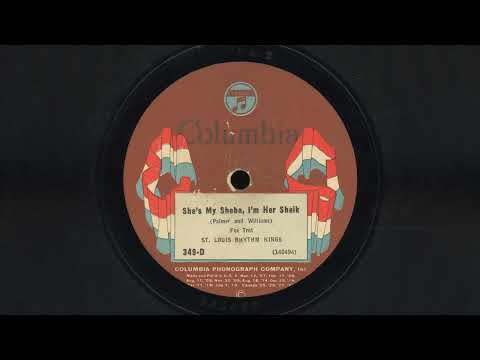
One of only two sides cut by this studio band made up of Mickey Bloom (the younger brother of pianist Rube Bloom) – who played with California Ramblers, Cotton Pickers, and Georgia Melodians – and Pete Pellizzi – who played with Johnny Sylvester and the Original Indiana Five.
Like many early jazz bands, though their band name might suggest otherwise, they were all New York studio musicians.
Lots of New Orleans-style ensemble playing on this bouncy and lively track!
Recorded in New York City on April 4, 1925. Released as Columbia 349-D – this copy with the beautiful flag label.
Credits: Mickey Bloom – trumpet Pete Pellizzi – trombone Louis Maesto – clarinet Nick Moleri – piano Christian Maesto – drums
Digitally transfered from original 78 rpm shellac record.
Frederico “Fred” Elizalde was born to a wealthy family in the Philippines who sent him to study Law at Stanford University in the early 1920s, where he also continued his piano studies and played at the Biltmore Hotel in Los Angeles and recorded for Brunswick with the Cinderella Roof Orchestra in San Francisco. He then moved to London to study at Cambridge, but soon found himself focusing full-time on his music.
His London band included his brother “Lizz” on alto sax and was hired to play at the Savoy Hotel. In 1927 alone, his band (under various names) recorded 34 tunes and released 14 records for Brunswick and one for HMV.
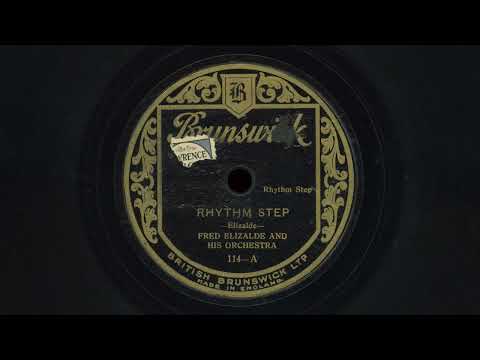
This original tune by Elizalde, “Rhythm Step”, showcases his admiration of the swingin’ jazz rhythms that he was exposed to in the U.S. While the track does include extended piano and trumpet solos, the emphasis is always firmly on the rhythm.
Elizalde also recorded a solo piano version of this tune around the same time.
A few months later, Elizalde would famously bring over Americans Adrian Rollini, Bobby Davis, and Chelsea Quealey of the California Ramblers to play in his orchestra – a story for another time.
Recorded in London circa July-August, 1927. Released in the U.K. as Brunswick 114.
Credits: Fred Elizalde – piano, arranger, director Henry Levine, George Ratcliffe – trumpet Jack Miranda, Manuel “Lizz” Elizalde – clarinet, alto sax Joe Crossman – tenor sax, baritone sax George Hurley – violin Joe Brannelly – banjo Tiny Stock – tuba Max Bacon – drums
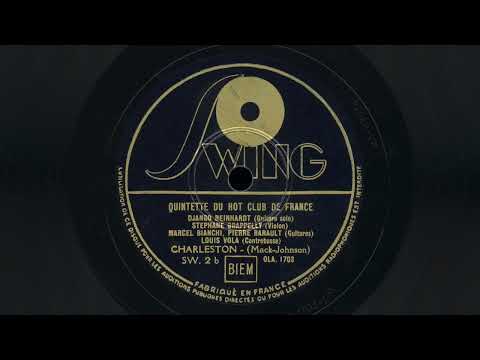
I’ve had the Charleston on my mind ever since I posted that Ben Selvin version last week. Here’s a much later version from a surprising source: Django Reinhardt and the Quintet of the Hot Club of France.
Some great hot rhythms and energetic riffing here by both Grappelli and Reinhardt. Starting at 1:35, Reinhardt even starts playing in octaves, foreshadowing a style that Wes Montgomery would make famous twenty years later.
This record was never issued concurrently on HMV or Victor and this issue on the Swing label represented its only release.
Recorded in Paris, France on April 21, 1937. Released as Swing 2.
Credits Stéphane Grappelli – violin Django Reinhardt, Marcel Bianchi, Pierre Barault – guitar Louis Vola – bass
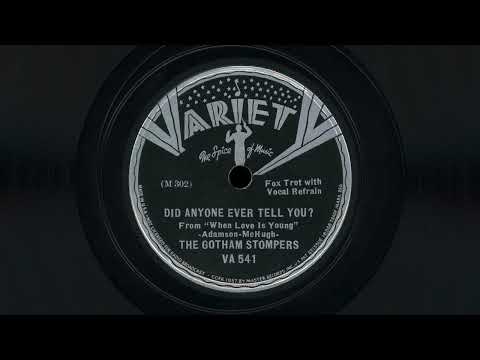
The short-lived Variety label released some great jazz records in 1937. It was produced by Irving Mills’ Master Records, Inc. – so it makes sense that we see a lot of pickup bands with personnel from the Duke Ellington orchestra.
Ivie Anderson, who had been singing with the Ellington orchestra dating back to 1931, sings on this track – and shows her remarkable talent and charm.
The vocals are followed by a quick succession of solos: trombone, alto sax, piano, and a few bars of Barney Bigard’s clarinet.
When it was released in June of 1937, the record was panned by Billboard, who wrote: “For that undiluted swing The Gotham Stompers fail to send. In spite of such star swingsters as Johnny Hodges, Barney Bigard, Harry Carney and Cootie Williams, from Duke’s Ellingtonians, with Ivy Anderson’s piping to boot, tooters never once take their jammin’ seriously. And even the presence of drummer Chuck Webster, nee Chick Webb, fails to inspire ’em.”
Recorded in New York City, March 25, 1937. Released as Variety 541.
Credits: Ivie Anderson – vocals Cootie Williams – trumpet Sandy Williams – trombone Barney Bigard – clarinet Johnny Hodges – alto sax Harry Carney – baritone sax Tommy Fulford piano Bernard Addison – guitar Billy Taylor – bass Chick Webb – drums Wayman Carver – arranger