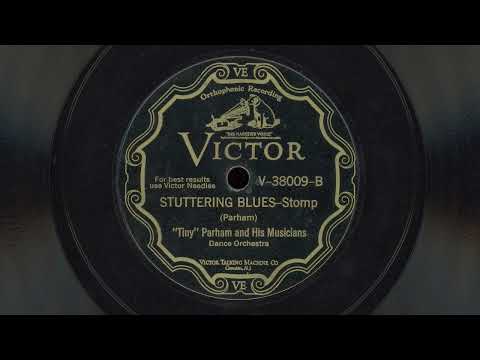
A wonderful classic of 20s jazz from a Chicago band fronted by Canadian-born pianist Hartzell Strathdene “Tiny” Parham. Excellent solos abound – including a stompin’ tuba solo by Quinn Wilson and a rollicking banjo solo from bluesman Papa Charlie Jackson.
What a tragedy of American music that Parham’s career was so short. It makes the celebration and appreciation of gems like “Stuttering Blues” all the more important.
Recorded in Chicago, Illinois on July 2, 1928 Originally released as Victor V-38009 and later reissued as Bluebird B-8130.
0:00 Intro 0:10 Brief piano solo (Parham) followed by clarinet solo (Johnson) 0:44 Cornet solo (Miller) 1:06 Banjo solo (Jackson) 1:28 Clarinet solo (Johnson) 1:50 Tuba solo (Wilson) 2:13 Ensemble playing 2:35 Cornet outro
Credits Tiny Parham – piano, director Punch Miller – cornet Charles Lawson – trombone Charles Johnson – clarinet, alto sax Papa Charlie Jackson – banjo Quinn Wilson – tuba Ernie Marrero – drums
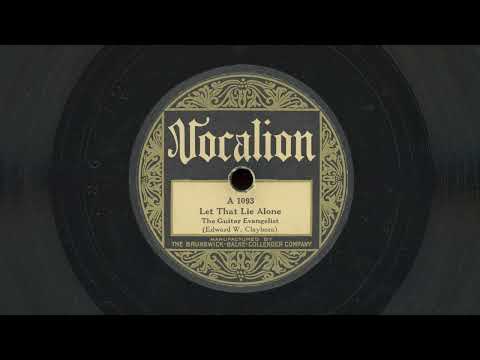
Edward W. Clayborn, under the stage name “The Guitar Evangelist”, recorded over 40 sides for Vocalion records from 1926 to 1929.
Musically, his rhythm playing often was simple and unvaried, while his lovely but occasional slide guitar added just the right amount of flavor to keep things interesting.
Unlike gospel-inspired bluesmen like Blind Willie Johnson whose emotive vocal technique often took on a deep tone approaching a growl, Clayborn’s vocals tended to be sober and unadorned. This, combined with the straightforward moral messages contained in his lyrics could perhaps be a contributing reason why his work has not enjoyed the popularity of other early blues performers of his time.
His songs were more gospel than blues – and Clayborn was billed as “Reverend Edward W. Clayton” on his later recordings.
He later ministered to St. Luke’s Baptist Church in Pittsburgh, Pennsylvania after his musical career ended. He lived a long life and passed away in 1978 at the age of ninety-eight.
Recorded in Chicago, IL on April 19, 1927. Released as Vocalion 1093.
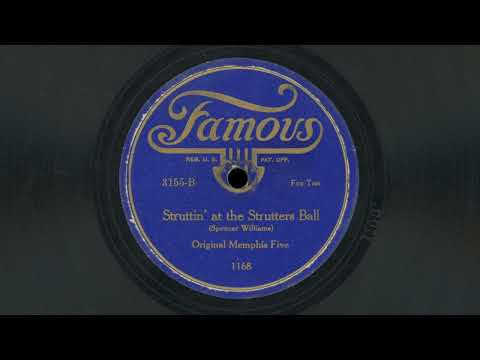
Here we have a performance of “Struttin’ at the Strutters Ball” by Spencer Williams on the Famous label – a recording also released on the Paramount, Puritan, Banner, Broadway, Triangle, Emerson, Grey Gull, and Regal labels. This was the B side of OM5’s second recording of “I Wish I Could Shimmy Like My Sister Kate”, a big hit that they first recorded in June of 1922.
The Original Memphis Five (often abbreviated as OM5) were prolific in the 1920s – recording a large number of sides for a wide variety of labels – and under various pseudonyms such as Ladd’s Black Aces on the Gennett label and The Cotton Pickers on the Brunswick label.
Matrix 1168 Take 1 Recorded in New York City in August, 1922. Released as Famous 3122, Banner 1110, Paramount 20161, Broadway 11165, Grey Gull 1140, Puritan 11161, and Regal 9363
Credits: Phil Napoleon – trumpet Miff Mole – trombone Jimmy Lytell – clarinet Loring McMurray – alto sax, tenor sax Frank Signorelli – piano Jack Roth – drums
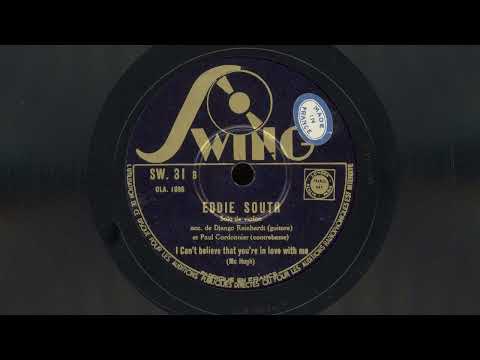
While guitarist Django Reinhardt is most associated with French violinist Stéphane Grappelli, here we hear him accompany American jazz violinist Eddie South in one of many duets and trios he recorded with Django in Paris during his stay there in 1937.
South played with jazz greats such as Freddie Keppard, Charles Elgar, and Erskine Tate in Chicago in the early 1920s before forming his own band, the Alabamians. His classical training and interest in Hungarian gypsy music in some ways prefigured the “hot club” sound of Reinhardt and Grappelli – so what a treat it is to hear these greats playing together – along with bassist Paul Cordonnier.
The tune “I Can’t Believe That You’re In Love With Me”, by Jimmy McHugh, is played with lyrical zest and enthusiasm by South – while Reinhardt allows the American visitor to Paris the full spotlight as he accompanies him on rhythm guitar.
A true master of his craft – South always has deserved more praise and credit for his outstanding work. I’ve always loved his playing and hope you enjoy it also.
Sadly – many of these excellent Parisian sessions for the Swing label were only released in Europe – with only two sides (Sweet Georgia Brown and Eddie’s Blues) making it to HMV in the U.K. and Victor in the U.S.
Recorded November 23, 1937 in Paris, France. Released as Swing 31.
Credits: Eddie South – violin Django Reinhardt – guitar Paul Cordonnier – string bass
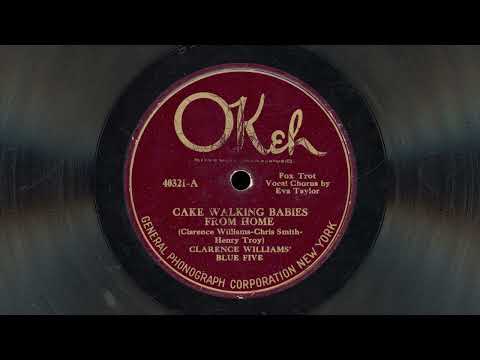
The Red Onion Jazz Babies, a studio supergroup organized by Clarence Williams, recorded “Cake Walking Babies From Home” for Gennett in late December of 1924. The group included both Louis and Lil Armstrong along with Sidney Bechet. The Gennett side is an excellent example of New Orleans-style ensemble playing coupled with what amounted to a cutting contest between the dueling Satch and Bechet (most seem to agree on the Gennett version, Bechet gets the better of young Armstrong).
Remarkably, a second version of this tune was recorded in an Okeh session about two weeks after the Gennett version with a largely unchanged lineup – with Louis Armstrong, Sidney Bechet, Banjo player Buddy Christian, and trombonist Charlie Irvis all reprising their roles from the “Jazz Babies” session. Clarence Williams (who co-wrote the song) replaced Lil Armstrong on piano, and his wife Eva Taylor took lead vocals. This version is really quite remarkable – both for the strong vocal performance and hearing Louis Armstrong come into his own as a force of nature in real-time.
I was fortunate enough to obtain this V copy for a shockingly reasonable amount at a poorly attended virtual auction last year that was selling the estate of a Los Angeles collector. The sleeve of this record noted that it came from the “Izumi Kinosita collection” – and it appears from its label markings to be the same copy that was sold by a Japanese seller in November of 2016 on eBay.
Please pardon the noisy rough start – it smooths out after 15-20 seconds. By the time we get to the solos immediately following the vocals, it’s playing quite clean.
0:00 Intro 0:40 B Section 0:55 Vocals (Eva Taylor) 1:34 Cutting Contest (Bechet v. Armstrong)
Recorded on January 8, 1925 in New York City. Released as Okeh 40321.
Credits Louis Armstrong – cornet Sidney Bechet – soprano sax Charlie Irvis – trombone Clarence Williams – piano Buddy Christian – banjo Eva Taylor – vocals
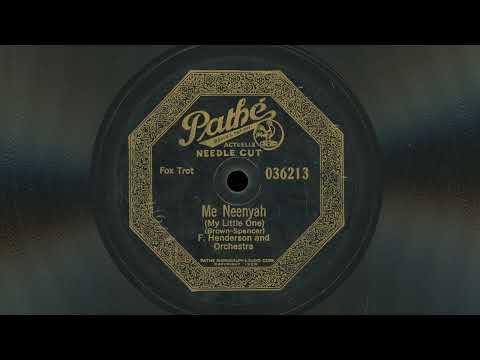
Here’s an interesting record: A straightforward dance number by Fletcher Henderson with Louis Armstrong present at the recording session that *doesn’t* feature a hot solo. Though Satch is heard soloing quite prominently on “Poplar Street Blues” and “12th Street Blues” – the two songs recorded immediately before this one – I’m not hearing his distinctive signature on this tune at all. So he either just laid back and played it straight as an ensemble player or sat this one out. What do you think? Am I missing something?
This sweet dance tune, whose title is an anglicization of “Mi Niña”, was presented by music publishers as a “Spanish Love Song”. It was composed by Herbert Spencer, who also composed “Fancies” – which the Henderson Dance Orchestra recorded on the Black Swan label in 1921.
As was common at the time, this track was attributed to pseudonyms on the other record labels it was simultaneously released on: It was attributed to the “Lenox Dance Orchestra” on Perfect label and ironically, to “Lanin’s Arcadians” on Homochord. Henderson’s band had been headlining with Sam Lanin’s dance orchestra at the Roseland in NYC throughout 1924.
At the end of the track, a ukulele can be heard. it has been speculated that this could have been played by Fletcher Henderson himself, as he accompanied Clara Smith on ukulele in 1924 on “Backwoods Blues”. Alternately, since Cliff Edwards (“Ukulele Ike”) recorded on the next matrix number immediately following “Me Neenyah”, it also could have been him popping in for a brief cameo.
0:00 Intro / Main theme 1:14 – Trumpet – Elmer Chambers 1:36 – Alto sax – Don Redman 2:12 Trombone – Charlie Green 2:22 Outro – Main theme restatement
Recorded in New York City on February 1925. Released as Pathé Actuelle 036213.
Credits: Fletcher Henderson – piano, arrangement, director, ukulele? Elmer Chambers, Howard Scott, Louis Armstrong – trumpet Charlie Green – trombone Buster Bailey, Don Redman – clarinet, alto sax Coleman Hawkins – clarinet, tenor sax Charlie Dixon – banjo Ralph Escudero – tuba Kaiser Marshall – drums
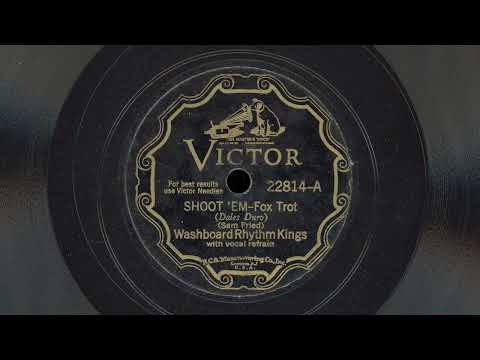
Deep depression cut from the Washboard Rhythm Kings that is characteristically both delightfully catchy and infectiously joyful.
Dave Page’s trumpet leads us in – and hot washboard and percussion breaks abound. Ben Smith’s alto heralds a quick solo while the band eggs him on. Jimmy Spencer scats a few verses before the gleeful chorus “Shoot ‘Em in the pants! Shoot ’em in the britches!”. Carl Wade and Dave Page trade solos before a wickedly hot banjo solo from Steve Washington makes a surprise appearance. More solos and hot percussion breaks follow – with hoots and hollers of enthusiastic encouragement from the band.
A fun listen!
Recorded in Camden, New Jersey on September 23, 1931. Released as Victor 22814. Also released on Bluebird, Sunrise, and HMV.
Credits: Dave Page – trumpet Ben Smith – alto sax Carl Wade – tenor sax Eddie Miles – piano Steve Washington – banjo, guitar Jimmy Spencer – drums, washboard, vocals
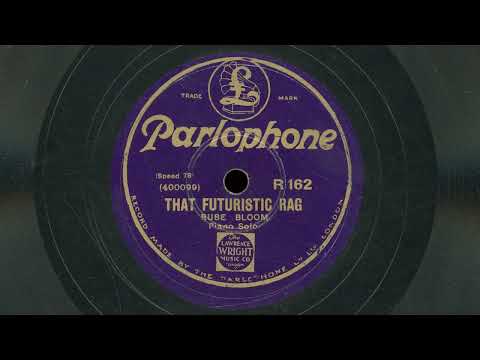
Self-taught pianist Rube Bloom played with a wide variety of influential jazz players in the 1920s, including Bix Beiderbecke, Miff Mole, Frank Trumbauer, Nobel Sissle, Ethel Waters, Joe Venuti, Eddie Lang, Annette Hanshaw, and Red Nichols.
He also composed and recorded over twenty piano rags released primarily on the Okeh and Columbia labels. This one, entitled “That Futuristic Rag” had two recorded takes – each released on a different label. This is take B, which was only released in the U.K. on the Parlophone label.
Love this composition – and love the cheekiness of calling a rag composed in 1923 a “futuristic rag” to distinguish it from all the unfashionable old-timey rags out there. Forward-thinking music! 🤓
Recorded in New York City on February 21, 1928.
Matrix 400099-B released only in the U.K. as Parlophone R 162 (C take – matrix 400099-C – was released as Okeh 41073)
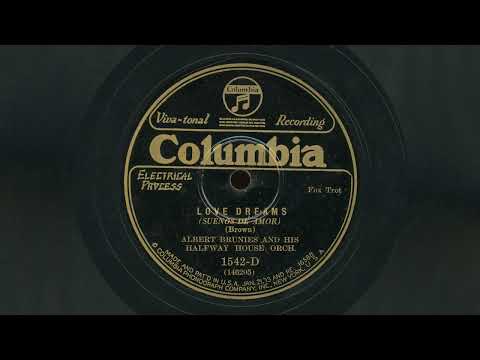
Albert “Abbie” Brunies was born into a musical New Orleans family in 1900. When his older brothers Merritt and Henry left town in 1920, Albert revived the name of the jazz band they had started in 1918, “The New Orleans Jazz Babies”. The band started playing at a roadhouse outside of New Orleans known for its hot dance music – The Halfway House – where they performed and recorded as the Halfway House Orchestra.
This snappy number was recorded with five other tunes in April of 1928 with clarinetist Sidney Arodin – who starts this dance number out with a solo right out of the gate, followed later on the record by Joe Loyacano (alto sax) and Abbie himself on cornet.
I was lucky to have found a copy of this one in excellent shape – sound quality is quite nice on this one!
“Love Dreams” – Albert Brunies and his Halfway House Orchestra Recorded in New Orleans on April 26, 1928. Released as Columbia 1542-D
Credits: Albert “Abbie” Brunies – cornet, director Sidney Arodin – clarinet Joe Loyacano – alto sax Glyn Lea “Red” Long – piano Angelo Palmisano – banjo Chink Martin – tuba Emmett Rogers – drums
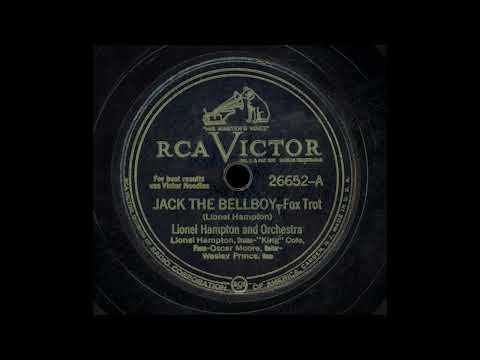
If you’ve only heard Nat King Cole from his later vocal records – if you’ve only heard Lionel Hampton on the vibes – if you’ve never heard the King Cole Trio with drums – you’ve gotta hear this!
Hamp is out of the gate at a furious pace – cymbals ablaze – he proceeds to tear up the room throughout with hot breaks, wild punctuations, seemingly spontaneous solos, and a whole range of percussive novelties. Pianist Nat “King” Cole and guitarist Oscar Moore come in at a clip, each trading high-energy solos – but amidst the continuous onslaught coming from the drum set, they seem to get lost in the vortex of Hamp’s masterful performance. At a couple points, one of them cries out in spontaneous joy – which no doubt was a whirlwind of inspiration for those present.
What a wild ride! Great record!
Recorded in Hollywood, California on May 10, 1940. Released as Victor 26652
Credits: Nat “King” Cole – piano Oscar Moore – guitar Wesley Prince – bass Lionel Hampton – drums