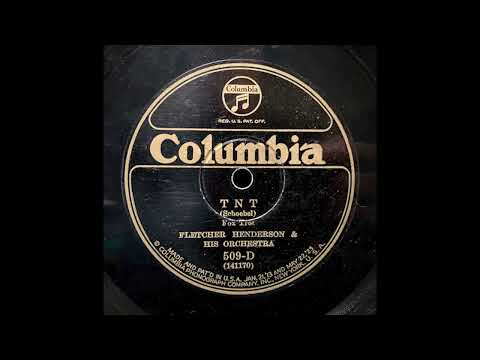
On Tuesday, November 27, 1923, Fletcher Henderson and his Orchestra recorded their only two tunes for Edison, doing three takes of each (which were all mastered and issued). This is take C.
We hear quite a bit of Coleman Hawkins on tenor sax, Teddy Nixon on trombone, Charlie Dixon on Banjo, and Billy Fowler on bass sax.
Released as Edison 51276.
Credits Fletcher Henderson – piano, director Howard Scott – cornet Elmer Chambers – cornet Teddy Nixon – trombone Don Redman (?) – clarinet, alto sax Coleman Hawkins – clarinet, tenor sax Billy Fowler – bass saxophone Charlie Dixon – banjo Kaiser Marshall – drums
Bix and Tram take us “Way Down Yonder in New Orleans” in one of the many universally beloved sessions recorded by Frank Trumbauer and his Orchestra in 1927.
This copy looks beat but plays mighty fine.
Recorded in New York on May 13, 1927. Originally released as Okeh 40843.
Credits Frank Trumbauer – C melody sax, director Bix Beiderbecke – cornet Bill Rank – trombone Don Murray – clarinet, baritone sax Doc Ryker – alto sax Irving “Itzy” Riskin -piano Eddie Lang – guitar Chauncey Morehouse – drums
An unsung hero of early jazz: trumpeter Francisco Saverio “Frank” Guarente taking a beautifully exquisite solo on “Dancin’ Dan” with The Georgians in this session for Columbia from December of 1923.
Guarente was born in Italy but emigrated to the US and spent some time in New Orleans in 1914 befriending Nick LaRocca and King Oliver before eventually making his way to New York where he played in Paul Specht’s orchestra. Specht started featuring small-combo hot sets in between the full orchestra sets which proved quite popular. The Georgians – a “band-within-a-band” – were born.
Guarente recorded many excellent sides with The Georgians on Columbia from through 1924, when he left for a long fruitful period of touring and playing in Europe. Upon returning to the U.S. in 1928, he found a very different scene than the one he left and although he continued to work with Specht and Victor Young in the 30s, was never quite able to re-establish himself as the leading man he once was.
Recorded on December 28, 1923. Released as Columbia 62-D
Credits Frank Guarente – trumpet, director Archie Jones – trombone Johnny O’Donnell – clarinet, bass clarinet, alto sax Dick Johnson – clarinet, tenor sax Harold Saliers – clarinet, alto sax, tenor sax Arthur Schutt – piano Russell Deppe – banjo Chauncey Morehouse – drums
One of the gems of the collection: A pristine copy of “Black Snake Blues” – one of my favorite sides by Clarence Williams’ Blue Five.
You know I love a good Cyrus St. Clair baritone solo – and this tune starts right out with a window rattler! Ed Allen chimes in with a feisty cornet solo answered by clarinetists Arville Harris and Ben Whittet. Trombonist Charlie Irvis takes a vibrant swing at the stars during his twelve bars, followed by Ed Allen, who gives us a good talking to on the way out before Cyrus reminds us one more time why he is king of the baritone brass.
Recorded in New York on April 14, 1927 for Okeh – the day after a session by Sylvester Weaver and right before a session by the Goofus Five. Can you imagine the Okeh studios at that time?!
Released as Okeh 8465.
Credits Ed Allen – cornet Charlie Irvis – trombone Ben Whittet – clarinet, alto sax Arville Harris – clarinet, alto sax or tenor sax Clarence Williams – piano Leroy Harris – banjo Cyrus St. Clair – baritone brass (tuba) Floyd Casey – drums
“Clarinetitis” written and performed by a 19-year-old Benny Goodman in June of 1928 at a Chicago recording session with Mel Stitzel on piano and Bob Conselman on drums. The sound is bright and lively on this wonderful Panachord master pressing from the UK.
Recorded in Chicago on June 13, 1928. Released as Panachord 25017, Vocalion 15705, and Melotone M-12073.
Benny Goodman – clarinet Mel Stitzel – piano Bob Conselman – drums
Recorded in New York on October 16, 1931. Released as Columbia 2559-D
Credits Fletcher Henderson – piano, arrangement, director Russell Smith, Rex Stewart, Bobby Stark – trumpet J. C. Higginbotham – trombone Russell Procope – clarinet, alto sax Edgar Sampson – alto sax, violin Coleman Hawkins – tenor sax Clarence Holiday – guitar John Kirby – tuba, string bass Walter Johnson – drums Les Reis – vocals Archie Bleyer – arrangement
In late 1927 Adrian Rollini left New York and set sail for London with trumpet player Chelsea Quealey and saxophonist Bobby Davis for a gig at the posh Savoy hotel with Fred Elizalde, a young Filipino pianist who had studied law at both Stanford and Cambridge before starting a successful run as a bandleader.
In “Tiger Rag”, recorded in January of 1928, was from the first recording session of Elizalde’s “hot” band with the newly arrived American players.
The first clip includes the head with vibrant ensemble playing reminiscent of the best University Six and Goofus Five records. The second clip starts with a brief piano break by Elizalde, after which we hear Davis launch into an inspired sax solo. The last clip includes Rollini rolling through a bass sax solo like a oversized load speeding through a narrow stretch of road.
Released in the UK only as Brunswick 147. Never released in the U.S. on 78 rpm.
Credits Fred Elizalde – piano Chelsea Quealey – trumpet Bobby Davis – clarinet, soprano sax, alto sax Adrian Rollini – bass saxophone, goofus, hot fountain pen Len Fillis – guitar Ronnie Gubertini – drums
The first recorded session of a trio known as Three Jolly Miners who recorded a total of sixteen sides under that name for Vocalion from 1925-26. Consisting of a clarinet, piano and banjo – it was an unconventional small combo jazz group for the time, which tended to favor large orchestras.
Recorded in New York on March 9, 1925. Released as Vocalion 15009.
Credits: Bob Fuller – clarinet Louis Hooper – piano Elmer Snowden – banjo