Jazz Crazy Records

An Archive of Early Jazz on 78 RPM

Category: Postwar Jazz

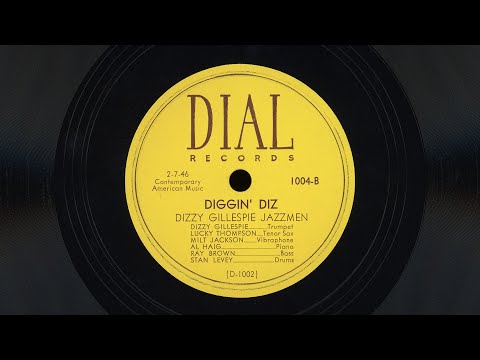
  • “Diggin’ Diz” – Dizzy Gillespie Jazzmen (1946) 🎺

    “Diggin’ Diz” – Dizzy Gillespie Jazzmen (1946) 🎺

    At the time of this recording, Dizzy had just been named “Influencer of the Year” by Metronome magazine, which wrote in its January 1946 issue: “This [1945] was the year in which Dizzy Gillespie became the symbol of a revolution in jazz circles… Dizzy has become the central figure in a new movement of harmonic and rhythmic ingenuity, coupled with technical mastery, in jazz improvisation…”

    Here, in Diz’ first session for Ross Russell’s newly launched Dial label as bandleader, things unfortunately did not work out as planned. Milt Jackson and Lester Young were no-shows at the session and the band only managed to record one track – and that after frequent interruptions caused by a group of fans showing up at the studio and by technical issues with faulty equipment.

    It is reported that the frustrated band left in anger after recording this tune, “Diggin’ Diz”. They would re-record the tune as “Diggin’ For Diz” two days later sans Parker but with Milt Jackson adding vibes to the mix.

    All of that said, I find this recording to be a delightful listen. 🎺

    0:00 Intro
    0:37 Piano (Handy)
    0:53 Alto sax (Parker)
    1:12 Trumpet (Gillespie)
    1:31 Tenor sax (Thompson)
    1:50 Guitar (Garrison)
    2:08 Piano (Handy)
    2:27 Outro

    Recorded at Electro Broadcast Studios in Glendale, California on February 5, 1946
    Released as Dial 1004.

    Credits (label has some errors):
    Dizzy Gillespie – trumpet
    Charlie Parker – alto sax
    Lucky Thompson – tenor sax
    George Handy – piano
    Arvin Garrison – guitar
    Ray Brown – bass
    Stan Levey – drums

    Sources:
    Dizzy Gillespie Discography at JazzDisco
    https://www.jazzdisco.org/dizzy-gillespie/discography/
    Dizzy: The Life and Times of John Birks Gillespie by Donald L. Maggin, pp. 187-190.
    Groovin’ High – The Life of Dizzy Gillespie by Alyn Shipton
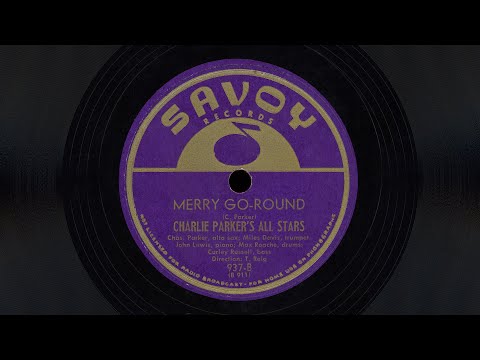
  • “Merry Go-Round” – Charlie Parker’s All Stars (1948) 🎷🎶

    “Merry Go-Round” – Charlie Parker’s All Stars (1948) 🎷🎶

    Listen to jazz of the 20s and 30s for a while, then check out this 1948 bebop disc by Charlie Parker. The non-stop deluge of angular notes that spill from Parker’s alto sax at escape velocity starting at 0:07 is revolutionary. For the next 50 seconds, it is relentless. Then the young twenty-two year-old Davis steps up and starts in with his own blistering contribution. While Davis was still racing to keep up with Parker’s galloping tempo, by the point he was matching his energy. When John Lewis finally gets his piano solo, it seems a moment of quiet repose and reflection, broken by the call-to-arms of Max Roach on drums.

    While some early jazz fans dislike bebop, I can’t help but see it as a burst of fresh creative energy that gave jazz a new urgency and created momentum for a new generation of artists. I love it!

    Miles Davis, in his autobiography, wrote of Charlie Parker: “Bird was such a great and inventive improviser that he would turn songs inside out. If you didn’t know music, you didn’t know where the f**k Bird was at when he was improvising… When Bird played, it was totally another ball game, totally something else, something different every time. Among the masters he was the master.”

    0:00 Intro
    0:07 alto sax solo (Parker)
    0:58 trumpet solo (Davis)
    1:23 piano solo (Lewis)
    1:47 drum solo (Roach)
    2:00 alto sax solo (Parker)

    Recorded at Harry Smith Studios in New York City on September 24, 1948.
    Released as Savoy 937

    Credits:
    Charlie Parker – alto sax
    Miles Davis – trumpet
    John Lewis – piano
    Curley Russell – bass
    Max Roach – drums

    Sources:
    Miles: The Autobiography, Miles Davis with Quincy Troupe, Simon & Schuster, 1989, p. 78
    The Charlie Parker Discography: https://www.jazzdisco.org/charlie-parker/discography/

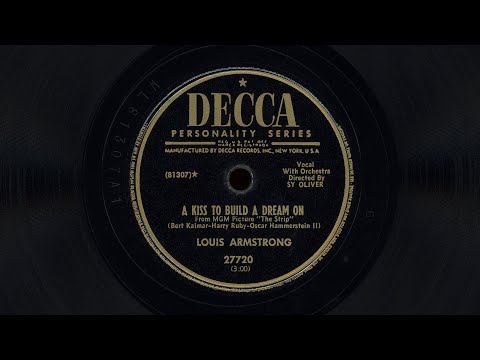
  • “A Kiss to Build a Dream On” – Louis Armstrong (1951) 🎺 Original 78 rpm Single 🎺

    “A Kiss to Build a Dream On” – Louis Armstrong (1951) 🎺 Original 78 rpm Single 🎺

    One of Satch’s most well-loved pop records – and one that he himself was reportedly quite fond of: “A Kiss to Build a Dream On”. The song was written in 1935 for a Marx Brothers film in which it never appeared. It languished for 15 years before it was picked up for use in another film, The Strip, starring Mickey Rooney.

    This record enjoys popularity today among video game fans who know it from the game Fallout 2.

    Recorded in New York City on July 24, 1951.
    Released as Decca 27720.

    Credits:
    Louis Armstrong – vocals, trumpet
    Sy Oliver – director, arranger
    Cutty Cutshall – trombone
    Milt Yaner – clarinet, alto sax
    George Dorsey – alto sax
    Fred Williams, Al Klink – tenor sax
    Billy Kyle – piano
    Everett Barksdale – guitar
    Sandy Block – bass
    Bunny Shawker – drums

    Source:
    https://michaelminn.net/discographies/armstrong/all-stars/index.html#19510724

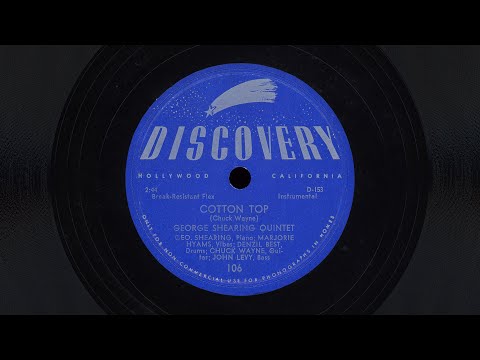
  • “Cotton Top” – George Shearing Quintet (1949)

    “Cotton Top” – George Shearing Quintet (1949)

    An early track from the George Shearing Quintet featuring some very nice work from guitarist Chuck Wayne, the composer of this pleasant number.

    Shearing also contributes a solo and we also hear from the excellent Majorie Hyams on vibes.

    Recorded on January 31, 1949.
    Released as Discovery 106.
    Later included on the 1956 LP “Midnight on Cloud 69”

    Credits
    George Shearing – piano
    Chuck Wayne – guitar
    Marjorie Hyams – vibes
    Bass – John Levy – bass
    Drums – Denzil Best – drums

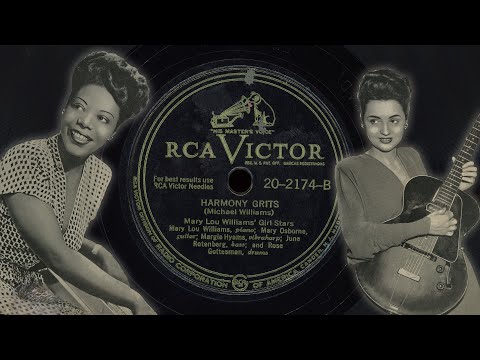
  • “Harmony Grits” – Mary Lou Williams’ Girl Stars (1947)

    “Harmony Grits” – Mary Lou Williams’ Girl Stars (1947)

    This boppin’ side showcases some strong jazz talent at the crossroads between swing and bebop. Fans of the channel know how much I admire Mary Lou Williams – and what a treat to hear her with the lively guitarist Mary Osborne at the beginning of her career and the talented Margie Hyams on vibes.

    Mary Lou Williams is best known to early jazz fans for her role as a pianist and composer in Andy Kirk’s Twelve Clouds of Joy in Kansas City. When she finally left the Clouds in 1942, she briefly formed a small group in Pittsburgh that featured a young Art Blakey. The group played an engagement in New York before disbanding. In 1943 she moved to New York City – where she stayed for the rest of her life. There, she met and played with many artists who would go on to form the bebop vanguard such as Bud Powell, Miles Davis, and Fats Navarro.

    In her book on women’s bands in America (which is fascinating—and which explores many intersectional aspects of this story—and which I will quote from quite a bit below), Jill Sullivan writes about “an exceptional moment in Mary Lou William’s career”:

    “From 1945 to 1947, Williams went into the studio four times to record fifteen sides with an all-female combo, the Girl Stars… These Girl Stars recordings, along with surrounding documentation, serve as an extraordinarily rich source for understanding how emergent changes in jazz intersected with emergent changes in U.S. gender and race norms.”

    “…these recordings, first, confirm Williams’ ability as a leader—as the primary creative presence in a jazz combo—in a variety of settings (trio, quartet, and quintet) during the first few years of her solo career. Second, they reveal Williams’ early bebop piano style and her versatility, as exemplified by her ready ability to switch back and forth among stride, boogie, and bebop.”

    Guitarist Mary Osborne was just hitting her stride in the NYC jazz scene while vibraphonist Margie Hyams had just spent almost a year playing with Woody Herman. Bassist June Rotenberg was classically trained but had played with a USO band during the war and had sat in with Art Tatum uptown.

    Recorded in New York, July 24, 1946.
    Released as RCA Victor 20-2174

    Credits:
    Mary Lou Williams – piano
    Mary Osborne – guitar
    Margie Hyams – vibraphone
    June Rotenberg – bass
    Rose Gottesman – drums

    Sources:
    Women’s Bands in America : Performing Music and Gender by Jill M. Sullivan, Rowman & Littlefield, 2016

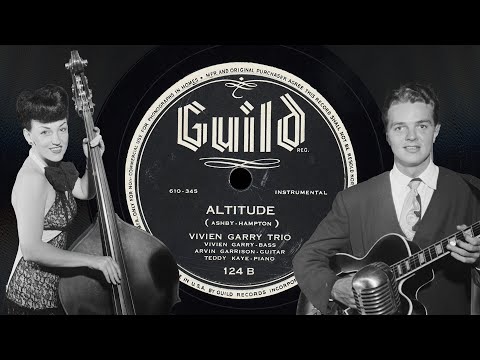
  • “Altitude” – Vivien Garry Trio (1945)

    “Altitude” – Vivien Garry Trio (1945)

    From an early recording session of the Vivien Garry Trio featuring the iconic Vivien Garry on bass and rising star Arv Garrison (who later went on to record with Dizzy Gillespie, Charlie Parker, and Howard McGhee for the Dial label) on guitar.

    Arv and Viv met when Arv was playing with the Bud Ziegler Trio in Toledo, Ohio in 1941. In a 1989 interview with Bob Dietsche for Toledo magazine, Viv stated:

    “I was so crazy about Arv when I first met him that I used to follow him around to all of his rehearsals. I noticed that his bass player was having trouble getting the chords right, and I said to myself, ‘Hell, I can do better than that’, so I went out and bought a bass from a guy who informed me that ladies did not play the bass fiddle. I took it home and put it in the middle of the front room. When Arv came over that night, I said, ‘Teach me to play this, and we’ll become famous.’ I learned fast, so in a few weeks I was already better than Arv’s regular bass player.”

    They soon got married and formed their own trio and headed to NYC, where they landed a contract at Kelly’s Stable on 52nd Street. This venue gained them exposure, and soon after, this session for the Guild label was arranged.

    “Altitude” – a proto-bop tune by Lionel Hampton and guitarist Irving Ashby from 1941 – demonstrates the trio’s articulate timing and delightful ensemble interplay.

    Recorded at Decca Studios in New York City circa 1945.
    Released as Guild 124.

    Credits:
    Vivien Garry – bass
    Arvin Garrison – guitar
    Teddy Kaye – piano

    Sources:
    https://jazzresearch.com/arv-garrison/
    https://jazzresearch.com/vivien-garry-on-record/

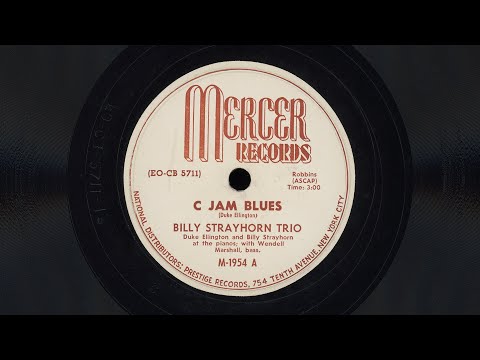
  • “C Jam Blues” – Billy Strayhorn Trio (1950)

    “C Jam Blues” – Billy Strayhorn Trio (1950)

    A popular jazz standard with a melodic head that anyone who can locate a C and a G on a piano can play – and anyone who knows the 12-bar blues song form can play along with.

    While the tune was originally recorded by Barney Bigard with a small combo Ellington unit in 1941, it eventually became one of the Duke Ellington Orchestra’s most recorded and most played numbers. At that original session Billy Strayhorn helped arrange the number – and then added additional elements for Ellington’s full-orchestra version recorded at the end of that year.

    Over the years, it ranked among the twenty most-played tunes by the Ellington orchestra.

    Here we have Billy Strayhorn and Duke both at the piano, nearly ten years after the original recording was made. At times it is tricky to figure out who is playing what – a testament to their close musical connection.

    Recorded in New York City on October 3, 1950.
    Released as Mercer M-1954

    Credits:
    Billy Strayhorn, Duke Ellington – piano
    Wendell Marshall – bass

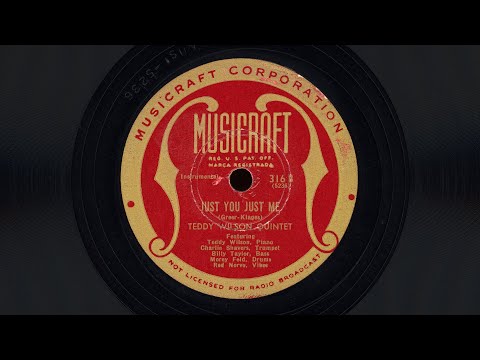
  • “Just You Just Me” – Teddy Wilson Quintet (1945)

    “Just You Just Me” – Teddy Wilson Quintet (1945)

    Another version of the 1929 jazz standard “Just You, Just Me” by pianist Teddy Wilson and his Quintet from 1945.

    To quote Butterfly from Digable Planets, “The vibe here is very pleasant.”

    Recorded in New York City on January 8, 1945.
    Released as Musicraft 316.

    Credits:
    Teddy Wilson – piano
    Charlie Shavers – trumpet
    Billy Taylor – bass
    Morey Feld – drums
    Red Norvo – vibes

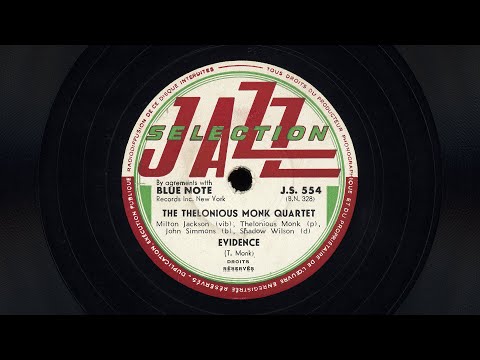
  • “Evidence” – The Thelonious Monk Quartet (1948)

    “Evidence” – The Thelonious Monk Quartet (1948)

    After sitting in as a sideman on recorded jam sessions quite a bit from 1941-1944 with luminaries like Charlie Christian, Kenny Clarke, Joe Guy, and Roy Eldridge, Thelonious Monk got his first session dates as leader in late 1947 for the then evolving Blue Note label. Blue Note had started in 1939 primarily as a label that featured stride pianists and hot jazz artists from the 20s and 30s like Sidney Bechet and Teddy Bunn. In the late 40s they began recording more modern jazz styles and new artists.

    “Evidence” was a contrafact of “Just You, Just Me”, a tune featured in a 1929 MGM film “Marianne” and was originally titled “Justice” (“just us”) in homage to the original composition. The original tune was recorded in the late 20s by Al Goodman, Ukulele Ike, Jack Hylton, and others. It was recorded later in the 30s by Artie Shaw and Red Norvo but really enjoyed a resurgence after the war when it seemed everyone was recording it again – including Lester Young, Teddy Wilson, and Eddie Heywood.

    From the first dyad octaves of Monk’s version, played in a rough and seemingly disjointed style, you can hear how Monk’s approach to jazz was markedly different than what came before. So simple – in some ways – just octaves played in unison – but following the harmony in an advanced manner – emphasizing the sevenths and tritones of the underlying chords. At once, off kilter and perfectly aligned.

    The soft vibes of Milt Jackson kick in to lull us back while Monk spends the rest of the track weaving around the harmony in that same abrupt yet intentional movement through the changes. While not as well known as the flip side, “Ruby My Dear”, I find this track quite compelling.

    Recorded at Apex Studios in New York City on July 2, 1948.
    Released in France as Jazz Selection J.S. 554.
    Originally released in the U.S. as Blue Note 549.

    Credits:
    Milt Jackson – vibes
    Thelonious Monk – piano
    John Simmons – bass
    Shadow Wilson – drums

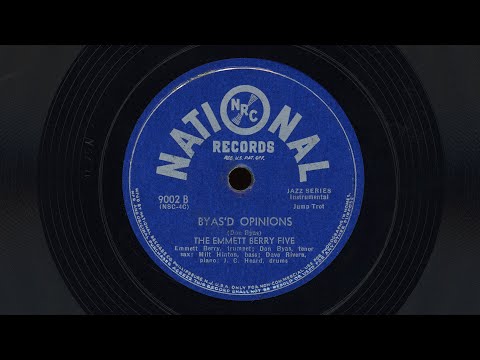
  • “Byas’d Opinions” – The Emmett Berry Five (1944)

    “Byas’d Opinions” – The Emmett Berry Five (1944)

    Some fine swingin’ proto-bop with an excellent title.

    Labeled not as a Jump Blues or a Fox Trot – but as “Jump Trot”!

    After a fun riffy head and brief solos by Rivera and Berry, Don Byas lays out his opinions and tells it like it is.

    0:00 Intro
    0:38 Piano (Rivera)
    0:54 Trumpet (Berry)
    1:08 Tenor Sax (Byas)
    2:09 Outro

    Recorded in New York City on August 31, 1944.
    Released as National 9002.

    Credits:
    Emmett Berry – trumpet
    Don Byas – tenor sax
    Milt Hinton – bass
    Dave Rivera – piano
    J. C. Heard – drums