Jazz Crazy Records

An Archive of Early Jazz on 78 RPM

Category: Postwar Jazz

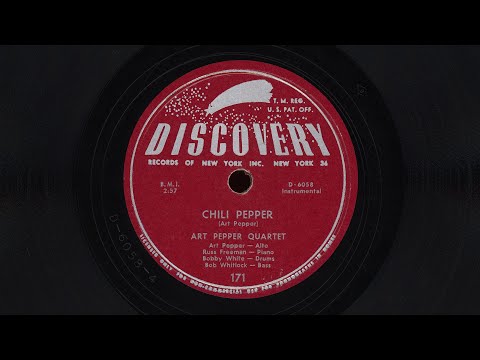
  • “Chili Pepper” – Art Pepper Quartet (1953) ๐ŸŒถ๏ธ๐ŸŒถ๏ธ๐ŸŒถ๏ธ

    “Chili Pepper” – Art Pepper Quartet (1953) ๐ŸŒถ๏ธ๐ŸŒถ๏ธ๐ŸŒถ๏ธ

    After a successful initial session with Discovery in 1952, the Art Pepper Quartet was called back in to record four more tunes, with plans to release as 78 rpm singles and a 10″ LP.

    On this original composition, Pepper comes in hot and is deftly accompanied by pianist Russ Freeman who dances eloquently around his lines. Hard to believe the amazing fidelity of this 1953 78 rpm disc! Really impressed by the sound stage of this mono disc and the warm liveliness of the recording.

    Recorded at Radio Recorders in Los Angeles, California on March 29, 1953.
    Released as Discovery 171.
    Also appears on the 1953 10″ self-titled LP (Discovery DL 3019) and the 1957 LP release Surf Ride (Savoy MG 12089).

    Credits:
    Art Pepper – alto sax
    Russ Freeman – piano
    Bob Whitlock – bass
    Bobby White – drums

    Some great info on the history of the Discovery label and Pepper’s sessions for Discovery at:
    https://jazzresearch.com/art-pepper-the-discovery-sessions/
  • “Up from Munich” – Hans Koller Quartet (1952) f/Jutta Hipp

    “Up from Munich” – Hans Koller Quartet (1952) f/Jutta Hipp

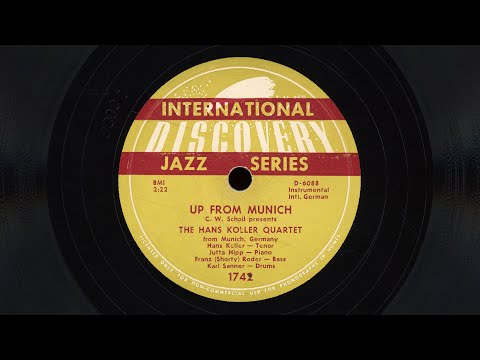
    How exciting to find pianist Jutta Hipp on 78 rpm! I’m a fan of her Blue Note releases on vinyl from the mid to late 50s. Here we find Jutta playing in Munich with Austrian saxophonist Hans Koller, who moved to Germany in 1950.

    This cool tune “Up from Munich” will give you a light head rush as it airily bops along, seeming to never touch the ground.

    Koller has a light “dry martini” sound that immediately reminded me of Paul Desmond’s approach – yet in 1952 Desmond and the Dave Brubeck band were not yet widely known.

    Recorded in Munich, Germany on May 20th, 1952.
    Released as Discovery 1742.

    Credits
    Hans Koller – tenor sax
    Jutta Hipp – piano
    Franz (Shorty) Roder – bass
    Karl Sanner – drums

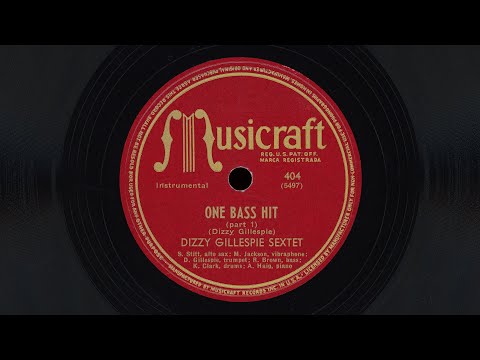
  • “One Bass Hit (Part 1) – Dizzy Gillespie Sextet (1946)

    “One Bass Hit (Part 1) – Dizzy Gillespie Sextet (1946)

    From the heady early days of bebop – here’s “One Bass Hit” from the Dizzy Gillespie Sextet featuring Sonny Stitt, Milt Jackson, and Klook on drums. But perhaps the real star of the number is bassist Ray Brown, who keeps things moving and grooving throughout.

    We start out on a real understated groove led by Brown and Klook, punctuated by insistent horns. At 1:08 Dizzy takes us skyward. Jackson cools things down at 1:40 and Sonny Stitt follows at 1:53.

    Recorded in New York City on May 15, 1946
    Released as Musicraft 404.

    Credits:
    Dizzy Gillespie – trumpet
    Sonny Stitt – alto sax
    Milt Jackson – vibes
    Al Haig – piano
    Ray Brown – bass
    Kenny Clarke – drums

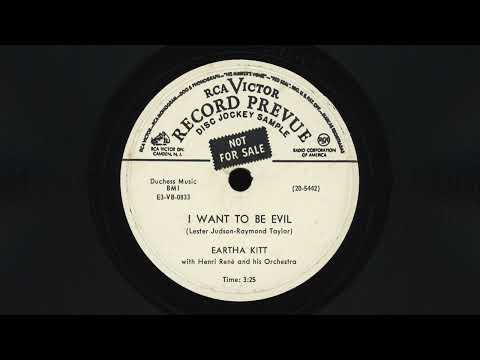
  • “I Want to be Evil” – Eartha Kitt (1953)

    “I Want to be Evil” – Eartha Kitt (1953)

    Starting off the week leading up to Halloween with a record by the great Eartha Kitt – who happens to be one of a handful artists of the 78 rpm era that I have seen perform live (some of the others include Bo Diddley and Ravi Shankar).

    I saw her at one of her many performances at the legendary Cafรฉ Carlyle in NYC. She was a phenomenal performer and had the whole room in the palm of her hand. Her crisp delivery of lyrics, coming from her background in theatre, seemed as sharp as ever.

    This single came out in the spring of 1953 and hit #22 on the charts and Billboard reviewed it as a “finely produced side bringing together an unusual piece of material and an uncommonly fine performer in Eartha Kitt.” Later that year she would get to #4 with her most successful song, “Santa Baby”.

    I’m wondering if this record had an influence over her casting as Cat Woman in the 60s.

    These RCA Victor promo discs are dead quiet – there is almost no surface noise at all.

    Recorded on March 12, 1953.
    Released as RCA Victor 20-5442.

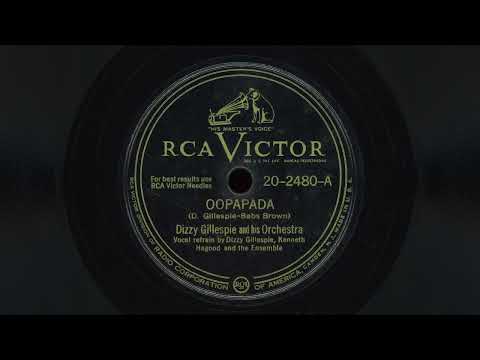
  • “Oopapada” – Dizzy Gillespie and his Orchestra (1947)

    “Oopapada” – Dizzy Gillespie and his Orchestra (1947)

    It’s Monday and we all need that jolt of joy that only bebop can deliver.

    Here’s Dizzy Gillespie with Oopapada – an infectious number involving some creative vocalizing from his heyday in 1947. Had a beat copy of this one for years and finally found a nice upgrade for it.

    Recorded in New York City on August 22, 1947.
    Released as RCA Victor 20-2480.

    Dizzy Gillespie – director, vocal
    Kenny Hagood – vocal
    Dave Burns, Matthew McKay, Ray Orr, Elmon Wright – trumpet
    Taswell Baird, William Shepherd – trombone
    John Brown, Howard Johnson – alto sax
    Joe Gayles, James Moody – tenor sax
    Cecil Payne – baritone sax
    Milt Jackson – vibes
    John Lewis – piano
    John Collins – guitar
    Ray Brown – bass
    Joe Harris – drums

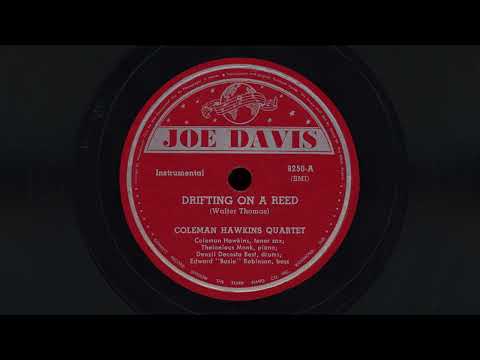
  • “Drifting on a Reed” – Coleman Hawkins Quartet (1944) f/ Thelonious Monk

    “Drifting on a Reed” – Coleman Hawkins Quartet (1944) f/ Thelonious Monk

    Here we have the Hawk performing “Drifting on a Reed” by Walter Thomas – not to be confused with the Charlie Parker composition that Bird would record three years later.

    The composition starts with a descending piano line played by the young Thelonious Monk, who is appearing here on his first commercial recording.

    Monk had been previously recorded in 1941-42 during jam sessions at Minton’s Playhouse by Columbia University’s student radio station WKCR by Jerry Newman. Newman recorded tunes on a portable Wilcox-Gay Recordio “disc cutter” that made recordings directly onto acetate discs and then ran them over to the radio station where they were broadcast.

    While we hear a brief moment of Monk at the intro, for most of the record, Monk takes an accompanist’s role and just lets Hawk blow.

    It’s clear from listening to Hawk’s lush breathy tone what Miles Davis was talking about when he said that โ€œWhen I heard Hawk, I learned to play ballads.โ€

    The Joe Davis label was created in 1945 by the music producer of the same name. They published jazz 78s in 1945-46 before changing the name to simply the Davis label.

    Recorded in New York City on October 19, 1944.
    Released as Joe Davis 8250.

    Coleman Hawkins – tenor sax
    Thelonious Monk – piano
    Edward “Basie” Robinson – bass
    Denzil Decosta Best – drums

    To hear the Charlie Parker tune “Drifting on a Reed” from 1947:
    https://www.youtube.com/watch?v=zcAqmLmzn9Q

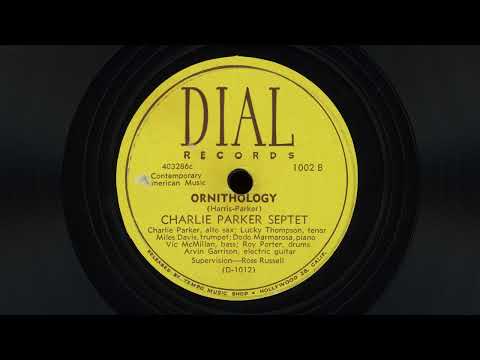
  • “Ornithology” – Charlie Parker Septet (1946)

    “Ornithology” – Charlie Parker Septet (1946)

    In January 1946, Ross Russell, the owner of the Tempo Music Shop in Hollywood, founded Dial Records with business partner Marvin Freeman. The label focused its efforts on capturing the emerging bebop style emerging from New York City. One of the first artists they signed was Charlie Parker, who in February of 1946 signed a one year contract with Dial.

    This tune was from his first session as bandleader with Dial at Radio Recorders Studio in Hollywood. “Ornithology” is an oblique reference to Parker’s nickname, “Bird”, but Parker generally did not title his compositions and left that duty to Russell. Perhaps this is why take 3 of this tune was also released with the title “Bird Lore” on Dial 1006.

    Regardless of title – the tune is a contrafact of “How High The Moon” – using the latter’s chord progression with new melodies and solos overtop.

    0:00 Intro
    0:39 Alto sax solo (Parker)
    1:14 Trumpet solo (Davis)
    1:48 Tenor sax solo (Thompson)
    2:22 Outro

    On April 3, 1946 – within days of recording this session, Parker “signed a handwritten agreement to give half of his Dial royalties to Emry “Moose the Mooche” Byrd, a narcotics dealer on Central Avenue in Los Angeles. Parker and Byrd’s agreement was typed and notarized on May 3, 1946.” Luckily, the agreement only covered a handful of songs – including this one. Dial honored the agreement and sent royalty checks to Mr. Byrd – even when he later found himself in prison at San Quentin.

    Recorded in Los Angeles, California on March 28, 1946.
    Matrix D1012-4.
    Released as Dial 1002.

    Credits:
    Charlie Parker – alto sax
    Miles Davis – trumpet
    Lucky Thompson – tenor sax
    Dodo Marmarosa – piano
    Arvin Garrison – guitar
    Vic McMillan – bass
    Roy Porter – drums

    Source: “The Dial Recordings of Charlie Parker” by Edward Komara, The Bebop Revolution in Words and Music, edited by Dave Oliphant, University of Texas at Austin, 1994

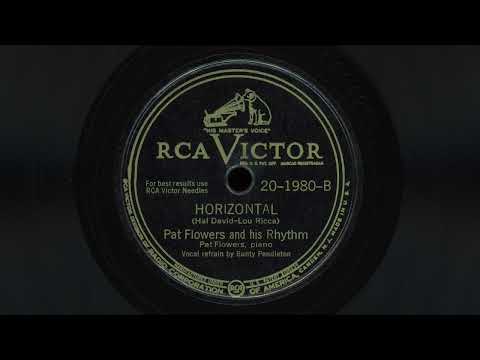
  • “Horizontal” – Bunty Pendleton with Pat Flowers and his Rhythm (1946)

    “Horizontal” – Bunty Pendleton with Pat Flowers and his Rhythm (1946)

    Artists chase fame and immortality hoping that one day something they create – even if only one work – will be remembered. Some achieve that and more – while untold thousands toil away with hundreds of hidden gems that the world may never see or hear.

    Lucy “Bunty” Pendleton was a pianist and vocalist who played in NYC clubs, restaurants, and hotel bars in the 1940s and 50s. There are photos of her jamming with Baby Dodds and Albert Nicolas. She was married to music critic Bob Sylvester, who “covered the nightclub circuit of 52nd Street when its string of jazz clubs earned the label Swing Street.”

    Despite all of that – The whole of Miss Pendleton’s recorded oeuvre is represented here in this three minute video. I discovered this record in a stash of mine that I was sifting through and seeing the RCA Victor label, I nearly chucked it in the “to sell or re-home” pile. The song title was intriguing and something about the names of Bunty Pendleton and Pat Flowers dredged up a Dickensian curiosity that caused me to put the record on.

    Thank goodness I did – because this tune has become a real favorite. The slow-paced chill vibe is the perfect backdrop for Pendleton’s warm and silky voice as she opines on the joy of being horizontal.

    Part of the beauty of this tune is certainly also due to the lyrics of Hal David – who later went on to collaborate with Burt Bacharach on tunes such as “The Look Of Love” and “Raindrops Keep Fallin’ On My Head”.

    In any case, most everyone who hears it may wonder why she didn’t do more recording. I’ll say that this one record – in all its beauty – is enough in my mind to earn Miss Pendleton a fond and worthy remembrance in the immortal halls of artists who made their mark. In any case, here we are seventy-eight years later still talking about it.

    Recorded in New York City on July 15, 1946.
    Released as RCA Victor 20-1980.

    Credits
    Bunty Pendleton โ€“ vocals
    Pat Flowers โ€“ piano, director
    Herman Autrey โ€“ trumpet
    Gene Sedric โ€“ clarinet, tenor sax
    Jimmy Shirley โ€“ guitar
    Cedric Wallace โ€“ double bass
    Willmore “Slick” Jones โ€“ drums

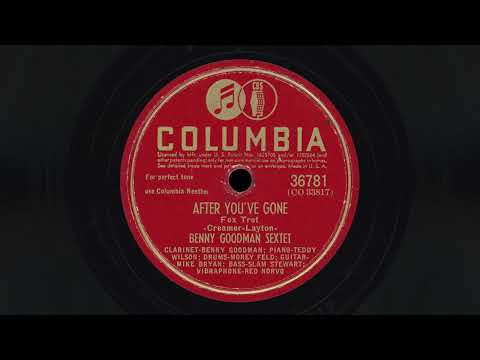
  • “After You’ve Gone” – Benny Goodman Sextet (1945)

    “After You’ve Gone” – Benny Goodman Sextet (1945)

    There are a couple of things that new collectors of 78s always hear – and some take as gospel: One is that prewar jazz is where it’s at and postwar jazz is not as interesting. The other is that there is no good music to be found on red label Columbia records.

    This record handily dispels both myths in one fell swoop – an astonishing version of the 20s classic “After You’ve Gone” by the Benny Goodman Sextet which is so loaded with musical ideas that by the end you feel a need to catch your breath!

    After Goodman states the theme, we get successive solos by Teddy Wilson on piano followed by Goodman on clarinet, Norvo on vibes, and Stewart on bass, complete with his characteristic melodic vocalizations.

    While Goodman is the obvious standout with his breakneck solos that seem to be racing so fast they risk leaping over the guard rails, Stewart really takes this number into the stratosphere – literally pushing Benny to the cusp of bop with his driving bass. Interestingly, this was his debut with the Goodman group – and what a showing!

    Don’t let anyone tell you there isn’t great music on these ole’ postwar red Columbias! If you follow your ears, you’ll find the good stuff.

    Recorded in New York City on February 4, 1945.
    Released as Columbia 36781

    Credits:
    Benny Goodman – clarinet, director
    Teddy Wilson – piano
    Red Norvo – Vibraphone
    Mike Bryan – guitar
    Slam Stewart – bass
    Morey Feld – drums

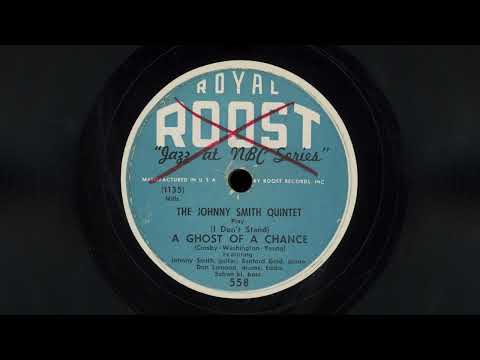
  • “(I Don’t Stand) A Ghost of a Chance” – The Johnny Smith Quintet

    “(I Don’t Stand) A Ghost of a Chance” – The Johnny Smith Quintet

    Not sure why a previous owner of this record drew a red “X” through the label – guess maybe they preferred the flip side with Stan Getz on tenor (“Where or When”).

    I’m usually one to fall asleep during ballads, but Johnny Smith’s dreamy cool jazz guitar has the ability to lull into a kind of trance state while still keeping one fully engaged. For some reason, this lush side really spoke to me the last time I put it on.

    While we hear a few subtle asides by Zoot Sims from time to time, it’s Smith who leads the show here, dazzling with his rich tone.

    After a bit of surface noise in the first 20-30 seconds, things smooth out.

    Recorded in New York City circa April, 1952.

    Credits
    Johnny Smith – guitar
    Zoot Sims – tenor sax
    Sanford Gold – piano
    Eddie Safranski – bass
    Don Lamond – drums