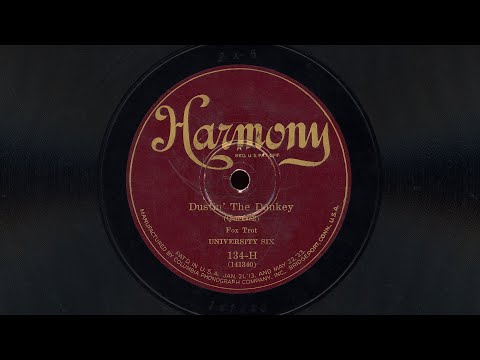
This Howdy Quicksell composition was recorded by the California Ramblers in May of 1925 for Pathé-Perfect. Then again by the Ramblers in an unissued session in October 1925 for Victor. Here, we have a final version for Columbia’s Harmony label under the University Six banner.
Rollini and Davis takes center stage on this number. At 0:55 Rollini launches into an inspired extended bass sax solo. At 1:55 Davis takes a effervescent sax solo. Lest you think things were running out of steam, at 2:31 Abe Lincoln adds a trombone solo.
Recorded in New York City on December 1, 1925. Released as Harmony 134-H
Credits: Roy Johnston – trumpet Abe Lincoln – trombone Bobby Davis – clarinet, soprano sax, alto sax Sam Ruby – tenor sax Adrian Rollini – bass sax, goofus, xylophone Irving Brodsky – piano, arranger Tommy Felline – banjo Stan King – drums, kazoo
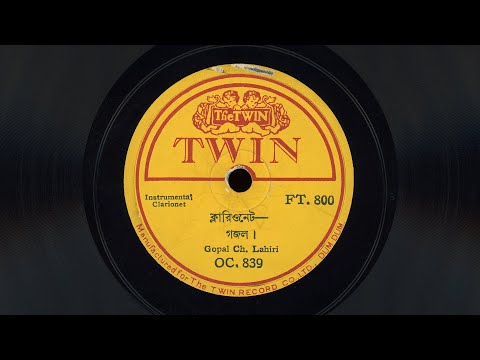
A digital transfer of both sides of a nice clarionet recording session by Gopal Chand Lahiri, about whom not much is known. The Bengali text on the label and production in Dum Dum, India indicates perhaps an artist from east India.
Side A (Mx. OC.838) is a Carnatic raag called Sindhu Bhairavi. This raag is “suited for lighter pieces” and expresses separation, sorrow, compassion, and devotion.
Side B (Mx. OC.839) is a ghazal (a type of love song originating in Arabic poetry). “The ghazal is always written from the point of view of the unrequited lover whose beloved is portrayed as unattainable.”
Recorded in India circa 1930. Released as Twin FT.800
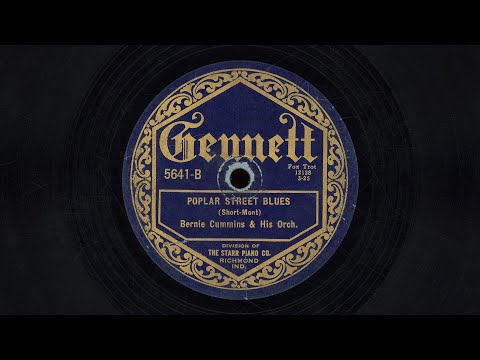
Another of my early Bernie Cummins Gennett discs. It gets off to a rough start, but worth hanging around for the pepped-up hot sax solo starting at 0:54, the intriguing muted trumpet hot break at 1:19, brief kazoo solo at 1:42, and a slightly-out-of-place languid clarinet coda at 2:14.
Recorded in Richmond, Indiana on January 22, 1925. Released as Gennett 5641 and Claxtonola 40416.
Credits: Bernie Cummins – drums, kazoo, director Paul Hasselburg (?) or Paul Roberts (?) – trumpet Buster Locks – trombone Jack King – clarinet, alto sax, soprano sax Karl Radlach – piano, arranger Walter Cummins – banjo Willis “Bill” Diehl – tuba Unknown Artists – trumpet, tenor sax
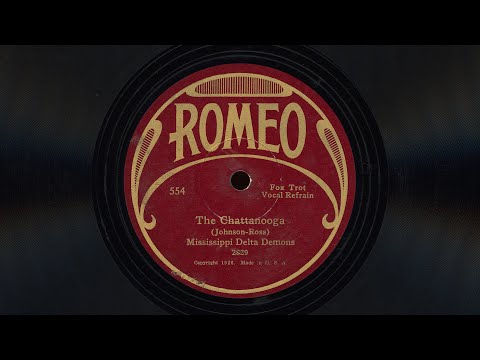
Here’s an oddball orchestra alias that is only used once – on this release. It’s a pleasant and perky dance tune that belies its Southern-fried heavy metal nomenclature.
My guess is that this is very likely Bob Haring’s orchestra, as the other matrices recorded around this time include:
Mx. Artist (Rec date) 2827 Bob Haring (1/19) 2828 Bob Haring (1/19) 2829 Mississippi Dixie Demons (1/19 or 1/20)? 2830 Society Nightclub Orchestra – a Bob Haring alias (1/20) 2831 Boston Society Orchestra – a Bob Haring alias (1/20) 2832 Bob Haring (1/20)
Not clear why this alias was not noted in Rust’s relevant discographies.
Mostly defly-performed dance music here, though there’s a melodically straightforward trumpet solo around 2:13 and an equally straight clarinet solo at 2:30. Not sure who the vocalist is, but he seems a pleasant chap – not demonic at all! 😈
Recorded in New York City on January 19 or 20, 1928. Released as Romeo 554 and Cameo 8131.
Credits: Bob Haring (?) – director Unknown artists – trumpet, clarinet, alto sax, banjo, tuba, drums
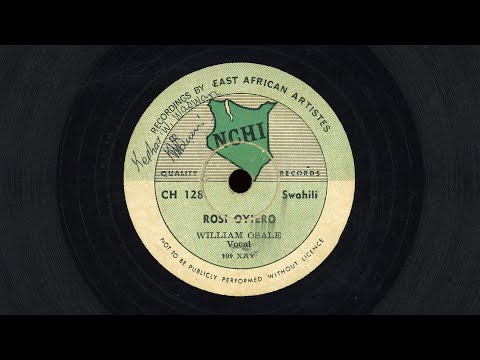
William Osale was a fingerstyle guitarist who performed and recorded in Kenya during the 1950s and 60s. Osale was a rural musician who played in the ‘sukuti’ style – a rhythmic style of finger-style playing invented by George Mukabi that results in a light, ‘bouncy’ sound.
In his “A History of Kenyan Guitar Music: 1945-1980”, John Low writes, “Some rural finger-stylists like George Mukabi and William Osale also had success in the towns, providing Swahili versions of songs that they might sing in local languages back home. The appeal of their songs lay in the fact that many town dwellers had (and still have) strong links with the land, and the themes of these songs, often conservative and sometimes nostalgic, reminded them of the old values.”
This beautiful record appears to be a love song written in a blend of Swahili and Luo languages about a person named Rosi Oyiero. Transcribing did not seem to be very successful – as the resulting translations were spotty.
The best I can work out is toward the end of the song, we hear: “Rosi Oyiero ninulia sana” which translates to “Rosi Oyiero, I cry a lot for you.”
If you speak Swahili/Luo and can help better translate, please comment!
Recorded in late 1950s or early 1960s (that’s a total guess) Released as NCHI CH 128 (Matrix AMX 464)
Credits: William Osale – guitar, vocals Unknown Artist – bottle, harmony vocal
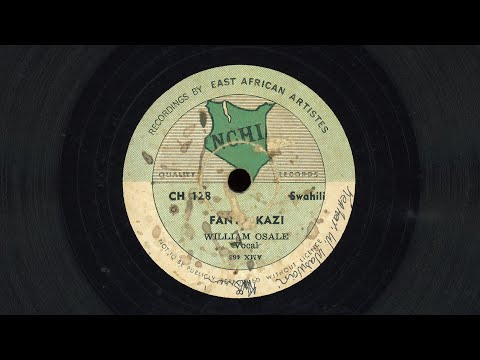
William Osale was a fingerstyle guitarist who performed and recorded in Kenya during the 1950s and 60s. Osale was a rural musician who played in the ‘sukuti’ style – a rhythmic style of finger-style playing invented by George Mukabi that results in a light, ‘bouncy’ sound.
In his “A History of Kenyan Guitar Music: 1945-1980”, John Low writes, “Some rural finger-stylists like George Mukabi and William Osale also had success in the towns, providing Swahili versions of songs that they might sing in local languages back home. The appeal of their songs lay in the fact that many town dwellers had (and still have) strong links with the land, and the themes of these songs, often conservative and sometimes nostalgic, reminded them of the old values.”
This lovely record by Kenyan guitarist William Osale is on a label for which I have found very little information – other than that it is a Kenyan label – very likely made in Nairobi.
This song’s title “Fany Kazi” translates to “Get to Work” and I’ve used YouTube’s auto-captioning to transcribe the lyrics and then used translation tools to try to eke out the meaning. Please, native speakers, correct any mistranscription or mistranslation in the comments!
Lyrics Ukitaka utachiri ukuwe na bibi wa nguvu. If you want to be rich, have a strong wife.
Naona watu wengi wanapenda kukula lakini kwa kufanya kazi wanashindwa sana. I see many people love to eat, but when it comes to working, they really struggle.
Ni uongo. It is a lie.
Ni kweli. It is true.
Ni vizuri fanya kazi tutapata chakula It is good to work—then we shall eat.
Akishindwa na kazi anapenda kwao. When one fails at work, they run back home.
Recorded in late 1950s or early 1960s (that’s a total guess) Released as NCHI CH 128 (Matrix AMX 463)
Credits: William Osale – guitar, vocals Unknown Artist – bottle, harmony vocal
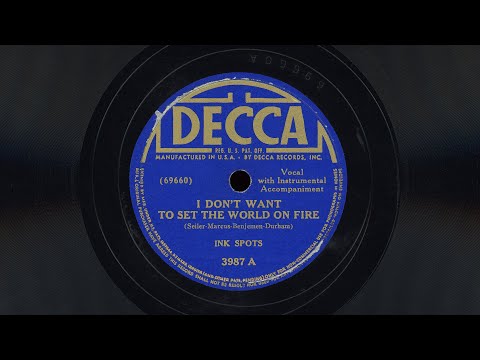
The Ink Spots were a massively popular vocal-driven quartet who got their start in Indiana and Ohio in the early 1930s. By the early 40s, they had sold millions of records and if you collect 78s, there seems to be at least one Ink Spots record in every collection.
This song from 1941 has enjoyed quite a resurgence of interest over the past decade – especially from younger fans. It was included in the Fallout video game series and was featured in Fallout 3, Fallout New Vegas, Fallout 4, and Fallout 76 – as well as serving as the theme song to the Fallout television show.
As a result, this record has become quite sought-after by a younger audience, which I think is wonderful way to introduce them to the music of the 78 rpm era.
Thus, in a shameless attempt to gain younger viewers to the channel, I am posting a transfer of my copy – and am starting a new playlist of 78s used in movies and video games.
Lyrics: I don’t want to set the world on fire I just want to start a flame in your heart In my heart I have but one desire And that one is you – no other will do
I’ve lost all ambition for worldly acclaim I just want to be the one you love And with your admission that you feel the same I’ll have reached the goal I’m dreaming of, believe me!
I don’t want to set the world on fire I just want to start a flame in your heart
Recorded in New York City on August 27, 1941. Released as Decca 3987.
Credits Bill Kenny – lead tenor vocals Charlie Fuqua – baritone vocals, guitar Deek Watson – tenor vocals, tenor guitar Orville Jones – bass vocals, cello
Often when Adrian Rollini’s bass sax would be heard, it was in the context of a rollicking hot number by the California Ramblers (or one of its many aliases or band-within-a-band variations). We hear it at the beginning of “Sugar Step” showcased clearly in a small combo setting. Rollini is able to spread out languidly from the get go – returning later for another moment in the spotlight. We hear him at a relaxed pace, with a fresh sense of inventiveness. Perhaps this is due to the relaxed environment of London and the respect and trust that bandleader Elizalde gave to Rollini.
“Sugar Step” was an original composition of Fred Elizalde, the Manila-born Spanish pianist who led an orchestra at the Savoy Hotel in London. Elizalde was on a mission to give British dance music the syncopation and spark of American jazz. He hired Rollini and fellow Ramblers Chelsea Quealey and Bobby Davis – along with South African guitarist Len Fillis – to fill out the band.
The tune features a variety of solos:
0:00 Bass Sax Intro (Rollini) 0:16 Ensemble (led by Quealey on trumpet) 0:47 Alto Sax solo (Davis) 1:05 Ensemble (led by Quealey on trumpet) 1:17 Guitar Break (Fillis) followed by Piano solo (Elizalde) 1:57 Muted trumpet solo (Quealey) 2:10 Clarinet solo (Davis) 2:25 Bass sax solo (Rollini) 2:43 Ensemble (led by Quealey on trumpet) 2:55 Coda
When I first read the title, I thought: Is this a humorous riff on “Sugar Foot Stomp”? Not a stomp, but a softer ‘step’? Every instrument just feels so chill on this one – sounding quite modern for its time. Funny enough, later in 1928 a short film was produced called “The Sugar Step” featuring a couple demonstrating how to dance its steps while the Elizalde band performs in the background.
Two weeks after this recording, Rollini would leave the UK for New York to say goodbye to his terminally ill father – who gave his blessing to Rollini’s intention to marry his sweetheart, Dixie. They were married on April 6 and Rollini’s father passed away on April 15. After sitting in on a session with the Dorsey brothers in NYC, Mr. and Mrs. Rollini headed back to London to rejoin Elizalde in early May.
Recorded in London, UK on March 11, 1928. Originally released in the UK as Brunswick 164. Reissued as a dub on Brunswick 02332.
Credits: Fred Elizalde – piano, arranger, director Chelsea Quealey – trumpet Bobby Davis – soprano sax, alto sax Adrian Rollini – bass sax, goofus, hot fountain pen Len Fillis – guitar Ronnie Gubertini – drums
Sources: Jazz and Ragtime Records 1897-1942, 6th Ed. Brian Rust Adrian Rollini: The Life and Music of a Jazz Rambler, Ate van Delden
A nice Fred Rich record that appears in Rust’s Jazz and Ragtime Records 6th edition, which only includes those records “known to have quality hot solos”.
We’ve got some quality performers present for the session. Imagine being present in the ballroom of the palatial Hotel Astor in 1926 to hear these fellows!
Looks like Jimmy Dorsey and Ray Bauduc were not part of this session – please read Javier Soria Laso’s comment on this video for details.
Recorded in New York City on March 10, 1926. This is take 3. Originally released as Harmony 136-H. Reissued as Silvertone 3230.
Credits: Fred Rich – piano, director Herman “Hymie” Farberman – trumpet [soloist in the 1st chorus, verse, and 4th & last chorus] Leo McConville – trumpet [soloist in the 3rd chorus] Miff Mole – trombone Teddy Klein/Kline – clarinet, alto sax, soprano sax [soloist on the bridge of the 4th & last chorus] Ken “Goof” Moyer – clarinet, alto sax, baritone sax, soprano sax, mellophone Rudy Adler – clarinet, alto sax, tenor sax, soprano sax John Cali – banjo Jack Hansen – tuba Sam Wishnuff – drums
Source: Please read Javier Soria Laso’s comment below.