Jazz Crazy Records

An Archive of Early Jazz on 78 RPM

Author: Professor M

  • “የኦርበኛው · ያዘነሾም ፡ ታሪክ” – ፍቅረ ፡ ሥላሴ’እቍባዝጊ (1940)

    “የኦርበኛው · ያዘነሾም ፡ ታሪክ” – ፍቅረ ፡ ሥላሴ’እቍባዝጊ (1940)

    This extremely rare Eritrean record by Fecresellassie’ Ogbasghi (ፍቅረ ፡ ሥላሴ’እቍባዝጊ) was recorded and released while Eritrea and Ethiopia were under Italian occupation during WWII.

    Eritrea fell under Italian colonial control in the 1880s and it was used as a launching point for Mussolini’s brutal invasion of Ethiopia in 1936. British troops and resistance forces led by Haile Selassie liberated the country in 1941 and Italy finally signed an armistice in September, 1943.

    The East African records on Columbia’s AI series were pressed in Italy and sponsored by Eritrean business man Saleh Ahmed Checchia – whose last name can be seen on the right side of the label as “Commendatore Checchia”.

    The seal of the Italian East Africa government can be seen in the runout at the bottom of the record.

    This record features an instrumental accompaniment on the ክራር, translated on the label as a “Kirar” or “chitarra” on the label. This instrument is a traditional Eritrean lyre.

    The song title “የኦርበኛው · ያዘነሾም ፡ ታሪክ” literally translates to “Of the patriot: the story that saddened him” The label translates this into Italian as “Storia del Guerriero Henescim” or “Story of the Warrior Henescim”. It is possible that “Henescim” is a transliteration of the word “ያዘነሾም” (romanized as “Yazenesom”).

    I got this from an Ethiopian record collector who found a few in pristine condition with original sleeves. If you enjoy this, check out the other (much rougher) AI series Columbia in my collection:
    https://youtu.be/WDvGbhpKdck

    Recorded in Eritrea circa 1940.
    Released as Columbia AI. 605 (mx. AOI.211)

    Credits:
    Fecresellassie’ Ogbasghi – vocals, Krar (Eritrean lyre)
  • “Charleston” – Texas Ten (1925)

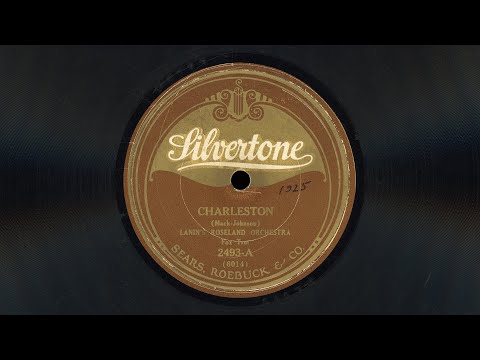
    “Charleston” – Texas Ten (1925)

    A rough start for this beat disc (with a repaired crack, no less) – but it cleans up after 10-20 seconds of sizzling bacon.

    Another fun version of “Charleston” by Nathan Glantz and friends (here curiously under the alias of Sam Lanin’s band). They recorded a different take on the same day issued under a different matrix for Pathé-Perfect.

    Recorded in New York City on May 5, 1925.
    Originally issued as Banner 1540, Bell 351, Domino 3510, Oriole 413 and Regal 9835.
    Reissued as Silvertone 2493 credited to “Lanin’s Roseland Orchestra”.

    Credits:
    Nathan Glantz – alto sax, director
    Unknown performers – trumpet (2x), trombone, clarinet, alto sax, tenor sax, piano, banjo, tuba, drums

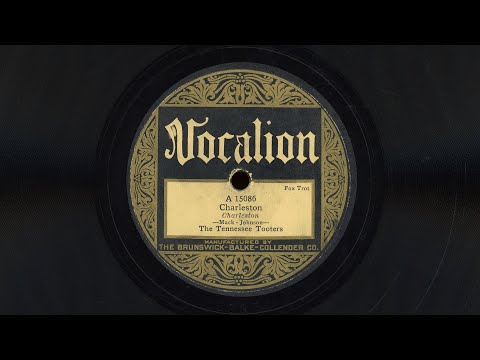
  • “Charleston” – The Tennessee Tooters (1925)

    “Charleston” – The Tennessee Tooters (1925)

    With 2025 drawing to a close, we’re going to celebrate a few versions of one of the biggest dance crazes of the 1920s: The Charleston.

    Here’s one of my favorite versions of the tune first penned by James P. Johnson for the Broadway show Runnin’ Wild in 1923.

    We hear some great syncopated ensemble playing and an extended Rube Bloom piano solo at 1:03, and a sax solo at 1:39.

    If you liked this one, take a listen to another one of my favorite versions of The Charleston by Ben Selvin here:
    https://youtu.be/eA00y3wr0II

    Recorded in New York City on August 12, 1925.
    Released as Vocalion 15086.

    Credits:
    Hymie Farberman (?) or Harry Gluck – trumpet
    Miff Mole – trombone
    Bennie Krueger – alto sax
    Lucien Smith – tenor sax
    Rube Bloom – piano
    Unknown Artist – banjo
    Joe Tarto – tuba
    Ray Bauduc – drums

    Source:
    Jazz and Ragtime Records (1897-1942), 6th Edition, Brian Rust

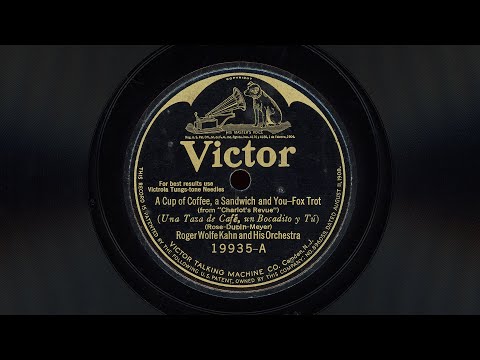
  • “A Cup of Coffee, a Sandwich and You” – Roger Wolfe Kahn and His Orchestra (1925)

    “A Cup of Coffee, a Sandwich and You” – Roger Wolfe Kahn and His Orchestra (1925)

    A dance band arrangement by the sophisticated Manhattan darlings led by banking scion turned jazz entrepreneur Roger Wolfe Kahn. A few flourishes of jazz interest in this one – You’ll hear Miff Mole on trombone and later on: Joe Venuti on violin – who states the melody at 1:49 and then launches into a hot solo starting at 2:07. Jazzers like Tommy Gott, Arthur Schutt, and Vic Berton also populate the band – as Kahn had an ear for talent and paid well for players.

    The song was written by Joseph Meyer with lyrics by Al Dubin and Billy Rose – the title an Americanized riff off a line from the Rubáiyát of Omar Khayyám involving a loaf of bread and jug of wine. It was performed by Jack Buchanan and Gertrude Lawrence as part of the original Broadway production of Charlot’s Revue of 1926 – which opened at the Selwyn Theatre on November 10, 1925 – just a month before this recording was made.

    Fun pop culture trivia: in the 1956 Warner Brothers cartoon “Broom-Stick Bunny”, Witch Hazel references this song by singing “A cup of Vosne, a spider, some glue. A lizard’s gizzard, a eel’s ear, or two.” when preparing a witch’s brew. Later, she brews a beauty potion intended for Bugs Bunny and when serving it, she happily sings “A cup of tea, a cookie, and you.”
    https://www.reddit.com/r/looneytunes/comments/1de9kyd/broomstick_bunny_1956/

    Recorded in New York City on December 15, 1925.
    Released as Victor 19935.

    Credits:
    Roger Wolfe Kahn – director
    Tommy Gott, Leo McConville – trumpet
    Miff Mole – trombone
    Arnold Brilhart, Owen Bartlett – clarinet, alto sax
    Harold Sturr – clarinet, tenor sax
    Joe Venuti, Joe Raymond – violin
    Arthur Schutt – piano
    Domenic Romeo – banjo, guitar
    Arthur Campbell – tuba
    Vic Berton – drums

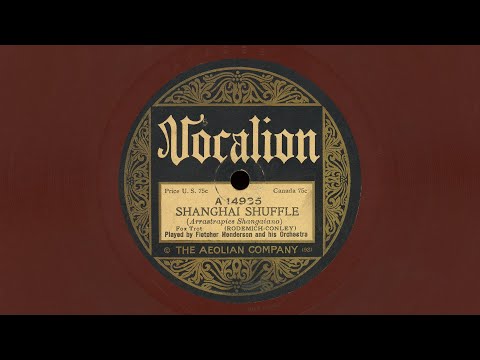
  • “Shanghai Shuffle” – Fletcher Henderson and his Orchestra (1924) f/Louis Armstrong

    “Shanghai Shuffle” – Fletcher Henderson and his Orchestra (1924) f/Louis Armstrong

    Henderson’s orchestra first recorded the Gene Rodemich song “Shanghai Shuffle” in October of 1924 for Pathé-Perfect, which was their second recording session with new cornetist Louis Armstrong, who had just moved to New York from Chicago, where he had been playing with King Oliver.

    Here we have a slightly later version of the tune from a November session with Vocalion. The title is an Eastern-inspired dance band number – but as soon as Armstrong enters the ring at 0:59, the whole center of gravity changes and for over thirty glorious seconds, we are taken on a wild melodic ride. It’s tough to imagine the shock of how good – and novel – Armstrong’s approach was when this first came out. It still sounds fresh over 100 years later!

    0:00 Intro
    0:25 Ensemble
    0:59 Trumpet solo (Armstrong)
    1:32 Clarinet trio
    1:50 Trombone solo (Green)
    2:05 “Whoopee Hey Hey” (Redman) and Coda

    An interesting bookend to this session is that the day before, on November 6, Armstrong recorded “Everybody Loves My Baby” with Clarence Williams’ Blue Five and on November 8, Armstrong recorded “Of All the Wrongs You Done to Me” with the Red Onion Jazz Babies.

    It should be noted that the original lyrics to this tune are cringe and awful. Thankfully, both Henderson versions are instrumentals.

    Recorded in New York City on November 7, 1924.
    Released as Vocalion 14935.

    Credits:
    Fletcher Henderson – piano, director
    Elmer Chambers, Howard Scott, Louis Armstrong – trumpet
    Charlie Green – trombone
    Buster Bailey – clarinet, alto sax
    Don Redman – clarinet, alto sax, arranger
    Coleman Hawkins – clarinet, tenor sax
    Charlie Dixon – banjo
    Ralph Escudero – tuba
    Kaiser Marshall – drums

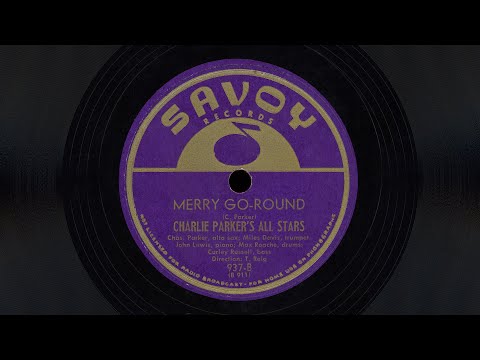
  • “Merry Go-Round” – Charlie Parker’s All Stars (1948) 🎷🎶

    “Merry Go-Round” – Charlie Parker’s All Stars (1948) 🎷🎶

    Listen to jazz of the 20s and 30s for a while, then check out this 1948 bebop disc by Charlie Parker. The non-stop deluge of angular notes that spill from Parker’s alto sax at escape velocity starting at 0:07 is revolutionary. For the next 50 seconds, it is relentless. Then the young twenty-two year-old Davis steps up and starts in with his own blistering contribution. While Davis was still racing to keep up with Parker’s galloping tempo, by the point he was matching his energy. When John Lewis finally gets his piano solo, it seems a moment of quiet repose and reflection, broken by the call-to-arms of Max Roach on drums.

    While some early jazz fans dislike bebop, I can’t help but see it as a burst of fresh creative energy that gave jazz a new urgency and created momentum for a new generation of artists. I love it!

    Miles Davis, in his autobiography, wrote of Charlie Parker: “Bird was such a great and inventive improviser that he would turn songs inside out. If you didn’t know music, you didn’t know where the f**k Bird was at when he was improvising… When Bird played, it was totally another ball game, totally something else, something different every time. Among the masters he was the master.”

    0:00 Intro
    0:07 alto sax solo (Parker)
    0:58 trumpet solo (Davis)
    1:23 piano solo (Lewis)
    1:47 drum solo (Roach)
    2:00 alto sax solo (Parker)

    Recorded at Harry Smith Studios in New York City on September 24, 1948.
    Released as Savoy 937

    Credits:
    Charlie Parker – alto sax
    Miles Davis – trumpet
    John Lewis – piano
    Curley Russell – bass
    Max Roach – drums

    Sources:
    Miles: The Autobiography, Miles Davis with Quincy Troupe, Simon & Schuster, 1989, p. 78
    The Charlie Parker Discography: https://www.jazzdisco.org/charlie-parker/discography/

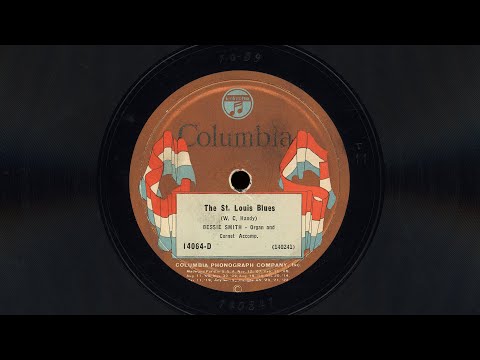
  • “St. Louis Blues” – Bessie Smith (1925) f/ Louis Armstrong

    “St. Louis Blues” – Bessie Smith (1925) f/ Louis Armstrong

    One of the most famous versions of the W.C. Handy classic “St. Louis Blues” was performed by blues Empress Bessie Smith accompanied by a young Louis Armstrong on cornet and Fred Longshaw on reed organ.

    The performances are extraordinary – and it is no wonder that this recording was inducted into the Grammy Hall of Fame in 1993.

    This surely must have been a big seller, as this copy is marked 1-G-39. I believe that the “G” means that it is a West Coast pressing and 39 meaning that this stamper has been through a lot! It looks like all subsequent reissues are dubs. My guess is that they wore the master out repressing it so many times!

    Recorded in New York City on January 14, 1925.
    Released as Columbia 14064-D.

    Credits:
    Bessie Smith – vocals
    Louis Armstrong – cornet
    Fred Longshaw – reed organ

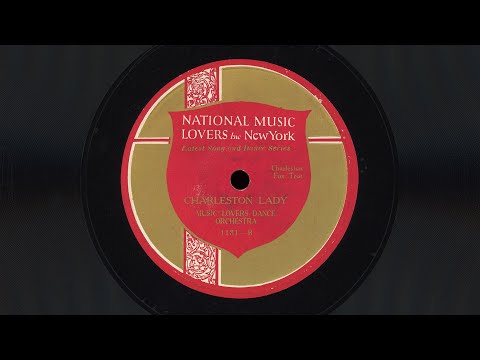
  • “Charleston Lady” – Music Lovers Dance Orchestra (1925)

    “Charleston Lady” – Music Lovers Dance Orchestra (1925)

    This one is a real mystery record. Even in the “National Music Lovers and New Phonic Records Discography” by Allan Sutton this band is labeled as an “unknown dance orchestra”. While some places attribute this to be an “Emerson studio band.”

    The source of the recording is said to be Grey Gull 1320, where the song is labeled “Sadie Salome” by the University Dance Orchestra, which 78discography.com notes is Nathan Glantz . The matrix for that side is listed as 3516-B – which is also attributed to a different Glantz side (“Oriental Nights” on Grey Gull 1248). Indeed, the sax on this number does sound reminiscent of Glantz’ style.

    But in the NML discography (and on the runout of this disc), this record’s matrix is 3703-2.

    In Grey Gull matrices (from 78discography.com):
    3701 Broadway Music Makers (GG 1301) 8/25
    3702 White Way Dance Orchestra (GG 1304) 8/25
    3703 This release (GG 1320)
    3704 Not found
    3705 Not found
    3706 White Way Dance Orchestra (GG 1306) 9/25
    3707 High Society Seven (GG 1305) 9/25

    But I’ve wasted your time on minutiae when the real story is at 1:05 when a muted trumpet solo turns this dance band number into a real growler!

    Now – who has got the goods on the identity of this performer?

    Recorded in New York City circa September 1925.
    Released as National Music Lovers 1131
    Originally released as Grey Gull 1320

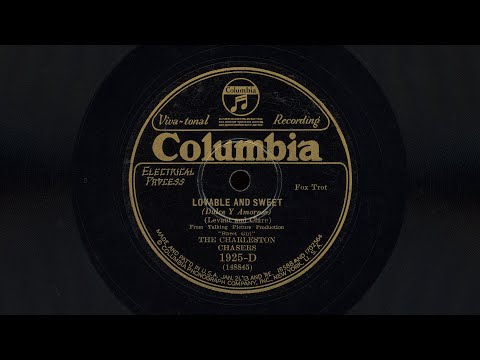
  • “Lovable and Sweet” – Charleston Chasers (1929)

    “Lovable and Sweet” – Charleston Chasers (1929)

    The Charleston Chasers were a studio band that recorded with the Columbia label that is most closely associated with Red Nichols and Miff Mole. However, this lovable number only features Miff. Red’s last session with the group was in 1928 and here we have Phil Napoleon on trumpet along with a second who is presumed to be Leo McConville.

    For me, the real standout of this track is Joe Tarto, whose very audible and prominent string bass playing really sets this recording apart from many 20s recordings that relied on the tuba or bass sax in the rhythm section. It is a harbinger of things to come! The Columbia Viva-tonal recording process really captures the acoustic bass sound here and the few hot bass breaks are quite vividly rendered.

    That said, we hear many fine solos throughout:
    0:00 Intro with bass
    0:11 Trombone solo (Mole)
    0:33 Ensemble
    0:45 Trombone solo (Mole)
    0:56 Ensemble
    1:07 Trumpet solo
    1:18 Muted trumpet solo
    1:40 Tenor sax solo (Pumiglio)
    1:52 Muted Trumpet solo
    2:03 Ensemble and Coda

    Recorded in New York City on July 24, 1929.
    Released as Columbia 1925-D.

    Credits:
    Phil Napoleon, Leo McConville (?) – trumpet
    Miff Mole – trombone
    Pete Pumiglio – clarinet, tenor sax
    Arthur Schutt – piano
    Joe Tarto – string bass
    Stan King – drums

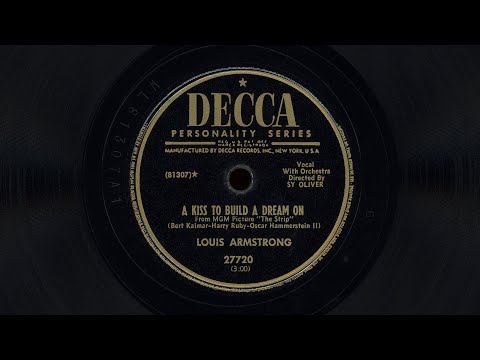
  • “A Kiss to Build a Dream On” – Louis Armstrong (1951) 🎺 Original 78 rpm Single 🎺

    “A Kiss to Build a Dream On” – Louis Armstrong (1951) 🎺 Original 78 rpm Single 🎺

    One of Satch’s most well-loved pop records – and one that he himself was reportedly quite fond of: “A Kiss to Build a Dream On”. The song was written in 1935 for a Marx Brothers film in which it never appeared. It languished for 15 years before it was picked up for use in another film, The Strip, starring Mickey Rooney.

    This record enjoys popularity today among video game fans who know it from the game Fallout 2.

    Recorded in New York City on July 24, 1951.
    Released as Decca 27720.

    Credits:
    Louis Armstrong – vocals, trumpet
    Sy Oliver – director, arranger
    Cutty Cutshall – trombone
    Milt Yaner – clarinet, alto sax
    George Dorsey – alto sax
    Fred Williams, Al Klink – tenor sax
    Billy Kyle – piano
    Everett Barksdale – guitar
    Sandy Block – bass
    Bunny Shawker – drums

    Source:
    https://michaelminn.net/discographies/armstrong/all-stars/index.html#19510724