Starting in 1936, Benny Goodman began recording sessions with trios, quartets, and sextets in various configurations – often involving some combination of pianist Teddy Wilson, drummer Gene Krupa, and vibes player Lionel Hampton. These sessions produced some excellent records of small combo jazz that are among my favorites.
Recorded in New York City on February 3, 1937. Released as Victor 25529.
Credits: Benny Goodman – clarinet, director Teddy Wilson – piano Lionel Hampton – vibes Gene Krupa – drums
Sārang (सारंग) is a bright luminous rāga associated with midday. It has a clear and open feel, evoking daylight and expansive natural environments.
The short timeframe of a 78 rpm record does not allow for the full thematic development of the rāga – so what we get is a tightly compressed summarized form. When Ravi Shankar recorded on LP starting in 1957 with “Music of India”, he would be able to expand these ragas to their natural length, and it was common for a single rāga to take an entire side of an LP.
I am not confident of this recording year – but it was in the mid 1950s to be sure.
Interestingly, Ravi Shankar’s debut recording was not as a virtuoso sitar player, but as a member of an Indian ensemble led by his brother, Uday. They recorded in NYC in 1937. Shankar (going by his full first name Ravindra) was a dancer in the group and played esraj.
Released as His Master’s Voice N.87538 Matrix OJE. 8537
Credits: Ravi Shankar – sitar Ustad Ali Akbar Khan – sarod Kanai Dutta – tabla
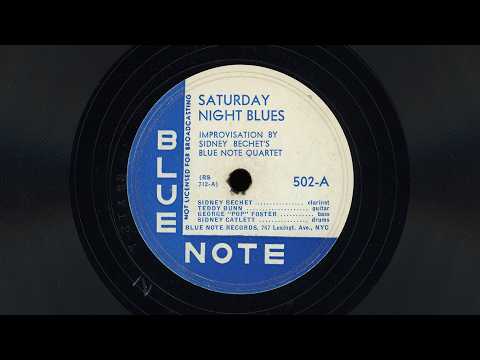
An early Blue Note 78 by the legendary Sidney Bechet, performing a chill blues perfect for a melancholic last call late on Saturday night.
Blue note said of the tune: “Bechet’s charged but restrained melodic line reaches an unprecedented artistic summit. Collaborating with Bechet is a rhythm section of unparalleled distinction – Teddy Bunn, whom the famous French critic, Panassie, calls ‘the world’s greatest guitarist’; and George ‘Pop’ Foster and Sidney Catlett, celebrated bassist and drummer respectively of Louis Armstrong’s orchestra.”
The label notes the performance is an improvisation, and one imagines a late night jam session on an easy blues. Alas, March 27, 1940 was a Wednesday night so the illusion is spoilt. But as we listen, it ceases to matter: Bechet and company take us there regardless.
Hope your Saturday night is not blue – but if it is, here is the remedy. 💙
Recorded at Reeves Sound Studios, NYC, on March 27, 1940. Released as Blue Note 502.
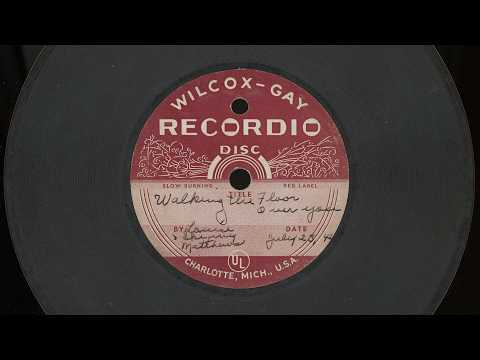
Found in the basement of a bar in Reinbeck Iowa – a home recording of Louise and Skinny Matthews, two performing artists recording in 1942.
These Recordio discs were sold as blanks – and with the help of a special cutting turntable you could cut your own records. These discs are quite fragile – with a cardboard core and a thin layer of material that can flake off if you look at it funny.
They are not professional quality – and so prepare for a lo-fi experience with plenty of surface noise. I did my best to improve the sound, but these discs were not known for their high fidelity.
But how cool is this – the only recording of these two artists in existence!
The first track is a cover of Ernest Tubbs’ “Walking the Floor Over You”, which had just come out in 1941 and was a big hit – selling over a million copies. Both Louise and Skinny sing together on this one.
The second track is an old Jimmie Rogers tune which he originally recorded as “Desert Blues” in 1929. It is here presented as “Big Chief Buffalo Nickel” from a line in the lyrics. Skinny takes this one solo. I’m wondering if he was the guitar player on both tracks?
I was not able to find much out about these two – a local newspaper in Washington, Iowa mentions a local named Skinny Matthews in a few articles in 1938. It’d be kind of cool if the ancestors of Skinny and Louise found this video and could tell us more about them!
Recorded on July 23, 1942 somewhere in (presumably) Iowa.
Here we find the Novelty Dance Orchestra of F. Wheeler Wadsworth recording a W. C. Handy composition for Pathé. Pathé issued the tune on its vertical-cut discs and also licensed the masters to the Operaphone company, who produced lateral-cut dubs that they reissued on that label. This dub was then licensed and re-issued by the Empire Talking Machine Company of Chicago Illinois. So this recording has had quite a journey!
Wadsworth, Arden, and Green recorded extensively for Victor, Edison, and Okeh as the “All Star Trio” starting in 1918 – but here on the third-hand Empire label, they appear anonymously using the alias Jones’s Novelty Dance Orchestra.
Interesting to note that the saxophone in 1919 was not as ubiquitous an instrument in jazz orchestras as it is today. Then, clarinets, trumpets, and trombones were favored as lead instruments. The saxophone was seen as a novelty instrument.
Artists such as Wadsworth, Rudy Wiedoeft, Paul Biese, Nathan Glantz, and Six Brown Brothers all played a role in popularizing the instrument, which would gain popularity over the next 10-15 years to take more and more of the spotlight in the jazz ensemble.
Recorded in New York City circa September 1919. Released as Pathé 22206, Empire 507 and Operaphone 31136.
Credits: Frank Wheeler “Waddy” Wadsworth – alto sax Victor Arden – piano George Hamilton Green – xylophone
Source: American Dance Band Discography, Brian Rust
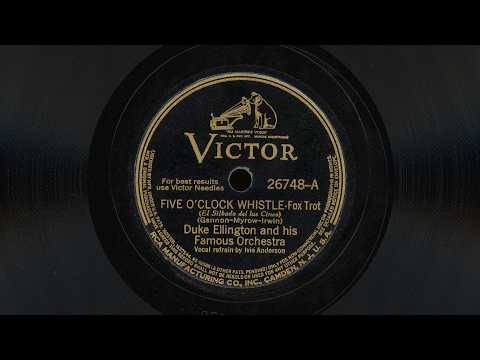
I was thinking about a record that would make a good Labor Day post – and then I remembered this Ellington recording with one of my favorite jazz vocalists, Ivie Anderson.
This tune, recorded with the Blanton-Webster band, has always been kind of an unsung hero of mine. The liner notes by Mark Tucker of the RCA reissue 3 CD set of 1986 are brutal: “This is an unexceptional performance. It’s not that the band doesn’t play well, but they haven’t much to play.” Oof – Jazz writers are a tough crowd!
I find it a pleasant listen – and how can one complain when Ivie Anderson is on the mic? Rex Stewart’s insistent cornet provides the perspective of the missing whistle, constantly blasting as though being willed back into existence by the toiling workers expecting it to sound at any moment. If you’ve ever worked a long day of manual labor – you can relate.
Happy Labor Day! Hope your five o’clock whistle has long-since blown and you are relaxing and enjoying the day.
Recorded in Chicago, Illinois on September 5, 1940. Released as Victor 26748
Credits: Ivie Anderson – vocals Duke Ellington – piano, arranger, director Wardell Jones, Cootie Williams – trumpet Rex Stewart – cornet Joe Nanton, Lawrence Brown – trombone Juan Tizol – valve trombone Barney Bigard – clarinet Johnny Hodges – clarinet, soprano sax, alto sax Harry Carney – alto sax, bass sax Ben Webster – tenor sax Fred Guy – guitar Jimmy Blanton – string bass Sonny Greer – drums
Source: Jazz and Ragtime Records (1897-1942), 6th Ed. Brian Rust
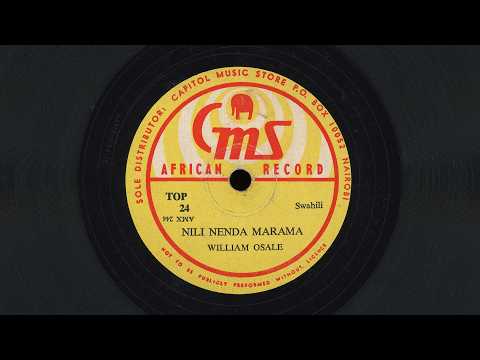
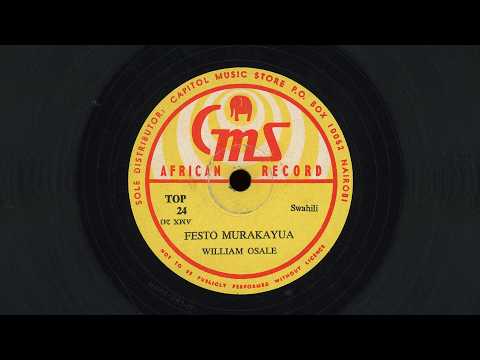
William Osale was a fingerstyle guitarist who performed and recorded in Kenya during the 1950s and 60s. Osale was a rural musician who played in the ‘sukuti’ style – a rhythmic style of finger-style playing invented by George Mukabi that results in a light, ‘bouncy’ sound.
In his “A History of Kenyan Guitar Music: 1945-1980”, John Low writes, “Some rural finger-stylists like George Mukabi and William Osale also had success in the towns, providing Swahili versions of songs that they might sing in local languages back home. The appeal of their songs lay in the fact that many town dwellers had (and still have) strong links with the land, and the themes of these songs, often conservative and sometimes nostalgic, reminded them of the old values.”
The song appears to be a light-hearted song about traveling to Marama area of Western Kenya and getting into trouble involving a girl and her armed relatives.
I do not have a recording date for this record – but will add one if I find a definitive source. My best guess is sometime in the late 1950s or early 1960s.
Released as CMS African Record TOP 24.
Credits: William Osale – guitar, vocals Unknown Artist – vocal harmony, glass bottle
William Osale was a fingerstyle guitarist who performed and recorded in Kenya during the 1950s and 60s. Osale was a rural musician who played in the ‘sukuti’ style – a rhythmic style of finger-style playing invented by George Mukabi that results in a light, ‘bouncy’ sound.
In his “A History of Kenyan Guitar Music: 1945-1980”, John Low writes, “Some rural finger-stylists like George Mukabi and William Osale also had success in the towns, providing Swahili versions of songs that they might sing in local languages back home. The appeal of their songs lay in the fact that many town dwellers had (and still have) strong links with the land, and the themes of these songs, often conservative and sometimes nostalgic, reminded them of the old values.”
The song appears to be a plaintive love song beckoning a woman named Tanyembe to return to her heartbroken beloved.
I do not have a recording date for this record – but will add one if I find a definitive source. My best guess is sometime in the late 1950s or early 1960s.
Released as CMS African Record TOP 24.
Credits: William Osale – guitar, vocals Unknown Artist – vocal harmony, glass bottle
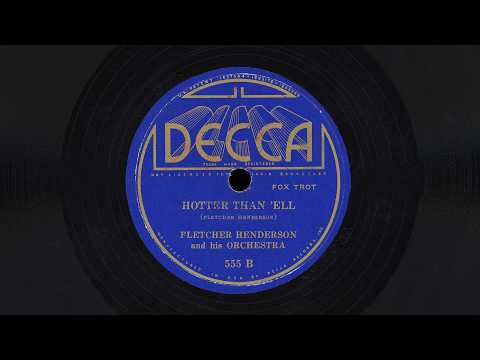
In September of 1934, the Henderson band travelled to Montreal, where they played at the Palais D’Or for a week before returning to NYC to record two sessions for Decca. His band was hot – coming out of the Great Depression with steady gigs and recording sessions.
They had a reputation for putting on musically thrilling live shows which were not always adequately captured in their recorded output. This record is an exception.
The tune was originally titled “Yeah Man!” by songwriters Noble Sissle and J. Russell Robinson. It is a “rhythm changes” contrafact – using the same chord progression as “I Got Rhythm” By George Gershwin. Henderson recorded “Yeah Man!” in 1933. On this record, however, the song was re-titled as “Hotter Than ‘Ell” – with songwriting credit to Henderson himself.
It begins with a kind of blaring call and response between the band’s brass and reed sections – and quickly heats up with solos by the orchestra’s star players: Buster Bailey, Henry Allen, and Ben Webster.
0:00 Intro 0:36 Clarinet solo (Bailey) 1:00 Trumpet solo (Allen) 1:26 Tenor sax solo (Webster) 1:54 Ensemble 2:34 Tenor sax solo (Webster) and Coda
Only a few months after this session, nearly the entire Henderson band quit en masse. Many joined up with Benny Carter – a few others with the Mills Blue Rhythm Band. While Henderson cobbled together other musicians and continued to play live shows, his celebrated orchestra would not record again until March of 1936 – when they would record their biggest hit.
Recorded in New York City on September 25, 1934. Released as Decca 555.
Credits: Fletcher Henderson – piano, director Russell Smith, Irving Randolph, Henry Allen – trumpet Claude Jones, Keg Johnson – trombone Buster Bailey – clarinet Russell Procope, Hilton Jefferson – alto sax Ben Webster – tenor sax Horace Henderson – arranger Lawrence Lucie – guitar Elmer James – string bass Walter Johnson – drums
Sources: Hendersonia, Walter C. Allen, 1973 The Uncrowned King of Swing: Fletcher Henderson and Big Band Jazz, Jeffrey Magee, 2005