An outstanding Earl Hines original composition played on an early electric piano.
The Storytone electric piano was introduced at the 1939 World’s Fair, and was “probably the first to be produced commercially.” It used electromagnetic pickups located behind each string – much like an electric guitar – whose output is then amplified. Only 150-250 units were produced and production ceased in 1942.
Recorded in New York City on February 26, 1940. Released as Bluebird B-10642
Fred Rich was born in Warsaw, Poland in 1898 who began recording as a bandleader in 1925 with his Hotel Astor Orchestra, which he led from 1922 – 1928. By the time of this recording, he had recorded quite prolifically. However – fun fact – at the time of this recording, Mr. Rich was still not yet a U.S. citizen. He did not become one until 1934.
This deep depression cut was pressed on the “Hit of the Week” label – made not of shellac but on a paper base coated with Durium – a synthetic resin. They were sold at newsstands for 15 cents apiece.
Unfortunately, the brief “Auld Lang Syne” track contained a needle dig (visible in the label scan around two o’clock) that rendered it unplayable due to skips. Even so, the longer format of these discs fit nearly five minutes of music on each side – so the sweet ballad “You Call It Madness” still clocks in at nearly four minutes long.
Though the tune is a slow dance tune, it does feature some jazz players such as Venuti & Lang, Bunny Berigan, Joe Tarto, and others. A brief piano solo is heard at 3:15.
I’m not always a fan of the schmaltz – but something about this track is quite lovely. Perhaps it is the voice of Helen Hannah Rubin (performing as Helen Rowland), who had been featured on the radio singing for NBC a few times that year.
Recorded in New York City circa November 1931. Released as Hit of the Week M2.
Credits: Bunny Berigan, Tommy Gott (?) – trumpet Tommy Dorsey (?), Charlie Butterfield – trombone Elmer Feldkamp, Tony Parenti – clarinet, alto sax Joe Venuti – violin Walter Gross – piano Cornell Smelser – pac Eddie Lang – guitar Joe Tarto or Hank Stern – tuba Helen Rowland – vocals Unknown Artists – trumpet, tenor sax (x2), drums
Sources: Helen Rubin – Radio Singer, by Neal R. Simpson, Vintage Jazz Mart https://www.vjm.biz/174-helen.pdf American Dance Band Discography, Vol. 2, Brian Rust
In early March, 1927, gang warfare caused The Plantation Cafe in Chicago to close. It had been where King Oliver’s band had been in residence under a steady longstanding contract. On April 5, it was completely destroyed by a fire, putting the Oliver band out of work – and destroying the band’s collection of photographs and publicity material.
It was shortly after this event that Oliver made the decision to move the band to New York City to accept a gig at the Savoy Ballroom. This was the last recording he made in Chicago before he left.
I picked this one up recently, graded as being in Poor condition. Visually, it’s probably a G+ at worse and V- at best – so I wasn’t expecting much. Probably the seller just didn’t want a buyer to complain so they graded it ultra-conservatively. For $5 I figured it might even make a nice wall hanger. However, as you can hear, it sounds pretty good! Just goes to show that with 78s, you often can’t accurately judge the grade by appearance alone.
In the “Kings of Jazz” book series, Martin Williams was quite hard on this performance. He wrote: “Black Snake uses Omer Simeon (he took up soprano saxophone just for the arrangement) to advantage, but hardly to the near-brilliance that Morton did—it is quite possible that Simeon was always a better ensemble improviser than soloist. Ory manages again to be both witty and deeply serious. Oliver’s opening is sure and the slightest technical shakiness of his final chorus is fully overcome by his dignity and force. Black Snake is one Luis Russell arrangement for the Syncopators that does manage variety without clutter, but it is variety of a rather pointless sort, a variety of several good effects within a score, but with such little attention to over-all pattern. If the total effect of such writing is good, it is almost an accident.”
Me, I just really enjoyed the performances. 🙂
Recorded in Chicago, Illinois on April 27, 1927. Released as Vocalion 1112.
Credits: King Oliver, Thomas “Tick” Gray – cornet Kid Ory – trombone Omer Simeon – clarinet, soprano sax, alto sax Paul Barnes – clarinet, alto sax Barney Bigard – clarinetr, tenor sax Luis Russell – piano, arranger Junie Cobb – banjo Lawson Buford – tuba Paul Barbarin – drums
Sources: King Joe Oliver, B.A.L. Rust and Walter C. Allen, 1957, A Jazz Book Club Production, London Kings of Jazz: King Oliver, Martin Williams, 1961, A.S. Barnes & Co., New York
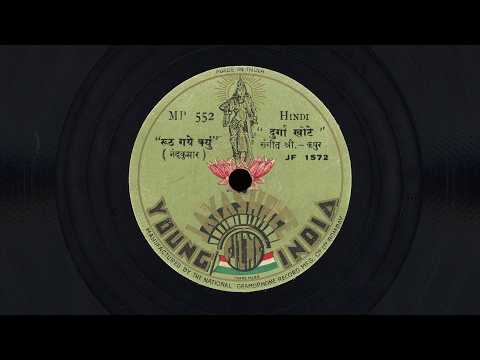
Today I fulfill a request from a friend of the channel – a disc from my collection of 78 rpm records on the Young India label – this series featuring songs from early Parbhat Film Company movies.
The films produced by Parbhat are from the very early era of Indian cinema. Parbhat was founded in Kolhapur in 1929, and made 45 films in its run through the 30s and 40s. In 1960, the Indian government acquired the defunct Parbhat studio and transformed it into the Film and Television Institute of India (FTII).
This record features songs from the Parbhat’s film Nandkumar = नंदकुमार, released in 1938. The film recounts the birth, childhood, and early antics of Lord Krishna.
The film was directed by Keshav Rao Dhaibar, produced by Jayashree Films. Both songs in this video were sung by Durgābāī Khoṭe ( दुर्गाबाई खोटे ) – better known as Durga Khote – an actress with a long prolific career in Hindi and Marathi cinema who performed in over 200 films – the last produced in 1983.
Warning: You will hear a small baby crying on side one. That is Krishna, being comforted by a maternal figure played by Durga Khote, who then sings to him. This first side, रुठ गये क्युं , seems to translate as “Why are you displeased?”
The second side, सुत है जगमें सबसे प्यारा , translates to “The Son – dearest in all the world.” Some very beautiful instrumentation and arrangement on this side, which features Durga Khote singing to “the world’s most beloved son.”
I think this may be one of the more beautiful labels of records in my collection – and is somewhat unique, as later discs in the MP series had a different design that featured a small photo of the primary vocalist on the label with the recognizable graphic from Prabhat’s title sequence featuring a dramatic silhouetted figure holding a large curved horn. I think perhaps only the discs featuring songs from Nandkumar had this exquisite design.
Recorded in India circa 1938. Released as Young India MP 552. Mx JF 1572 and JF 1573.
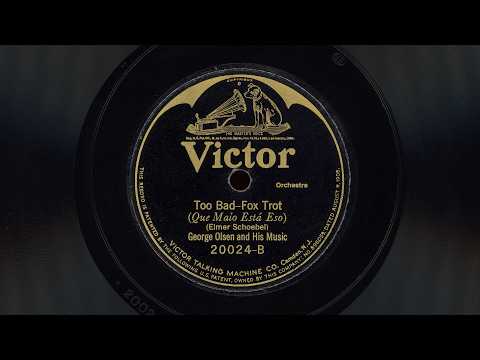
George Olsen was born in Portland, Oregon but started his first band at the University of Michigan while a student there. He moved back west after college and started a band in Portland in 1919. By 1923 they were well known on the west coast and began recording for the Victor label, rapidly becoming one of the more popular dance orchestras in the country.
Though known more for playing popular sweet dance music, Olsen’s band did record some hotter records from time to time – including this one, which turned 100 years old just yesterday.
Recorded in New York City on February 5, 1926. Released as Victor 20024.
Credits: George Olsen – drums, director Floyd Rice, Bob Borger – trumpet Jack Fulton – trombone Fran Frey – alto sax Edward Joyce – clarinet, alto sax Milton Neul – clarinet, tenor sax Eddie Kilfeather – piano Bob Rice – banjo, guitar Jack Hansen – tuba
Cameroonian guitarist Cromwell Nzié recorded this Marche with the Opika label in what is now called Kinshasa, Democratic Republic of the Congo.
“Le Guitariste Cromwell”, is the brother of popular singer Anne-Marie Nzié, the “Golden Voice of Cameroon” ( “La Voix d’Or du Cameroun”). Cromwell reportedly taught Anne-Marie to play guitar while she was bedridden with a broken leg. In the 1950s, Cromwell was “widely popular and received a great deal of radio airplay.”
In 1963, the two participated in a guitar contest organized by a German musician that included many popular guitarists of the time. Anne-Marie won the contest – a success that “restarted her musical career [and] led her to becoming the most popular female singer in the newly founded Republic of Cameroon.”
This song is in the Ngoumba language, spoken by a population originating from Kribi and Lolodorf, in southern Cameroon. Unfortunately, this makes translation somewhat difficult, as Ngoumba is not a widely spoken language.
Recorded in Léopoldville, Belgian Congo circa 1953-54. Released as Opika 1069.
Credits: Cromwell Ndzie Moise – guitar, vocals
Sources: BRUNNER, ANJA. “THE SINGER ANNE-MARIE NZIÉ AND THE SONG ‘LIBERTÉ’: ON POPULAR MUSIC AND THE POSTCOLONIAL STATE IN CAMEROON.” African Music, vol. 9, no. 3, 2013, pp. 40–58. JSTOR, http://www.jstor.org/stable/24877314. Accessed 4 Feb. 2026.
Cameroonian guitarist Cromwell Nzié recorded this Assiko with the Opika label in what is now called Kinshasa, Democratic Republic of the Congo.
“Le Guitariste Cromwell”, is the brother of popular singer Anne-Marie Nzié, the “Golden Voice of Cameroon” ( “La Voix d’Or du Cameroun”). Cromwell reportedly taught Anne-Marie to play guitar while she was bedridden with a broken leg. In the 1950s, Cromwell was “widely popular and received a great deal of radio airplay.”
In 1963, the two participated in a guitar contest organized by a German musician that included many popular guitarists of the time. Anne-Marie won the contest – a success that “restarted her musical career [and] led her to becoming the most popular female singer in the newly founded Republic of Cameroon.”
This song is in the Ngoumba language, spoken by a population originating from Kribi and Lolodorf, in southern Cameroon. Unfortunately, this makes translation somewhat difficult, as Ngoumba is not a widely spoken language.
The vocals on this track sound impassioned – as though they wish to urgently communicate a strong message.
Recorded in Léopoldville, Belgian Congo circa 1953-54. Released as Opika 1069.
Credits: Cromwell Ndzie Moise – guitar, vocals
Sources: BRUNNER, ANJA. “THE SINGER ANNE-MARIE NZIÉ AND THE SONG ‘LIBERTÉ’: ON POPULAR MUSIC AND THE POSTCOLONIAL STATE IN CAMEROON.” African Music, vol. 9, no. 3, 2013, pp. 40–58. JSTOR, http://www.jstor.org/stable/24877314. Accessed 4 Feb. 2026.
Louis Armstrong’s Hot Five of 1928 was a whole new group from the earlier Hot Five that featured Lil Armstrong, Kid Ory, Johnny Dodds, and Johnny St. Cyr who recorded with Louis in 1925-27. Armstrong formed this new Hot Five group around pianist Earl Hines.
“Louis was wild and I was wild, and we were inseparable. He was the most happy-go-lucky guy I ever met. Then Louis and I met Zutty… formed our own group, and I don’t know what happened but we like to starve to death, making a dollar or a dollar and a half apiece a night. So we drifted apart…” — Earl Hines
“Things gotten so tough with us until fifteen cents looked like fifteen dollars. But we did not lose our spirit. We all kept that good ‘ol clean shirt on everyday, and ‘ol Earl Hines kept the big fresh cigar in his mouth everyday. Zuttie and I both admired that… You’d be surprised to know how happy we were.” – Louis Armstrong, “The Goffin Notebooks, Book 5: 1928”
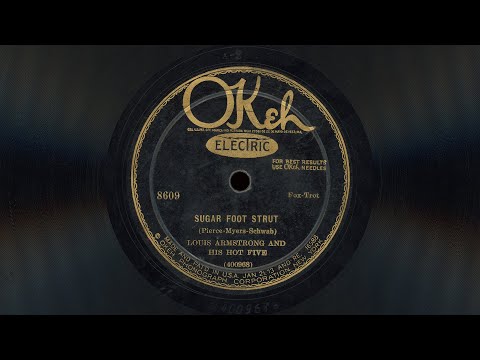
Here we find the new Hot Five performing “Sugar Foot Strut”, which starts off with a call and response between Zutty Singleton’s hand cymbals and the rest of the band. The ensemble states the melody with Satch at the lead. At 1:02 Armstrong delivers a trumpet solo, followed at 1:23 by Earl Hines on piano, leading straight into the vocal section, where Armstrong is accompanied by Hines. At 2:07 we get a Fred Robinson trombone solo, followed at 2:30 by more Hines on piano and at 2:40 BY Jimmy Strong on clarinet and 2:48 by Armstrong bringing it all home with a dramatic trumpet run.
Hughes Panassié wrote of the musical relationship between Satch and Fatha Hines on this recording and the flip side, A Monday Date: “It contains, like Sugar Foot Strut, a vocal chorus by Louis accompanied by the piano in such an original and audacious way that one has to marvel at the understanding between these two musicians.”
Recorded in Chicago, Illinois on June 28, 1928. Released as Okeh 8609.
Credits: Louis Armstrong – trumpet, vocals Fred Robinson – trombone Jimmy Strong – clarinet, tenor sax Earl Hines – piano Mancy Cara – banjo Zutty Singleton – drums
Sources: Jazz and Ragtime Records (1897-1942), 6th Ed. Brian Rust. Louis Armstrong: In His Own Words, Ed. by Thomas Brothers, p99-100 Louis: The Louis Armstrong Story, Max Jones & John Chilton, p100 The Music of Louis Armstrong on Records, Hughes Panassié, p83
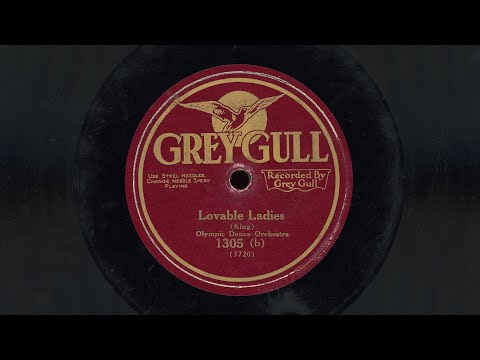
1925 found African-American songwriter Jo Trent in a quite prolific period of his career. He claimed copyright on over 38 songs that year under contract with Grey Gull records – who did not publish sheet music themselves. They bought songs directly from songwriters to avoid having to pay royalties to an outside publisher. In 1925-26, there were a total of 77 Trent/Grey Gull song copyrights!
The unfortunate side of the deal for Trent was that because Grey Gull did not publish the music or license the songs elsewhere, much of this prolific songwriting output from this time was not available to other orchestras and can only be found recorded on Grey Gull discs published during those years.
I can’t seem to find much information on this recording – Wondering if it might be Nathan Glantz on alto sax? At 2:09 there’s a feisty trumpet solo that’s quite good.
Recorded circa September 1925. Released as Grey Gull 1305