Jazz Crazy Records

An Archive of Early Jazz on 78 RPM

Author: Professor M

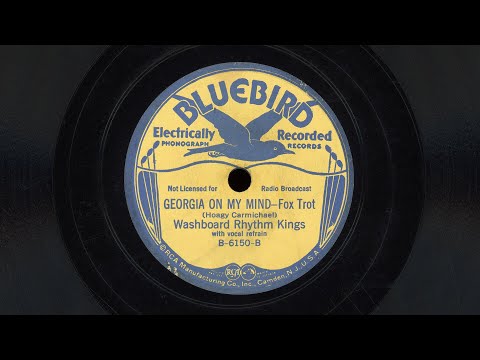
  • “Georgia on my Mind” – Washboard Rhythm Kings (1931)

    “Georgia on my Mind” – Washboard Rhythm Kings (1931)

    A deep-depression cut from the ragtag Victor studio band called the Washboard Rhythm Kings.

    “Georgia on my Mind” was written by Hoagy Carmichael in 1930 and first recorded by his star-studded band on September 15, 1930 (released as Victor 23013). The recording featured Bix, Venuti & Lang, Jack Teagarden, Jimmy Dorsey, Bud Freeman, and Chauncey Morehouse. Due to the huge dip in record sales during the Great Depression, this original recording only sold 3,646 copies.

    A year later, the lovable Washboard Rhythm Kings took up the tune and gave it their own spin. Dave Page’s trumpet starts us off, with Jimmy Spencer’s washboard scritching out a steady rhythm. As Eddie Miles begins the vocals, we hear Steve Washington’s banjo joyfully picking along. Brief but pleasant solos on trumpet and sax follow. The intimate small combo and light airy feel of this recording gives the song a real sense of warm joy and spontaneous delight.

    While there were a number of other recorded versions of the song in the 1930s: Frank Trumbauer (Jun 1931), Gene Kardos (Jun 1931), Mound City Blue Blowers (Jun 1931), Louis Armstrong (Nov 1931), Mildred Bailey (Nov 1931), Roy Fox (1932), Nat Gonella (1934 and 1937), Quintette du Hot Club de France (1936), Casa Loma Orchestra (1939), Ethel Waters (1939), and Mills Brothers (1939), the song did not gain national prominence as a standard until Ray Charles famously recorded the song over a backdrop of lush strings in 1960.

    The Ray Charles recording went to #1 on the Billboard Hot 100 charts and is probably the most well-known version of the song. Though Willie Nelson also recorded a country version of the song in 1978 that went to #1 on the Billboard Hot Country charts – giving the song even broader appeal. These two popular renditions cemented “Georgia on My Mind” as a true standard in the great American songbook.

    That said, I can’t help but adore this simple and unadorned early version of the song.

    I don’t have sales figures on the original Victor issue, but similar issues by the Washboard Rhythm Kings in late 1931 / early 1932 sold under 2,000 copies (Victor 22958 = 1,766 copies, Victor 23300 = 1,781 copies, Victor 23326 = 1,496 copies). Thankfully, the record was reissued on the Bluebird label in 1935.

    Recorded in Camden, New Jersey on September 23, 1931.
    Originally released in 1931 as Victor 23301.
    Reissued in 1935 as Bluebird B-6150.

    Credits:
    Dave Page – trumpet
    Ben Smith – alto sax
    Carl Wade – tenor sax
    Eddie Miles – piano, vocals
    Steve Washington – banjo, guitar
    Jimmy Spencer – drums, washboard

    Sources:
    DAHR
    https://adp.library.ucsb.edu/index.php/matrix/detail/800036736/BVE-70534-Georgia_on_my_mind
    Jazz and Ragtime Records (1897-1942), Brian Rust, 6th Ed
    https://archive.org/details/brian-rust-jazz-records-free-edition-6/
    Wikipedia
    https://en.wikipedia.org/wiki/Georgia_on_My_Mind

  • “Pilipili Yasipo Kula” – Mwenda Jean Bosco – Beautiful African Guitar 🎸

    “Pilipili Yasipo Kula” – Mwenda Jean Bosco – Beautiful African Guitar 🎸

    Beautiful fingerstyle guitar work by the master of the style, Congolese artist Mwenda Jean Bosco.

    The title translates loosely to “If You Don’t Eat the Chili”, and the song seems to have a strong moral message about avoiding behavior that could have negative consequences.

    Pilipili yasipo kula inakuahana gani?
    If you don’t eat chili, how can it burn you?

    Believed to have been recorded circa 1958.
    Released as Gallotone CO.200.

    Credits:
    Mwenda Jean Bosco – guitar, vocals
    Unknown Artist – percussion

  • “Bembeleza Mapendo” – Mwenda Jean Bosco – Beautiful African Fingerstyle Guitar 🎸

    “Bembeleza Mapendo” – Mwenda Jean Bosco – Beautiful African Fingerstyle Guitar 🎸

    Beautiful fingerstyle guitar work by the master of the style, Congolese artist Mwenda Jean Bosco.

    The title translates loosely to “Soothing Love” and the lyrics give relationship advice and moral guidance to women that reflect gendered norms such as humility, emotional labor, and loyalty.

    Kama anasirika we mama humupeze
    If he is angry, calm him down.

    Kama ya panacheka we mama rudisha tena
    If he is not smiling, make him smile again

    Kama uko na kiburi kwa bwana hakuna pesa
    If you act proud to your man, there is no money

    Mbele za mapendo kwa bwana hupate pesa.
    Show acts of love to your man to get money

    Believed to have been recorded circa 1958.
    Released as Gallotone CO.200.

    Credits:
    Mwenda Jean Bosco – guitar, vocals
    Unknown Artist – percussion

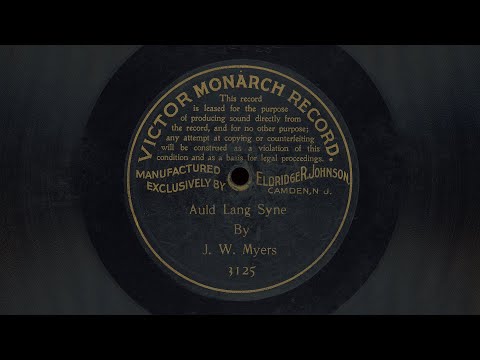
  • “Auld Lang Syne” – J.W. Myers (1901) Happy New Year! 🥂🍾 🎶

    “Auld Lang Syne” – J.W. Myers (1901) Happy New Year! 🥂🍾 🎶

    One of the oldest records in my collection – shared with you, my friends, on New Year’s Eve 2025.

    Happy New Year! 🥂🍾 🎶

    Recorded in Camden, New Jersey on February 20, 1901.
    Released as Victor Monarch 3125.

    Credits:
    J. W. Myers – baritone vocals
    Unknown artist – piano accompaniment

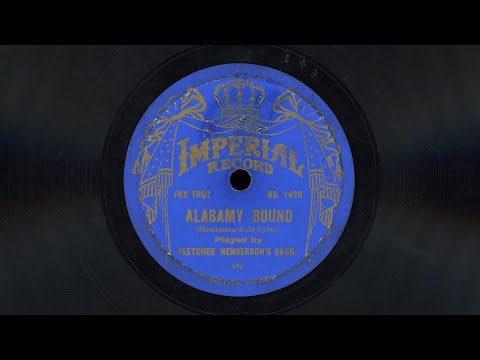
  • “Alabamy Bound” – Fletcher Henderson’s Orchestra (1925) f/ Louis Armstrong 🎺

    “Alabamy Bound” – Fletcher Henderson’s Orchestra (1925) f/ Louis Armstrong 🎺

    In early 1925, things were looking bright for the Fletcher Henderson Orchestra. The bandleader had just gotten married to his beloved Leora and moved to a house on 139th Street in Harlem. The band was playing regularly at the Roseland paired with Sam Lanin’s Orchestra – with trumpeter Louis Armstrong doing a vocal set on Thursday nights that proved very popular.

    On January 24, 1925, the Chicago Defender wrote: “Buster Bailey and Louis Armstrong are still the talk of B’way with Fletcher Henderson’s band. The Henderson orchestra has won themselves a place in the hearts of B’way dancers and are true musicians.”

    Here we have a dance number arranged by Don Redman, “Alabamy Bound” that features a hot trumpet solo by Satch at 1:32 and a brief tenor sax solo by Coleman Hawkins at 1:58. I’m assuming Kaiser Marshall must have been in charge of those train effects and whistles during the intro and outro.

    At 78 rpm my copy of this disc played in the key of F#, so I pitch-adjusted to G, the native key of “Alabamy Bound”. Hopefully, I did right – but if not, I know there are knowledgable horn players in the audience who will gently correct me. 😁

    Recorded in New York City on January 30, 1925. This is take 3.
    Released in the UK as Imperial 1420.
    Released in the US as Banner 1488, Domino 3458, Oriole 347 and Regal 9789.

    Credits:
    Fletcher Henderson – piano, director
    Louis Armstrong, Elmer Chambers, Howard Scott – trumpet
    Charlie Green – trombone
    Buster Bailey – clarinet, alto sax
    Don Redman – clarinet, alto sax, arranger
    Coleman Hawkins – clarinet, tenor sax
    Charlie Dixon – banjo
    Ralph Escudero – tuba
    Kaiser Marshall – drums

    Sources:
    Hendersonia, Walter C. Allen, p. 127-131, 156

  • “Biso Oyo Bakepura Ya Leo” – Camille Mokoko and Friends (early 1950s) Rumba Congolaise

    “Biso Oyo Bakepura Ya Leo” – Camille Mokoko and Friends (early 1950s) Rumba Congolaise

    A record from the middle period of the Ngoma label – likely from around 1951. The title translates roughly to “We, the Proud Ones of Today.”

    Not much is known about the artist – but his music has been featured on a few compilations of Congolese music from this time period, including:

    • “Ngoma, The Early Years, 1948-1960” on Popular African Music (CD, 1996),
    • “Early Congo Music 1946-1962” on El Sur Records (CD set, 2019)
    • “Nostalgique Kongo” on Buda Musique (CD, 2019)

    Recorded in Léopoldville, Belgian Congo in 1950-51.
    Released as Ngoma 869

    The flip side, “Boni Yo Oyili Ngai,” can be heard at:
    https://youtu.be/iPt6bWeuhVg

  • “Boni Yo Oyili Ngai” – Camille Mokoko and Friends (early 1950s) Rumba Congolaise 🇨🇩

    “Boni Yo Oyili Ngai” – Camille Mokoko and Friends (early 1950s) Rumba Congolaise 🇨🇩

    A record from the middle period of the Ngoma label – likely from around 1951. The title of this song by Congolese artist Camille Mokoko translates to “Why Do You Refuse Me?”

    Not much is known about the artist – but his music has been featured on a few compilations of Congolese music from this time period, including:

    • “Ngoma, The Early Years, 1948-1960” on Popular African Music (CD, 1996),
    • “Early Congo Music 1946-1962” on El Sur Records (CD set, 2019)
    • “Nostalgique Kongo” on Buda Musique (CD, 2019)

    Recorded in Léopoldville, Belgian Congo in 1950-51.
    Released as Ngoma 869

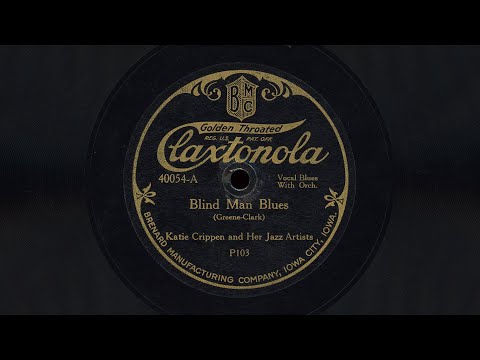
  • “Blind Man Blues” – Kate Crippen and Her Jazz Artists (1921) Early Blues

    “Blind Man Blues” – Kate Crippen and Her Jazz Artists (1921) Early Blues

    In 1921, Philadelphia-born vocalist Katie Crippen recorded four sides for Black Swan Records – a Harlem-based label founded by Harry Pace.

    This song, “Blind Man Blues”, according to Walter Allen in Hendersonia, was “one of the first 12-bar blues recorded.” It features a couple of classic lines, such as “I ain’t gonna marry, I ain’t gonna settle down” – later sung in 1926 by Bessie Smith’s “Young Woman’s Blues” and in 1928 by Jimmie Rodgers’ “Blue Yodel #2”. Lines such as this expressed a gendered independence and were a challenge to the social order of the time – only a year after women in the U.S. won the right to vote.

    Additionally, here we have one of Fletcher Henderson’s very early recorded sessions for Black Swan and his second commercially-released recording. He had moved to NYC in 1920 to study science after graduating from Atlanta University, where he played organ for the mandatory chapel services at the university.

    After working as a song plugger for the Pace and Handy Music Company, he took a job with Harry Pace at his newly formed Black Swan label as a pianist in 1920. The label strove for “cultural respectibility” in its choice of artists and repertoire, and Henderson’s first commercially-released record was providing accompaniment to classical vocalist C. Carroll Clark.

    Though he was a classically-trained pianist, this recording with Kate Crippen was the first of many he would go on to record with many early blues vocalists – as Mamie Smith’s hit “Crazy Blues” in 1920 had started a surge of interest in blues recordings. This style of playing did not come naturally to Henderson, and Ethel Waters, who played and recorded with him often from 1921-23 was quoted as saying:

    “Fletcher wouldn’t give me what I call ‘the damn-it-to-hell bass,’ that chump-chump stuff that real jazz needs… I kept nagging him – I said he couldn’t play as I wanted him to. When we reached Chicago I got some piano rolls that Jimmy Johnson had made and pounded out each passage to Henderson. To prove to me he could do it, Fletch began to practice. He got so perfect, listening to James P. Johnson play on the player piano, that he could press down the keys as the roll played, never missing a note. Naturally, he began to be identified with that kind of music, which isn’t his kind at all.”

    Crippen continued to perform with artists such as Fats Waller and Count Basie throughout the 1920s. She tragically died of cancer in November of 1929.

    Here we have an issue on the Iowa-based Claxtonola label – of my favorite labels to collect from the 78 rpm era. The label was made by the Brenard Manufacturing Company in Iowa City, which manufactured phonographs. They licensed masters from Paramount, Black Swan, and Gennett and issued them under their own labels, Claxtonola and National.

    Enjoy this scarce early blues recording!

    Recorded in New York City in February – March, 1921.
    Originally released as Black Swan 2003.
    Reissued as Paramount 12126, Puritan 11054, Famous 3048 and Claxtonola 40054.

    Credits:
    Katie Crippen – vocals
    Unknown artist – trumpet
    Chink Johnson (?) – trombone
    Edgar Campbell – clarinet
    Cordy Williams (?) – violin
    Fletcher Henderson – piano

    Sources:
    Hendersonia, Walter C. Allen
    His Eye is on the Sparrow, Ethel Waters & Charles Samuels
    Fletcher Henderson and Big Band Jazz, Jeffrey Magee

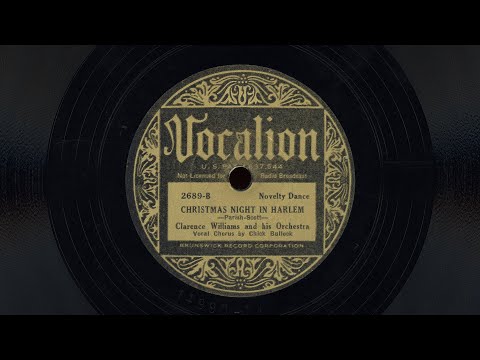
  • “Christmas Night in Harlem” – Clarence Williams and his Orchestra (1934)

    “Christmas Night in Harlem” – Clarence Williams and his Orchestra (1934)

    On Christmas Eve, we have a fresh transfer of Clarence Williams’ recording of a Christmas tune written by Mitchell Parish and Raymond Scott and featuring vocalist Chick Bullock.

    The tune was recorded by Paul Whiteman and his Orchestra a month later, in April of 1934 with Frank Trumbauer plus Charlie and Jack Teagarden.

    Much later, in 1955, it was recorded by an orchestra directed by Benny Carter featuring Louis Armstrong on vocals. Satch insisted on changing the racially charged lyrics of the original so that terms such as “black and tans” and “coal black joe” were replaced with more inclusive and positive language.

    Recorded in New York City on March 23, 1934.
    Released as Vocalion 2689.

    Credits:
    Charlie Gaines – trumpet
    Ed Allen – cornet
    Cecil Scott – clarinet, tenor sax
    Louis Jordan – alto sax, tenor sax
    James P. Johnson – piano
    Cyrus St. Clair – tuba
    Floyd Casey – washboard
    Chick Bullock – vocals

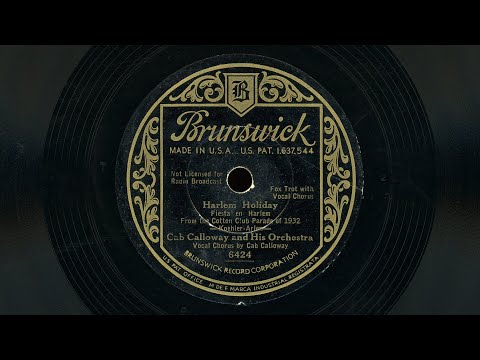
  • “Harlem Holiday” – Cab Calloway and His Orchestra (1932)

    “Harlem Holiday” – Cab Calloway and His Orchestra (1932)

    Ok, so not all holiday songs are about Christmas. Here we find a wonderful deep-depression cut from Cab Calloway extolling the “Harlem Holiday” a hopeful vision of good times during the Great Depression.

    Written by songwriters Ted Koehler and Harold Arlen, the song features an infectious trombone riff that will worm its way into your ear for hours.

    Lyrics
    There’ll be bands everywhere – going to town
    There’ll be flames in the air – flying all around
    The browns’ll be there – laying ’em down
    Every day will be a Harlem Holiday

    No more work, only play – sleep when you choose
    you get paid anyway – now tell me – ain’t that news?
    Every song will be gay – no where we blue
    Every day will be a Harlem Holiday

    When the whole world’s down
    and the times look blue
    You’ll be high up on Lennox Avenue

    There’ll be gals on the make – gin will be free
    If you don’t get a break – don’t blame me
    Every spot that you got will be hotter than hot
    Every day will be a Harlem Holiday

    Recorded in New York City on November 9, 1932.
    Released as Brunswick 6424.

    Credits:
    Cab Calloway – vocals, director
    Edwin Swayzee, Lammar Wright, Doc Cheatham – trumpet
    De Priest Wheeler, Harry White – trombone
    Arville Harris – clarinet, alto sax
    Andrew Brown – bass clarinet, tenor sax
    Walter Thomas – alto sax, tenor sax, baritone sax
    Eddie Barefield – clarinet, alto sax, baritone sax
    Bennie Payne – piano
    Morris White – banjo
    Al Morgan – string bass
    Leroy Maxey – drums