Can’t remember who but someone was asking about OM5 Arto discs. Here’s one!
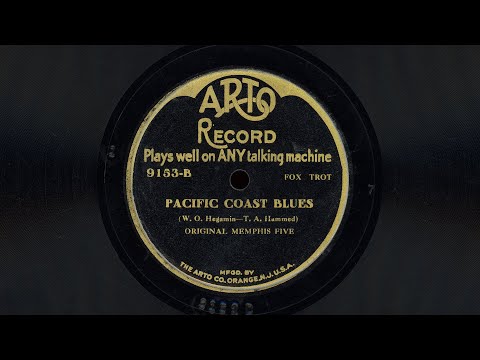
“Pacific Coast Blues” gets off to a jumpy start – and if you’ve ever driven on Highway 1 in California this is not surprising. But things soon get rolling along, led by Phil Napoleon’s bright and cheerful trumpet melodies. Great ensemble playing and a few hot breaks but few extended solos in their own right.
Recorded in New York City on June 14, 1922. Released as Arto 9153.
Credits: Phil Napoleon – trumpet Miff Mole – trombone Jimmy Lytell – clarinet Frank Signorelli – piano Jack Roth – drums
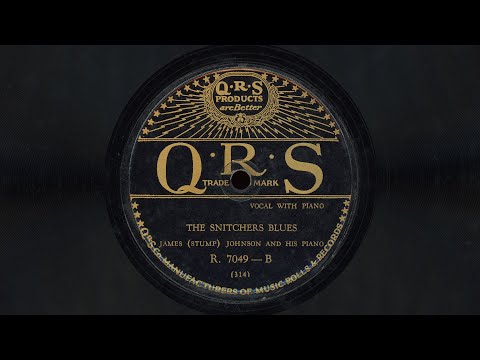
From James “Stump” Johnson’s first recording session in Long Island City, New York in early 1929, we have an original tune called The Snitchers Blues.
Johnson sometimes performed under the stage name Snitcher Roberts, so the title of the tune is self-referential.
A percussive effect is heard throughout the song – perhaps this is Mr. Johnson tapping his foot on the floor to keep time?
The song ends abruptly at 2:50 with Johnson exclaiming “What? Well Give me another drink, then – that’s all right then.” The session engineers wisely kept this informal interjection in the released recording.
The flip side, “The Duck Yas-Yas-Yas” is the more well-known side – and I couldn’t find another transfer of this B-side anywhere on YouTube, so I figured I’d get this one out there to enjoy. If there is interest, I’ll transfer the A-side as well.
Recently won this rare QRS disc on eBay for $13 – as the record has a well-repaired crack and I guess that scared other bidders off. Otherwise in great shape – and my de-clicking filter took the tick right out.
Recorded in New York City circa January 1929. Released as QRS R.7049 and Paramount 12842.
In November of 1918, the Original Dixieland Jazz Band signed a contract with British producer Albert deCourville for a ten-week engagement at London’s Hippodrome that was to begin in March of 1919.
However, the virulent Influenza pandemic took the band’s pianist Henry Ragas just two days before the band was to set sail for the UK in February of 1919. Finding a replacement took an additional month, and the band finally boarded the R.M.S. Adriatic and by April 1, 1919, the ODJB arrived in Liverpool and began a 15 month stay.
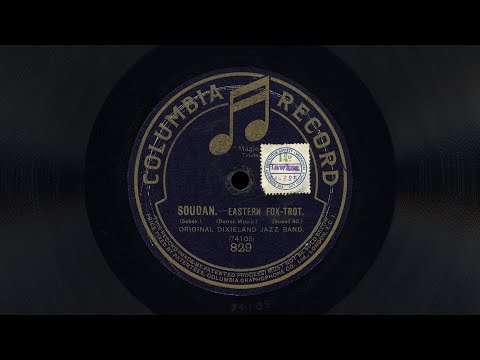
They recorded 17 sides during their stay in the UK, all for Columbia. This disc, “Soudan” was from their last session – and was a tune taught to the band by Frank Hale of the Hale & Patterson team, who used it to accompany one of their oriental dance numbers..
Those used to ODJB’s Victor output might be taken aback by
Recorded in London, UK on May 14, 1920. Released in the UK as Columbia 829.
Credits: Nick LaRocca – cornet, director Emile Christian – trombone Larry Shields – clarinet Billy Jones – piano Tony Sbarbaro – drums
Sources: Jazz and Ragtime Records (1897-1942), 6th Ed., Brian Rust The Story of the Dixieland Jazz Band, H.O. Brunn
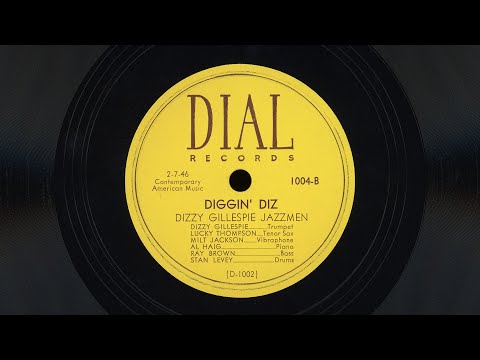
At the time of this recording, Dizzy had just been named “Influencer of the Year” by Metronome magazine, which wrote in its January 1946 issue: “This [1945] was the year in which Dizzy Gillespie became the symbol of a revolution in jazz circles… Dizzy has become the central figure in a new movement of harmonic and rhythmic ingenuity, coupled with technical mastery, in jazz improvisation…”
Here, in Diz’ first session for Ross Russell’s newly launched Dial label as bandleader, things unfortunately did not work out as planned. Milt Jackson and Lester Young were no-shows at the session and the band only managed to record one track – and that after frequent interruptions caused by a group of fans showing up at the studio and by technical issues with faulty equipment.
It is reported that the frustrated band left in anger after recording this tune, “Diggin’ Diz”. They would re-record the tune as “Diggin’ For Diz” two days later sans Parker but with Milt Jackson adding vibes to the mix.
All of that said, I find this recording to be a delightful listen. 🎺
0:00 Intro 0:37 Piano (Handy) 0:53 Alto sax (Parker) 1:12 Trumpet (Gillespie) 1:31 Tenor sax (Thompson) 1:50 Guitar (Garrison) 2:08 Piano (Handy) 2:27 Outro
Recorded at Electro Broadcast Studios in Glendale, California on February 5, 1946 Released as Dial 1004.
Credits (label has some errors): Dizzy Gillespie – trumpet Charlie Parker – alto sax Lucky Thompson – tenor sax George Handy – piano Arvin Garrison – guitar Ray Brown – bass Stan Levey – drums
Sources: Dizzy Gillespie Discography at JazzDisco https://www.jazzdisco.org/dizzy-gillespie/discography/ Dizzy: The Life and Times of John Birks Gillespie by Donald L. Maggin, pp. 187-190. Groovin’ High – The Life of Dizzy Gillespie by Alyn Shipton
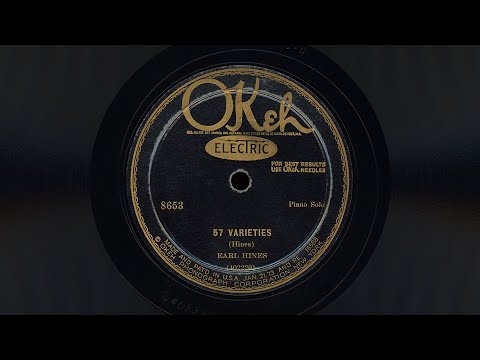
After wrapping up a full summer of recording some of the most beloved classics of early jazz with Louis Armstrong and his Hot Five, pianist Earl Hines was surreptitiously recorded while messing around on the piano. Satch and the Savoy Ballroom Five had just recorded Heah Me Talkin’ To Ya?, St. James Infirmary, and Tight Like This in the studio and took a break. I’ll let Hines tell the rest:
“It was an accident. I was recording with Louis, we were down making a session. In the intermission, the guys were all back in the room having dinner and drinking, having a ball. I didn’t feel like it, so I was out front playing piano, just fooling around. Finally somebody comes out after I’d played awhile and he whispers, “Put an ending, put an ending.” I didn’t know they were recording me. So I put an ending, and they said “Shhhh… we’ll finish it.” That was it. After I come out, they say, “What are we going to call it?”. So one boy says, “His name is Hines, call it ‘Hines 57 Varieties’.” I never played it since. I don’t know what I did, I was just playing.” – Earl Hines, in an interview with Anthony Baldwin in September of 1979.
The 57 Varieties connection is a play on the advertising slogan of the H.J. Heinz Company, which was introduced in 1896 to market its wide selection of food products such as pickles, horseradish, relishes, and ketchup. The slogan has appeared on bottles of Heinz Ketchup for decades and also led to the creation of a steak sauce called “Heinz 57”.
Enjoy!
Recorded in Chicago, Illinois on December 12, 1928. Released as Okeh 8653.
Credits: Earl Hines – piano
Sources:
Jazz and Ragtime Records (1897-1942), 6th Ed, Brian Rust
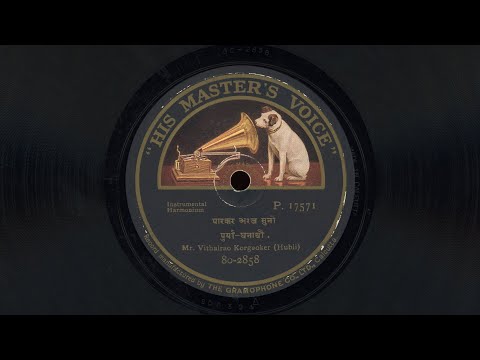
Mr. Vithal Rao Korgaokar of Hubli is one of many of prominent harmonium artists who recorded in India during the 20s and 30s.
Side A, Pārkar Arj Suno, is a dusk raga (Puriya‑Dhanashree) that is serious and emotionally introspective.
Side B, Lāge Hridayī Hur‑Hur, translates loosely to “My heart flutters”, with the phrase “Hur‑Hur” (हुर हुर) expressing romantic longing and emotional agitation. Here, we have an evening raga (Yaman) that expresses devotion, purity, longing, and calm.
Believed to have been recorded circa 1925. Released as His Master’s Voice P.17571
Credits: Mr. Vithal Rao Korgaokar Of Hubli – Harmonium Unknown Artist – Tabla
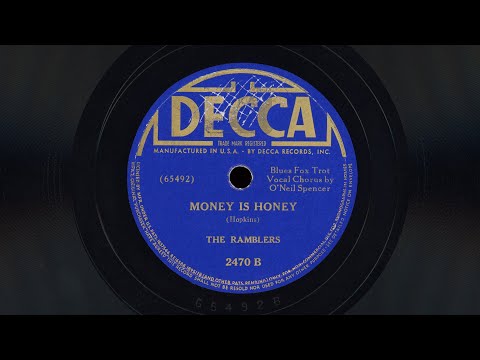
A studio group who did a session for Decca in 1939 that resulted in two issues. Notable for its inclusion of Bob Hamilton playing an electric organ – a relatively novel development in the 1930s – the decade that saw the first Hammond organ.
Here we have a tune by Mae Iris Hopkins, “Money is Honey”, later covered by the Count Basie Orchestra in the late 40s.
Hamilton’s accompaniment – especially the organ solo starting at 1:31- is quite interesting, and along with Teddy Bunn’s bluesy guitar solo at 1:53, it gives this R&B tune a decidedly modern feel. Add a little more volume and drench it with reverb and we could quickly have a “Green Onions” feel here.
Recorded in New York City on April 28, 1939. Released as Decca 2470.
Credits: Bob Hamilton – electric organ Billy Kyle – piano Teddy Bunn – guitar O’Neil Spencer – drums, vocals
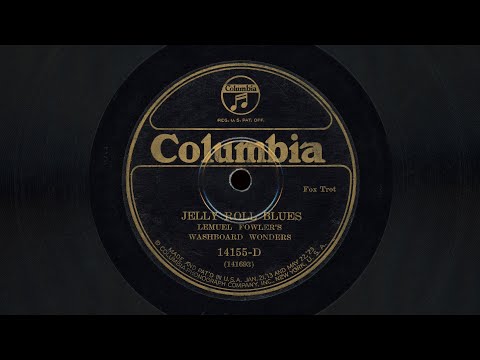
A delightful disc by a washboard jazz quartet led by pianist Lemuel Fowler.
Love the almost tremolo-like clarinet sound of Percy Glascoe at 0:07. Wonderful ensemble playing throughout from this jubilant group playing a Jelly Roll Morton original composition that was first published in 1915 – practically an “oldie” by the time this was recorded.
Recorded in New York City on April 6, 1926. Released as Columbia 14155-D.
Credits: Sidney de Paris – trumpet Percy Glascoe – clarinet, alto sax Lemuel Fowler – piano Al Brunson – washboard
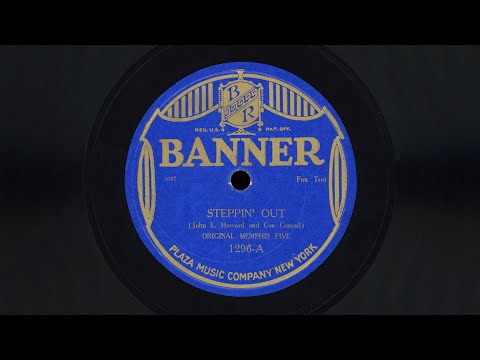
Here’s a peppy pop tune by Original Memphis Five, who prolifically recorded hundreds of jazzy sides in the 1920s.
In 2016 there was an active project to digitally transfer the complete OM5 oeuvre onto one massive CD set. Unfortunately, after making much headway (the complete set reportedly filled 28 CDs), the project was abandoned in 2022 when the project’s producer stopped making payments to the audio engineers producing the digital transfers. The ensuing dispute has sadly ensured that all of the hard work that had been done on this monumental project will never be heard by fans.
But 28 CDs, tho! That gives you an idea of the scope of OM5’s recording career! So here’s a tiny fraction of that: from a late 1923 recording session we have OM5’s take on “Steppin’ Out”, a tune by Con Conrad and John Howard.
Recorded in New York City on December 7, 1923. Released as Banner 1296. Also released domestically as Regal 9588, Bell P-262.
Credits: Phil Napoleon – trumpet Miff Mole – trombone Jimmy Lytell – clarinet Frank Signorelli – piano Jack Roth – drums
Sources: Lost Chords, Richard Sudhalter, p.106-109 Jazz and Ragtime Records (1897-1942), Brian Rust, 6th Ed.
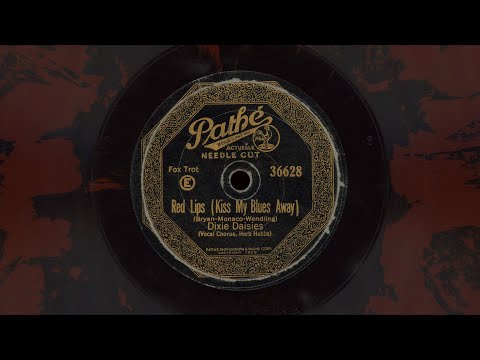
It’s midweek and therefore time for a fun rollicking dance number by one of Sam Lanin’s many aliases on a gorgeous Pathé Actuelle needle cut disc often referred to as a “bowling ball” splatter disc due to its beautiful swirled black and red patterns embedded in the shellac. These visually stunning discs were pressed for a very short time from 1926-27.
Most of the tune is relatively straightforward – though Earl Oliver can be heard playing around the melody throughout, while Leo McConville breaks into solo mode at 1:37 and 1:54.
At 2:04 we hear a brief tinkling piano solo – which is not noted in the credits I found, so I added it.
“Red Lips – Kiss my blues away, Red Lips – Kiss the night to day. Any old time that you come cuddling near Isn’t it strange the way the blues disappear?”
Recorded in New York City on March 10, 1927. Released as Pathé Actuelle 36628
Credits: Sam Lanin – director Earl Oliver, Leo McConville – trumpet Chuck Campbell – trombone Andy Sannella – alto sax, clarinet, soprano sax, guitar Larry Abbott – alto sax, clarinet, soprano sax Merle Johnston (?) – tenor sax, soprano sax Arthur Schutt – piano Tony “Toots” Colucci (?) – banjo Joe Tarto – tuba Vic Berton – drums Arthur Fields (as Herb Hobbs) – vocals
Source: “That Growling Trumpet! A Discography of Earle Preston Oliver aka Earl Oliver (1894-1933), Cyrus Bahmaie & Javier Soria Laso.