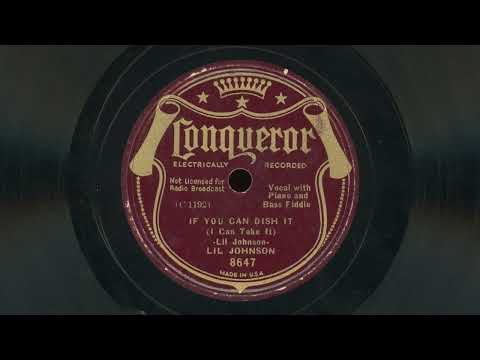
The wonderful Lil Johnson delivers her sly come-on song “If You Can Dish It” to the lively accompaniment of Black Bob on piano and Bill Settles on the “bass fiddle” as it’s referred to on the label.
You can feel her delightful and commanding stage presence through this record almost 90 years later. During the instrumental break Johnson playfully exhorts her accompanists: shouting “Dish it out – dish it out, Bob!” and “Hit that Fiddle!”
Recorded in Chicago, Illinois on December 17, 1935. Released as Conqueror 8647.
Credits Lil Johnson – vocals Bill Settles – string bass Black Bob – piano
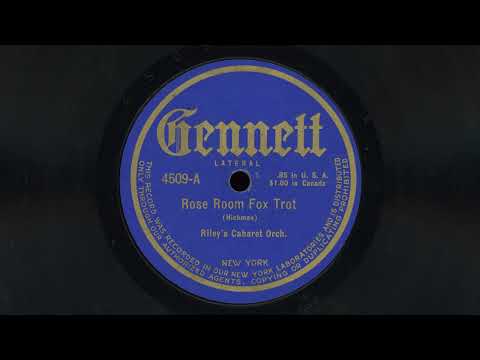
A very early version of the jazz standard “Rose Room” on a very early lateral cut Gennett from the 4500 series that began in 1919.
The Rose Room was a ballroom in the St. Francis Hotel in San Francisco, California where bandleader Art Hickman’s dance orchestra played. Hickman wrote the tune in 1917 and it was recorded in 1918 by Prince’s Orchestra and Joseph C. Smith and his Orchestra. Hickman himself did not record it with his band until September 1919. When it was released in 1920 on the Columbia label, it was a big seller.
The 32-bar form of the song and interesting chord changes make it a treat to play – and it’s no wonder it gained wider currency as a standard in the 30s when it got reinterpreted by Duke Ellington and Charlie Christian (playing with the Benny Goodman Sextet).
Riley’s Cabaret Orchestra was a New York-based dance band about which not much is known. By my count, they were the third to record this tune.
Recorded in New York City in January 1919. Released as Gennett 4509 in April 1919.
Just for fun, here’s a countdown of the top ten most-watched videos on the channel in 2023. I only counted views of videos that were uploaded in 2023 – though there is one honorable mention for a video that was not uploaded this year – yet still earned more views than any other video on the channel in 2023!
If you want to peek or skip ahead, I’ve made some chapters below – so… Spoiler warning – spoilers appear below!
0:00 Intro 0:52 Honorable mention 2:07 Number 10 2:28 Number 9 2:49 Number 8 3:10 Number 7 3:33 Number 6 3:51 Number 5 4:12 Number 4 4:33 Number 3 5:00 Number 2 5:24 Number 1 5:49 Conclusion
Here are links to all the videos – since I ran out of cards to put onscreen during the video:
Thanks everyone for listening – I do this channel out of pure love for the music and it’s been a real treat sharing it with you and reading your comments.
In addition to my normal videos of record transfers, in 2024 I hope to do more videos on topics related to jazz history and 78 rpm record collecting, as well as more conversations with jazz artists, producers, historians, and other collectors.
Have a very happy holiday, a very Merry Christmas, and a super happy new year! Matthew
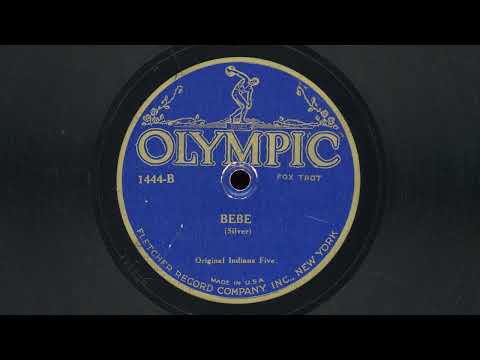
An early iteration of the Original Indiana Five on the Olympic label featuring the Johnny Sylvester lineup.
OI5 formed in 1920 but did not record until 1923. The original lineup had featured young clarinetist Jimmy Lytell, who left the group in late 1921 to join the Original Dixieland Jazz Band and was also a member of the Original Memphis Five.
After a rousing intro, the band settles into the melodic head, where the ensemble playing is quite nice and represents the most interesting performances throughout the record. At 1:06, we do hear a solo from what sounds to me like an alto sax while Tony Colucci’s banjo accompanies – but improvisation is minimal and the lines stick closely to the melody. At 2:02 a similarly straightforward melodic solo is heard from trombonist Vincent Grande.
In 1925 Johnny Sylvester left the band and the remaining OI5 members went on to record many excellent titles over the next four years.
The Olympic label was founded by musician John Fletcher in January of 1921. Sales were not good, however, and by the end of the year, the company went into receivership. The assets went up for auction – and were purchased by Fletcher himself (and two partners), who founded the Fletcher Record Company in 1922, and by the end of that year, Olympic records were again being pressed, recording jazz artists such as Fletcher Henderson, Bennie Krueger, Original Georgia Five, and OI5. The label struggled to attract buyers, and by the end of 1923 went bankrupt. The label was later revived for a brief period in Chicago.
Recorded in Long Island City circa May of 1923. Released as Olympic 1444. Also issued as Majestic 1444 and Broadway 11282, Puritan 11282, and Triangle 11282 (as the Majestic Dance Orchestra).
Credits: Newman Fier – piano, director Johnny Sylvester – trumpet Vincent Grande – trombone Johnny Costello – clarinet, alto sax Tony Colucci (?) – banjo Tom Morton – drums
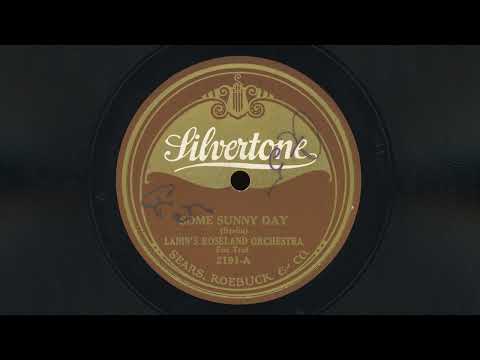
By request from one of my Discogs friends, a session originally released on the Federal label by Sam Lanin’s Roseland Orchestra that was reissued by the Silvertone label.
“Some Sunny Day” has a runout matrix of 2-1377 and was from a session in February 1922 that included “Do It Again” (Mx 2-1375) and “Every Day” (Mx 1-1371, 2-1372, and 3-1373).
It is believed that the tune “California” (Mx 2-1380) is from an entirely different orchestra altogether.
On “Some Sunny Day” we get a special treat: at 2:06 – an alto sax and trumpet duet featuring the excellent Loren McMurray laying on the heat.
Later this year, the Federal label suffered a catastrophe – their record factory burned down in a fire. They held on for a few years outsourcing to other manufacturers – but went out of business in 1925. Luckily, many Federal titles were reissued on the Silvertone label.
Recorded in mid-February, 1922 in New York City. Released as Federal 5191 and Silvertone 2191.
Credits for “Some Sunny Day” Sam Lanin – director Phil Napoleon – trumpet Miff Mole – trombone Bernhard “Doc” Berendsohn – clarinet, tenor saxophone Loren McMurray – alto saxophone Joe Gold (?) – piano Unknown Artist – violin, drums
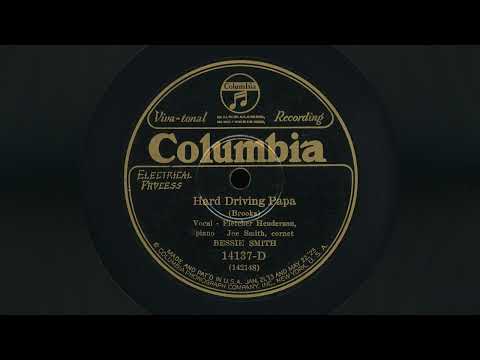
One of the cleanest Bessie Smith records in my collection – demonstrating how amazing 78 rpm records can sound when they are great shape.
Ms. Smith is accompanied by top-talent musicians from the NYC jazz scene who lend a mournful elegance to her powerful vocal performance. Mahalia Jackson once described the impact of Bessie’s voice: “Her music haunted you even when she stopped singing.”
Henderson and Smith recorded this session with Ms. Smith in between their Dixie Stompers session of April 14 (Dynamite, Jack-ass Blues, and Static Strut) and the Henderson orchestra session for Columbia of May 14 (The Stampede, Jackass Blues).
Recorded in New York City on May 4, 1926. Released as Columbia 14137-D
Credits: Bessie Smith – vocals Joe Smith – cornet Fletcher Henderson – piano
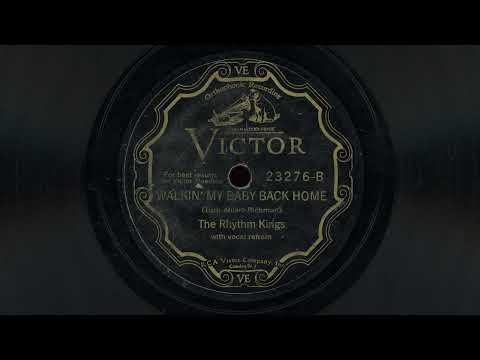
A delightful deep depression cut from an early incarnation of a band that later became known as the Washboard Rhythm Kings. Quite a rare disc, as the original release sold poorly when it came out in 1931.
In issue #19 and #20 of the British Jazz magazine Storyville, writer Theo Zwicky noted that during the period 1930-35, this group recorded around 140 titles – more sides than Louis Armstrong or Duke Ellington during the same period. This could, in part, be due to the immediate proximity of the musicians in the band (who Kaiser Marshall says were from Philadelphia) – and the location of Victor’s recording studio in Camden – right across the Delaware River.
Zwicky goes on to write that the WRK played “some of the most completely enjoyable jazz ever made. Driving along wildly and breathtakingly and yet relaxed and easy-going, scatting and humming through charming ditties as well as romping and stomping through distinctive jazz numbers, all overlaid with an innate sense of good taste, a flair for humour and a bright happy sound.”
Unfortunately, even Zwicky, who counted himself as a veritable WRK unofficial historian, many of the identities of the members of this group at the time of this session proved elusive – and not much is known about the performers outside of Teddy Bunn and the vocalist Buck Franklin.
In any case, I’ve always had a love for the gents in the Washboard Rhythm Kings ever since I heard their hot firecracker take of “Tiger Rag” complete with a raucous bull roarer. I gravitated to their fun unpretentious performances – often more of an impromptu celebratory jam session than a carefully rehearsed orchestration.
Recorded on May 8, 1931 in Camden, New Jersey. Released as Victor 23276 on June 19, 1931. Only 1,333 copies were sold.
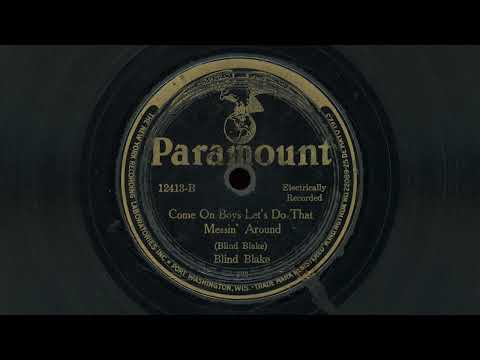
I usually stick to collecting jazz records but when this Blind Blake record was offered for sale recently at a price I couldn’t believe, I had to buy it!
The reason it was so inexpensive was that it has a crack from edge to label. However, it had been repaired by “record whisperer” Jim Cooprider, who is reputed to have the ability to bring records back from the dead using arcane methods. I was more than a little curious to see how good the repair was.
The crack was completely fused back together – using what alien technology I have no idea. It does sound – but not a sharp tic but more of a muffled and very slight thump as the needle skates over a thin layer of some magic substance that was used to fill and repair the crack. After de-clicking it’s hardly noticeable at all. Well done, Jim!
The record was graded at V- and it does have a rough start – but cleans up pretty well and is a very enjoyable listen.
This fun tune was from Blake’s second session with Paramount early in his career – and some copies are labeled simply as “Messin’ Around”.
I’ve always found Arthur Blake’s fingerpicking to be quite masterful. His firm clean tone and inventiveness is infectious and a pleasure to listen to.
Enjoy!
Recorded in Chicago, Illinois in October 1926. Released as Paramount 12413.