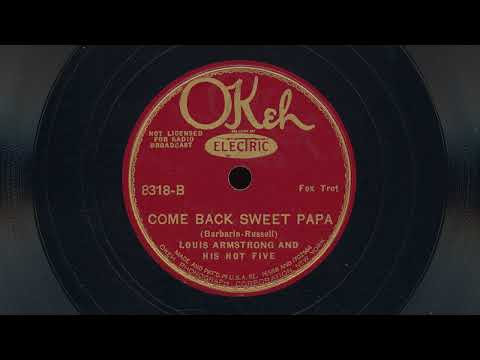
The second hot five session finds the group doing “Come Back Sweet Papa”, a tune by Paul Barbarin and Luis Russell.
Satch and Ory seem to be lit up and swingin’ hard on this track!
0:00 Intro (Armstrong & Ory) 0:08 Alto Sax solo (Dodds) 0:48 Cornet solo (Armstrong) over ensemble chorus 1:27 Ensemble 1:48 Piano solo (Lil Armstrong) 2:07 Ensemble and Cornet solo (Armstrong)
Recorded in Chicago, Illinois on February 22, 1926 Released as Okeh 8318 – this copy is a master pressing reissued in the 1930s.
Louis Armstrong – cornet Kid Ory – trombone Johnny Dodds – alto saxophone, clarinet Lil Armstrong – piano Johnny St. Cyr – banjo
The song “Copenhagen” was written by Indiana bandleader Charlie Davis as an homage to his sousaphone player’s favorite chewing tobacco. When the band performed the newly written piece in Indianapolis in April 1924, the seven members of The Wolverine Orchestra were in the audience listening. Within a few weeks, the Wolverines became the first band to record the composition in a session for Gennett that was released in June.
Melrose Brothers publishing quickly prepared a stock arrangement of the piece based on the Wolverines record – which was published in August of 1924. The title page of the arrangement stated: “This arrangement is RED HOT as written. Play what you see and the horns will start smoking.”
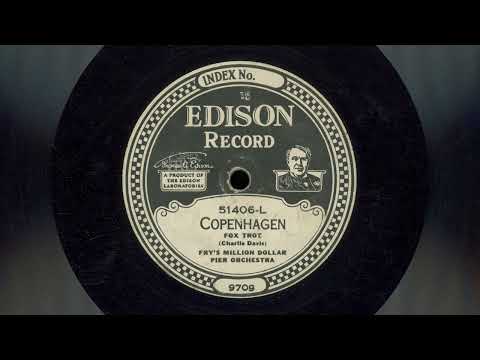
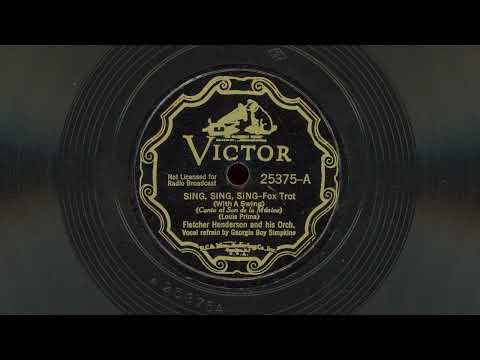
On September 8, the Benson Orchestra of Chicago recorded a very popular version for Victor. A week later, Charlie Fry and his Million Dollar Pier Orchestra – who had been playing with the Benson Orchestra in Atlantic City during the summer – released this version. Coincidentally, between these two sessions, the Wolverine Orchestra began a residency at the Cinderella Ballroom in New York City.
In the last three months of 1924, ten additional versions were recorded by bands including Fletcher Henderson, California Ramblers, and Arkansas Travelers.
Fry’s version stuck closely to the stock arrangement, with an extra clarinet and sax solo for good measure – since they were recording on Edison, maybe they figured had a little extra time since Diamond Discs could hold nearly 4 minutes of music compared with a little over 3 minutes for a standard 10″ shellac disc.
0:00 Intro (ensemble) 0:17 Clarinet solo 0:30 Tenor Sax solo 0:43 Ensemble 1:00 Clarinet solo 1:13 Tenor Sax solo 1:26 Ensemble 1:43 Trumpet solo 2:01 Ensemble 2:17 Tuba solo with banjo 2:43 Ensemble
Recorded in New York, New York on September 15, 1924. Released as Edison 51406-L
Charlie Fry – Director, Alto Saxophone, Violin Julian Kurtzman, Theo Wohleben – Trumpet Oscar Moldaur, Ray Thwaite – Clarinet, Alto Saxophone, Soprano Saxophone John Baviton – Clarinet, Tenor Saxophone Ben Morgan – Trombone Ray Allen – Piano Herman Schmidt – Tuba Frank Kriell – Banjo Fred Niehardt – Drums
All the credit for the excellent information about the history of “Copenhagen” goes to the very informative article “Revisiting Fletcher Henderson’s ‘Copenhagen’” by Jeffrey Magee in the Journal of the American Musicological Society , Spring, 1995, Vol. 48, No. 1 (Spring, 1995), pp. 42-66 http://www.jstor.com/stable/3128850
Lloyd “Tiny” Grimes broke into the music business by playing tenor guitar with the vocal quartet The Cats and the Fiddle during the early 1940s. In 1943 he joined forces with virtuoso pianist Art Tatum and bassist Slam Stewart in the powerhouse Art Tatum Trio.
He is probably most well known for a few sides he recorded as a bandleader for the Savoy label in 1944 with a young sideman named Charlie Parker.
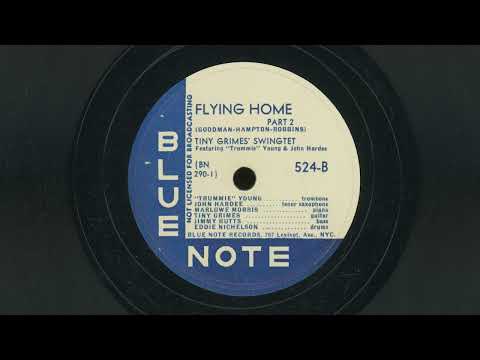
This session from 1946 finds Tiny recording for the Blue Note label. This blazingly fast rendition of “Flying Home”, a relaxed Benny Goodman/Lionel Hampton small combo composition from 1939, shows both the growing influence of bop and R&B on Tiny’s playing. The extended solos meant the track had to be divided into two parts to fit on a 10″ 78 rpm record – which could only hold a little over three minutes of music per side.
Here, I’ve put both parts together – the transition happens around the 3:00 mark.
0:00 Intro 0:34 Trombone solo (Young) 1:24 Tenor Sax solo (Hardee) 2:14 Piano solo (Morris) 3:03 Guitar solo (Grimes) 4:18 Ensemble
While his choice of composition and some aspects of his playing clearly drew inspiration from Charlie Christian, the accelerated tempo and virtuosic solos show the influence of bebop.
Recorded in New York City on August 14th, 1946. Released as Blue Note 524.
Credits: Trummy Young – trombone John Hardee – tenor sax Marlowe Morris – piano Tiny Grimes – guitar Jimmy Butts – bass Eddie Nicholson – drums
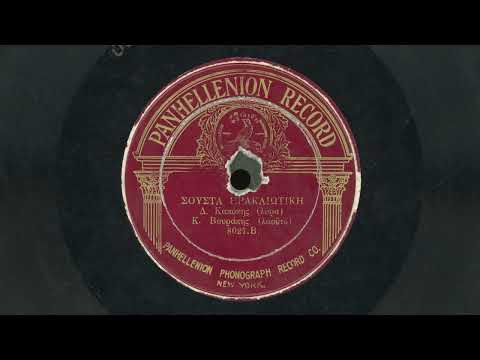
Give a listen to this astonishing duet by Greek musicians D. Kapokis and K. Vourakis, about whom I’ve been able to find out very little. Kapokis plays a λύρα – a bowed lyre – while Vourakis plays the λαούτο – a long-necked lute.
The Σούστα (Sousta) is a greek folk dance performed at weddings. The title of this Sousta is Heraklion – a city in Crete.
Recorded in New York City circa 1921. Released as Panhellenion 8027.
Credits λαούτο (Laouto) – Κ. Βουράκης (K. Vourakis) λύρα (Cretan Lyre) – Δ. Καπόκης (D. Kapokis)
In January of 1924, Fletcher Henderson’s band began its tenure at the newly opened Club Alabam on W. 44th St in New York City. Within several months they became known as one of the best jazz orchestras in the city.
In May of 1924, Henderson began making records for the Plaza Music Company, which owned the Banner, Regal, Domino, and Oriole labels. On the Plaza labels, Henderson’s orchestra went by a variety of pseudonyms so that the different labels could each advertise recordings seemingly by different bands. The recordings were also then leased to other labels, where new pseudonyms followed.
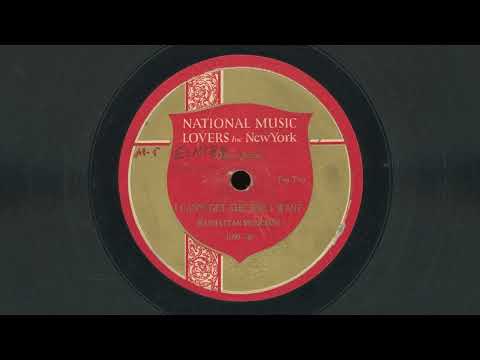
The recording of “I Can’t Get The One I Want” in June of 1924 set a record of sorts when it comes to this type of pseudonymic shenanigans: its three recorded takes were pressed and issued on at least twenty different labels, including Banner, Domino, Regal, Broadway, Lyratone, Triangle, Emerson, Federal, Globe, Nadsco, Radiex, Oriole, Paramount, Puritan, Silvertone, Apex, Usiba, and this one, the rather obscure National Music Lovers label, where they go by the rather unimaginative name of “Manhattan Musicians”.
While more of a sweeter style dance number, there are many interesting instrumental interactions in the arrangement and opportunities for hot breaks – we even hear the vivacious Coleman Hawkins leap in with a bouncy bass sax solo at 2:40 and again at 2:58.
Recorded in New York City on June 19, 1924. Released as National Music Lovers 1099.
Credits: Fletcher Henderson – piano, director, arranger Elmer Chambers, Howard Scott – cornet Teddy Nixon – trombone Don Redman – clarinet, alto sax Lonnie Brown (?) – alto sax Coleman Hawkins – tenor sax, bass sax Charlie Dixon – banjo Ralph Escudero – tuba Kaiser Marshall – drums
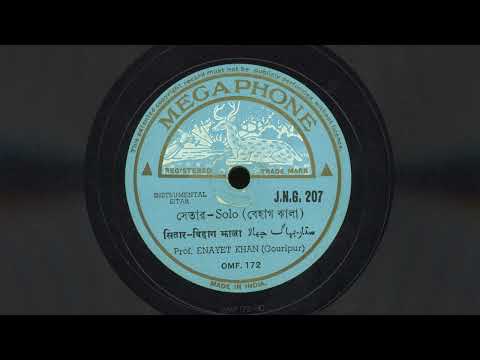
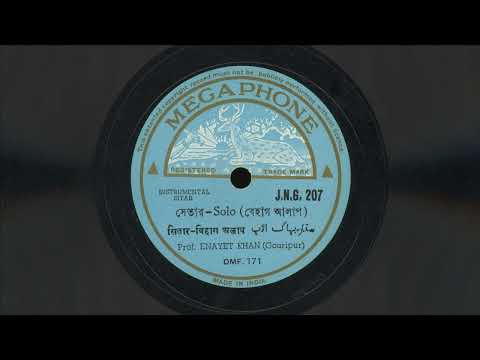
Enayet Khan, the son of Imdad Khan and father of Vilayat Khan, performs a beautiful Bihag raag on the sitar. Here, we hear the fast-paced Jhala, or conclusion of the raag.
It is believed this recording dates from 1935.
Sitar – Solo. Released in India as Megaphone J.N.G. 207 (Matrix OMF 172).
Enayet Khan, the son of Imdad Khan and father of Vilayat Khan, performs a beautiful Bihag raag on the sitar. Here, we hear the opening section of the raag, known as the Alap, which introduces the mode and mood of the composition’s form.
It is believed this recording dates from 1935.
Sitar – Solo. Released in India as Megaphone J.N.G. 207 (Matrix OMF 171).
Kenny Clarke began his career in New York City in the late 30s and early 40s, performing at Minton’s and recording with Count Basie, Billie Holiday, Sidney Bechet, Edgar Hayes, and many others. He also met and befriended Dizzy Gillespie during this time. After serving in the U.S. Army from 1943-46, Clarke joined Dizzy Gillespie’s band (replacing Max Roach) and recorded several tracks with them, including “Oop Bop Sh’ Bam” which I posted last week.
In 1948 he toured Europe and it was during this time that this recording was made. If anyone has a copy of “Klook: The Story of Kenny Clarke” there may be more information about this session in that book.
Emanon was a Detroit-based jazz record label started by Dave Usher in 1948 focusing on French recordings and recordings made in France. Not a lot out there about the label or how it sourced its masters. Its name, no doubt, comes from the Dizzy Gillespie tune, which is “No Name” spelled backwards. At any rate, the label appears to have only pressed two titles, 9600 and 9601, both European Kenny Clarke recordings.
In December of 1948, Down Beat reviewed the record, writing: “These sides were cut in Europe… and he made these and subsequent of the Emanon sides with European men and whatever American boppers… happened to be passing by at the moment.”
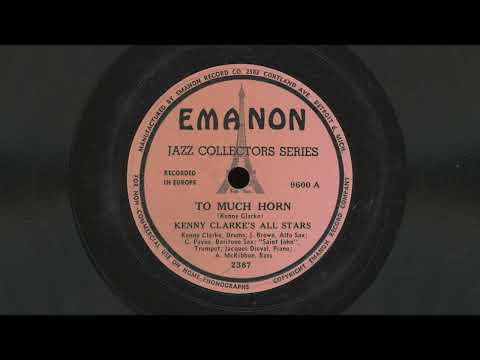
Of the track “Too Much Horn” (misspelled on the label), Down Beat awarded the record two out of four eight notes – a designation it described as “Tepid”. Despite this, they sorta dug the track, writing, “[Horn] comes on at a flash tempo, and if those are European cats, they get around on their horns pretty good.”
The label credits “Saint John” on trumpet, which is very likely a pseudonym for John “Dizzy” Gillespie. Sure sounds like him – what do you think?
Recorded in Paris, France circa March of 1948. Released as Emanon 9600.
Alto Saxophone – John Brown Baritone Saxophone – Cecil Payne Trumpet – Saint John (Probably an alias for Dizzy Gillespie) Piano – Jacques Dieval Bass – Al McKibbon Drums – Kenny Clarke
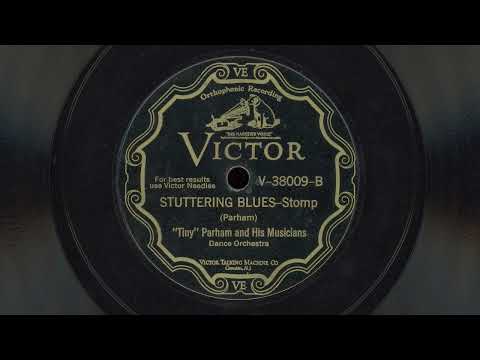
A wonderful classic of 20s jazz from a Chicago band fronted by Canadian-born pianist Hartzell Strathdene “Tiny” Parham. Excellent solos abound – including a stompin’ tuba solo by Quinn Wilson and a rollicking banjo solo from bluesman Papa Charlie Jackson.
What a tragedy of American music that Parham’s career was so short. It makes the celebration and appreciation of gems like “Stuttering Blues” all the more important.
Recorded in Chicago, Illinois on July 2, 1928 Originally released as Victor V-38009 and later reissued as Bluebird B-8130.
0:00 Intro 0:10 Brief piano solo (Parham) followed by clarinet solo (Johnson) 0:44 Cornet solo (Miller) 1:06 Banjo solo (Jackson) 1:28 Clarinet solo (Johnson) 1:50 Tuba solo (Wilson) 2:13 Ensemble playing 2:35 Cornet outro
Credits Tiny Parham – piano, director Punch Miller – cornet Charles Lawson – trombone Charles Johnson – clarinet, alto sax Papa Charlie Jackson – banjo Quinn Wilson – tuba Ernie Marrero – drums