Jazz Crazy Records

An Archive of Early Jazz on 78 RPM

Author: Professor M

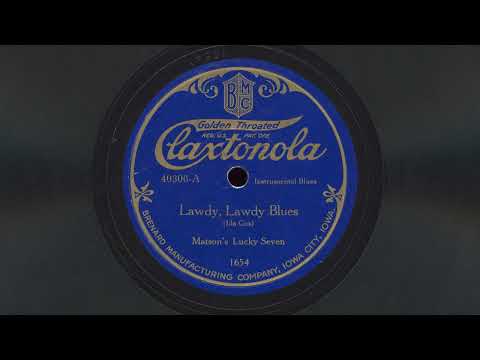
  • “Lawdy Lawdy Blues” – Matson’s Lucky Seven (1924)

    “Lawdy Lawdy Blues” – Matson’s Lucky Seven (1924)

    A scarce session by pianist Charles Matson’s band – the last record released under his name. Matson did a few sessions accompanying blues singers Clara Smith and Billie Wilson in 1924, but did not record again after that – though he remained involved with the music industry in New York City as a bandleader, booking agent and Secretary of the New York Musical Union.

    Matson was born in Wisconsin and his wife Ruth was born in Iowa – this recording was licensed from Paramount by the Iowa City-based Brenard Manufacturing Company, who released it on their Claxtonola label.

    An excellent write-up on Matson’s life and career can be found at:
    https://grammophon-platten.de/page.php?579

    Recorded in New York City in January 1924.
    Released as Claxtonola 40306.
    Also released as Paramount 20306 and Puritan 11306.

    Credits:
    Charles Matson, p, a, dir:
    Unknown Artist – cornet
    Unknown Artist – cornet
    John Mayfield (?) – trombone
    Ernest Elliott (?) – clarinet, alto saxophone
    Sam Speed (?) – banjo
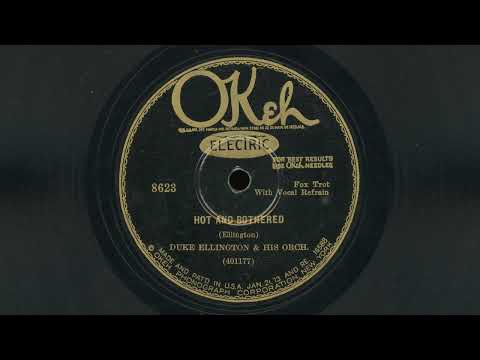
  • “Hot and Bothered” – Duke Ellington and his Orchestra (1928)

    “Hot and Bothered” – Duke Ellington and his Orchestra (1928)

    A scorcher by the Ellington band from 1928 – an altered version of Tiger Rag. Hot and bothered, indeed!

    Recorded in New York City on October 1, 1928.
    Released as Okeh 8623.

    Credits
    Duke Ellington – piano, arranger, director
    Bubber Miley, Arthur Whetsel – trumpet
    Joe Nanton – trombone
    Johnny Hodges – clarinet, soprano sax, alto sax
    Harry Carney – clarinet, alto sax, baritone sax
    Barney Bigard – clarinet, tenor sax
    Fred Guy – banjo
    Lonnie Johnson – guitar
    Wellman Braud – string bass
    Sonny Greer – drums
    Baby Cox – vocals

  • “Ding Dong Blues” – Bennie Moten’s Kansas City Orchestra (1927)

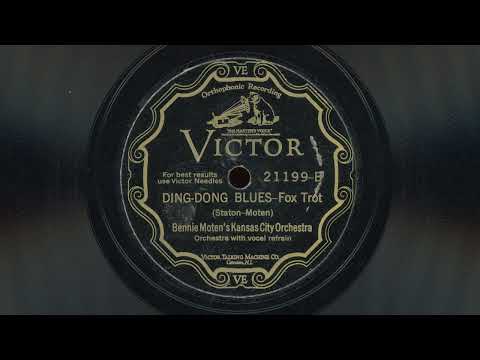
    “Ding Dong Blues” – Bennie Moten’s Kansas City Orchestra (1927)

    Another of the many excellent sides recorded by the Kansas City-based Bennie Moten orchestra on the Victor label.

    This is the B-side to “Pass Out Lightly” – which I also enjoyed so much that I had to post both sides.

    Side A: “Pass Out Lightly”
    https://youtu.be/nVWptpf4Dv0

    This piece has some excellent solos, as well as an intriguing and lively hummed vocalization section that appears at the 1:55 mark – accompanied by what sounds like a kazoo or perhaps a paper and comb.

    Recorded in Chicago, Illinois on June 12, 1927.
    Released as Victor 21199.

    Credits
    Bennie Moten – piano, director
    Ed Lewis, Paul Webster – cornet
    Thamon Hayes – trombone
    Harlan Leonard – clarinet, soprano sax, alto sax
    Jack Washington – clarinet, alto sax, baritone sax
    Woody Walder – clarinet, tenor sax
    LaForest Dent – alto sax, tenor sax
    Leroy Berry – banjo
    Vernon Page – tuba
    Willie McWashington – drums

  • “Pass Out Lightly” – Bennie Moten’s Kansas City Orchestra (1927)

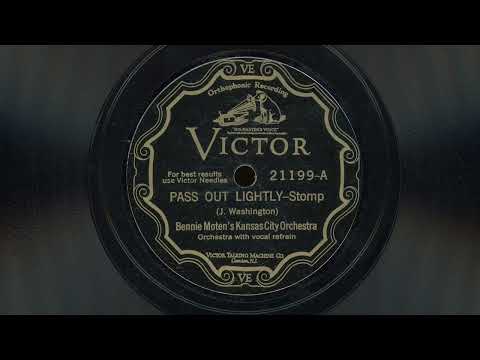
    “Pass Out Lightly” – Bennie Moten’s Kansas City Orchestra (1927)

    One of the many excellent sides recorded by the Kansas City-based Bennie Moten orchestra on the Victor label.

    After leaving the Okeh label at the end of 1926, the Moten band signed a contract with the larger Victor label.

    The band held auditions in Kansas City to augment its membership and to replace a few band members. Leroy Berry and Willie McWashington became the new rhythm section on banjo and drums, respectively – and the pair continued with Moten’s orchestra through 1932. You can really appreciate the power of the banjo in jazz listening to this track – which finds Leroy Berry adding a real sense of adventure to the tune with his playing.

    They also hired a new arranger, Jesse Stone (who later went on to a long and celebrated career as an arranger, bandleader, and songwriter) who found his job difficult, noting in an interview in 1977 that “These guys all played by ear… I was capable of writing the parts, but no one was capable of reading. So I had to sing the parts… I would sing a riff and then the group would learn that riff.”

    I find that the Moten band’s improvised style of this period, free from the stiff confines of precisely written arrangements, is quite fun to listen to – and no doubt was a hit with dancers of the time.

    Recorded in Chicago, Illinois on June 12, 1927.
    Released as Victor 21199.

    Credits
    Bennie Moten – piano, director
    Ed Lewis, Paul Webster – cornet
    Thamon Hayes – trombone
    Harlan Leonard – clarinet, soprano sax, alto sax
    Jack Washington – clarinet, alto sax, baritone sax
    Woody Walder – clarinet, tenor sax
    LaForest Dent – alto sax, tenor sax
    Leroy Berry – banjo
    Vernon Page – tuba
    Willie McWashington – drums

  • हारमोनियम तर्ज – कर्नाटकी / ठुमरी – S. P. Rane – Harmonium and Tabla – HMV N.1572

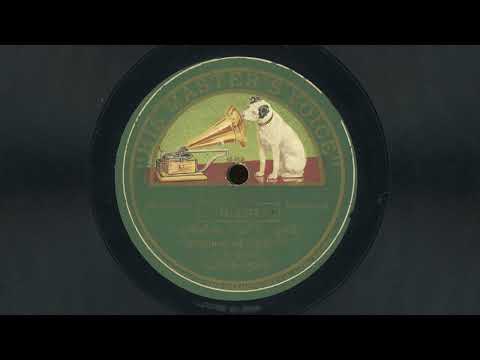
    हारमोनियम तर्ज – कर्नाटकी / ठुमरी – S. P. Rane – Harmonium and Tabla – HMV N.1572

    Suryakant Pandurang Rane was born in Bombay, India in 1895. This early recording features Mr. Rane playing harmonium accompanied by a tabla.

    He later went on to serve as musical director for over 15 Bollywood films from 1931 to 1936.

    The matrices on this green label HMV are from the Gramophone Concert Record label – so this is likely a reissue of an earlier GCR release.

    This video includes both sides of this very enjoyable performance.

    हारमोनियम तर्ज – कर्नाटकी / ठुमरी
    Harmonium Tarj – Karnataki / Thumri

    Released as HMV N.1572.

  • “Doin’ The Uptown Lowdown” – Joe Venuti and his Blue Six (1933)

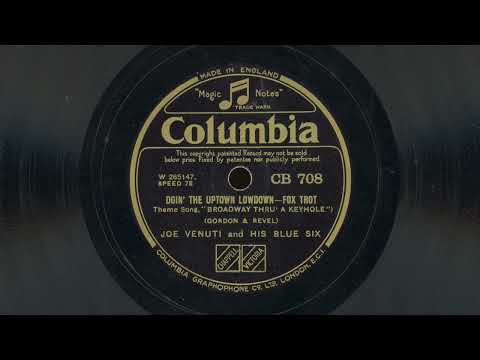
    “Doin’ The Uptown Lowdown” – Joe Venuti and his Blue Six (1933)

    A hot number featuring an all-star cast of performers!

    Hot impassioned solos abound and clip by at a frenetic pace to give everyone a moment in the spotlight.

    0:00 Intro
    0:13 Clarinet solo (Benny Goodman)
    0:32 Tenor sax solo (Bud Freeman)
    0:42 Clarinet solo (Benny Goodman)
    0:54 Violin solo (Joe Venuti)
    1:13 Piano solo (Joe Sullivan)
    1:23 Violin solo (Joe Venuti)
    1:32 Bass sax solo (Adrian Rollini)
    1:50 Tenor sax solo (Bud Freeman)
    2:08 Clarinet solo (Benny Goodman)
    2:26 Violin solo (Joe Venuti)
    2:44 Guitar solo (Dick McDonough)
    2:54 Outro

    Recorded in New York City on October 2, 1933.
    Released in the UK as Columbia CB 708.

    Credits
    Benny Goodman – clarinet
    Bud Freeman – tenor sax
    Adrian Rollini – bass sax
    Joe Venuti – violin
    Joe Sullivan – piano
    Dick McDonough – guitar
    Neil Marshall – drums

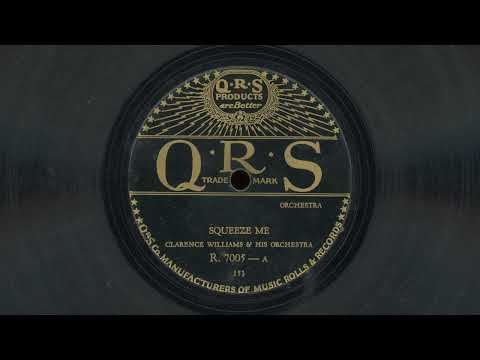
  • “Squeeze Me” – Clarence Williams & His Orchestra (1928)

    “Squeeze Me” – Clarence Williams & His Orchestra (1928)

    Clarence Williams’ many sessions with the QRS label are some of my favorite recordings in jazz history. The quality of the recordings, small combo arrangements, and excellent performances are quite unique. While Williams recorded no fewer than 46 sides with QRS – a label that only issued 92 total records – they are quite scarce and hard to find.

    Recently I was lucky enough to acquire this beautiful record – both sides from Williams’ first session with QRS in August of 1928.

    “Squeeze Me” is a languidly sensual love song – and the performances here are as elegant as they are sultry. Cyrus St. Clair is wonderfully present on tuba, keeping a relaxed pace while Williams’ light touch on the piano and Leroy Harris’ banjo gingerly fill out the rhythm section.

    The first solo we hear is from Ed Allen on cornet, a muted wah-filled plaintive pleading, book-ended by Cyrus’s. Then comes one of the most unexpected trombone solos – I had to check the speed on my turntable for fear I had slowed the speed down – and Ed Cuffee delivers a sleepy surprise, taking his time to lay out the pillow talk before an unknown tenor sax (Ben Waters?) cajolingly delivers the final wooing.

    0:00 Intro
    0:44 Cornet solo (Ed Allen)
    1:28 Tuba solo (Cyrus St. Clair)
    1:49 Trombone solo (Ed Cuffee)
    2:09 Tenor sax solo (Ben Waters?)
    2:30 Ensemble

    Recorded in the Gennett Records studio in Long Island City, New York in August 1928.

    Credits
    Ed Allen, Joe Oliver – cornet
    Ed Cuffee – trombone
    Clarence Williams – piano
    Cyrus St. Clair – tuba
    Leroy Harris – banjo
    Unknown Artist – clarinet, alto sax (Arville Harris?)
    Unknown Artist – clarinet, tenor sax (Ben Waters?)

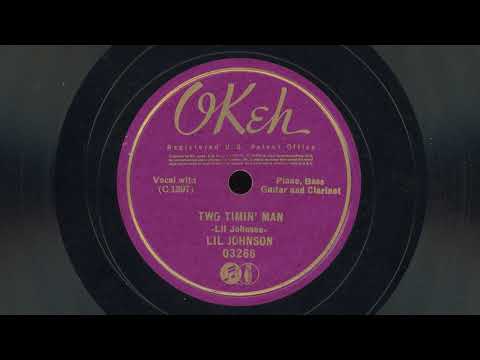
  • “Two Timin’ Man” – Lil Johnson (1936)

    “Two Timin’ Man” – Lil Johnson (1936)

    A rousing tune from Lil Johnson accompanied by an excellent group of Chicago performers.

    Recorded in Chicago, Illinois on June 11, 1936.
    Released as Vocalion 03266, Okeh 03266, Columbia 30059 and 37682..

    Credits
    Lil Johnson – vocals
    Arnett Nelson – clarinet
    Black Bob – piano
    Big Bill Broonzy – guitar
    Unknown Artist – bass (perhaps Bill Settles)?
    Unknown Artist – drums

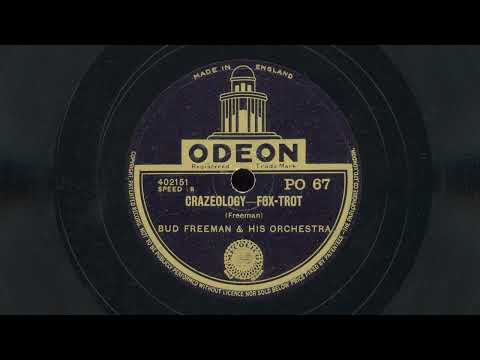
  • “Crazeology” – Bud Freeman and his Orchestra (1928)

    “Crazeology” – Bud Freeman and his Orchestra (1928)

    After recording with Red McKenzie and Jimmy McPartland in 1927 and Ben Pollack’s orchestra and Wingy Mannone in 1928, tenor saxophonist Bud Freeman recorded these two sides for Okeh in December of 1928.

    “Here, in raw form, is the foundation of the mature Freeman style: there is a new ease with arpeggiated phrases; delivered on the beat and stitched together with triplets; he’d begun to work out little variations – altered notes, chordal superimpositions, characteristic runs and rhythms.” – Richard Sudhalter, “Lost Chords”, p. 244

    The tune’s title, an original Freeman composition, usually appears hyphenated as “Craze-ology” or “Craze-O-Logy”, but here appears as one uninterrupted word.

    Recorded in Chicago, Illinois on December 3, 1928.
    Released domestically as Okeh 41168 and master-pressed in the U.K. as Odeon PO 67.

    Credits
    Johnny Mendel – trumpet
    Floyd O’Brien – trombone
    Bud Jacobson – clarinet
    Bud Freeman – tenor sax
    Dave North – piano
    Norman Foster – banjo
    John Mueller – string bass
    Gene Krupa – drums

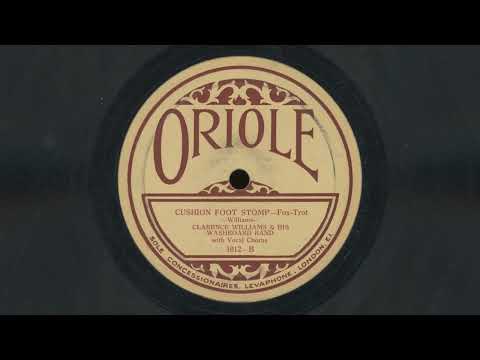
  • “Cushion Foot Stomp” – Clarence Williams & his Washboard Band (1927)

    “Cushion Foot Stomp” – Clarence Williams & his Washboard Band (1927)

    Clarence Williams’ distinctive tune “Cushion Foot Stomp” was recorded a number of times in March and April of 1927 by various incarnations of Williams groups – but this appears to be the first recording – and features an unidentified performer who has kept discographers guessing for many years.

    The lyrics are quick witty observations and rejoinders in reference to a dance called the “Cushion Foot Stomp”.

    “Blue note to note, Weird chords: Lord, Lord!”

    The ensemble playing here is excellent – following a 12-bar blues extended to 24 bars. The cornet, clarinet, and alto saxophone effortlessly exchange roles within the harmony, melodic lines, and fills to develop an exuberantly lively dance tune that certainly is worthy of the name.

    “Hot Stuff! No Bluff! Red Hot! Sure, Pop!”

    This take is one of two recorded on March 8 as matrix E-21786. The second take, matrix E-21787, was released as Brunswick 7000 and on the dubbed U.K. Vocalion reissue V.1034.

    Tom Lord makes the case that the vocalist here is the same vocalist known as Shufflin’ Sam who recorded “Cushion Foot Stomp” with Williams and his “Dixie Washboard Band” on a Columbia session on March 10. As viewer @MikeThomas78 noted in the comments, Brian Rust identified Clarence Lee as the vocalist on this session and as the true identity of Shufflin’ Sam.

    The clarinetist and alto saxophonist has been identified as Bennie Moten, Ben Waters, and Carmelo Jari.

    Recorded in New York City on March 8, 1927.
    Released as Vocalion 1088 in the U.S. and Oriole 1012 in the U.K.

    Credits:
    Clarence Williams – piano
    Ed Allen – cornet
    Floyd Casey – washboard
    Unknown Artist – clarinet, alto saxophone
    Unknown Artist – vocals