Jazz Crazy Records

An Archive of Early Jazz on 78 RPM

Author: Professor M

  • “When the Saints Come Marching In” – Four Harmony Kings (1924)

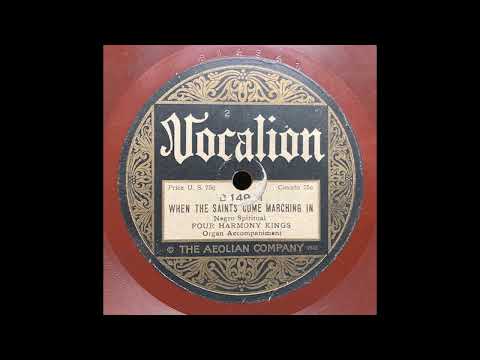
    “When the Saints Come Marching In” – Four Harmony Kings (1924)

    The vocal quartet Four Harmony Kings was formed in 1916 by bass William Hann. Other members included William Howard Berry, Charles Exodus Drayton and Ivan Harold Browning.

    They met and recorded with James Reese Europe in 1919 just before his untimely death. In the summer of 1921 they performed in the all-black Broadway musical “Shuffle Along” – where they briefly included in their quartet a young Paul Robeson when Hann briefly fell ill. “Shuffle Along” toured the US in 1923 and 1924 – and this Vocalion session was recorded just after the tour concluded.

    Recorded in mid-November 1924.
    Released as Vocalion 14941 in 1925.

    References:

    “Lost Sounds: Blacks & The Birth of the Recording Industry, 1890 – 1919” – Tim Brooks

    Review of Shuffle Along and the Saga of the Four Harmony Kings: Group Harmony Pioneers:
    http://classicurbanharmony.net/2016/05/10/review-of-shuffle-along-and-the-saga-of-the-four-harmony-kings-group-harmony-pioneers/
  • “Roaming Rambler Blues” – Lonnie Johnson (1927)

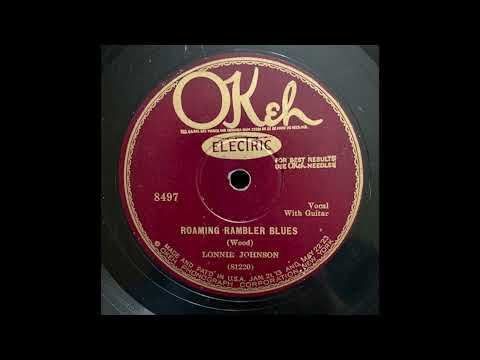
    “Roaming Rambler Blues” – Lonnie Johnson (1927)

    Classic early blues by guitarist Lonnie Johnson.

    This record had so many lam cracks that it causes a bit of a swish but still quite an enjoyable listen.

    Recorded August 1927 in New York. Released as Okeh 8497.

    Lyrics
    “I’m a roamin’ rambler – I ramble and roam everywhere.
    I’m a roamin’ rambler – I roam and ramble everywhere.
    I’ve rode on every railroad without a nickel fare.

    My mammy named me Rambler, I’ll tell you why I was told
    My mammy named me Rambler, I’ll tell you why I was told
    Because I started to ramblin’ when I was only two years old.

    I got a gal in Texas. I got gals in Tennessee.
    I’ve got gals in Texas. I’ve got gals in Tennessee.
    There’s a hundred those fastened, waitin’ for this rambler’s key.

    I never had a woman I couldn’t get her back again.
    I never had a woman I couldn’t get her back again.
    Cause they want a ramblin’ man – and not no monkey men.

    The judges all knows me – knows me as a ramblin’ man.
    The judges all knows me – knows me as a ramblin’ man.
    When they put me in jail, I gets out on a ‘stallments plan.”

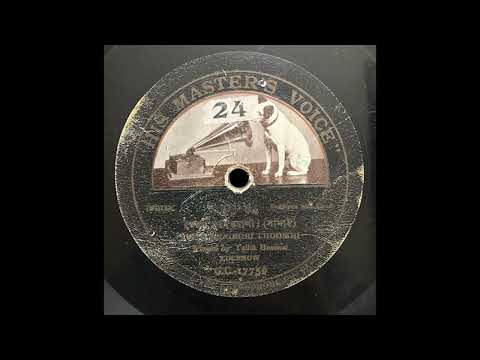
  • “Bhairobi Thoomri” – Talim Hossein – Shehnai with sruti box – 78 rpm

    “Bhairobi Thoomri” – Talim Hossein – Shehnai with sruti box – 78 rpm

    This beautiful classical raga by Talim Hossein features the meditative drone of a shehnai with a sruti box drone (inaccurately referred to at the time of issue as “Indian Bagpipes”) with drums. The title “Bhairobi Thoomri” includes the raga name (Bharavi) and type of song (thumri).

    Released as HMV P. 64 (Mx 17756) in 1916.

    “In late 1915, the best selling titles in Indian repertoire of The Gramophone Co., Ltd., were issued with the His Master’s Voice (HMV) label, including the words and picture. The HMV label introduced a new double-face number series that began with P-1 for 10″ discs. With the first release of the P-series of January 1916, were some one thousand three hundred double-sided discs that had been previously issued.”
    from “Reading Indian Record Labels” by Michael S. Kinnear

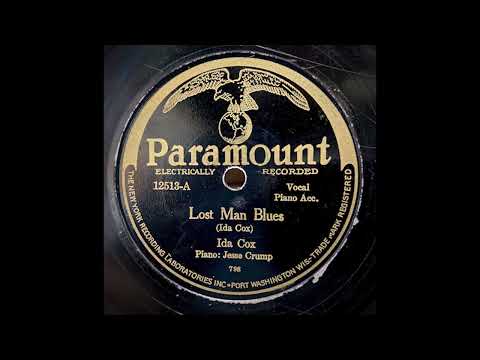
  • “Lost Man Blues” – Ida Cox (1927)

    “Lost Man Blues” – Ida Cox (1927)

    Recorded in July, 1927 in Chicago.
    Released as Paramount 12513

    Credits
    Ida Cox – Vocals
    Jesse Crump – Piano

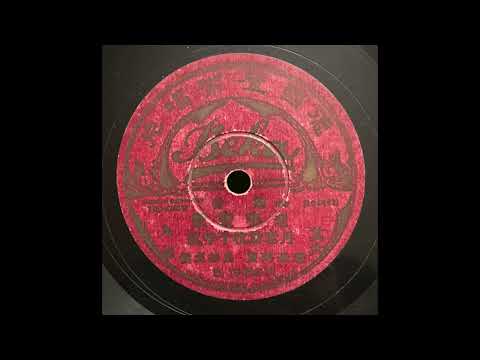
  • 月老翁收千年鳳九連 – 老賽寶豐 (~1920s) Chaoju 潮剧 Teochew Opera Music

    月老翁收千年鳳九連 – 老賽寶豐 (~1920s) Chaoju 潮剧 Teochew Opera Music

    (Yue Lao capture the thousand years old dragon Part 9)

    烏衫(female role) and 老丑(clown role) are difficult to decipher.

    Troupe is Lao Sai Bao Feng (老賽寶豐), also known as Lao Sai Bao Feng Ban (老賽寶豐班).

    Beka B.19856 V and VI
    Mx 104442
    78 rpm record

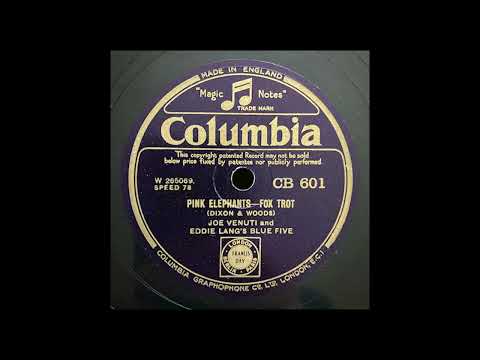
  • “Pink Elephants” – Joe Venuti and Eddie Lang’s Blue Five (1933)

    “Pink Elephants” – Joe Venuti and Eddie Lang’s Blue Five (1933)

    “Pink Elephants” by Joe Venuti and Eddie Lang’s Blue Five on a UK-only release that was recorded on February 14, 1933 and released as Columbia CB 601.

    This one is pretty special – as California Ramblers frontman Adrian Rollini joins in on four instruments: bass sax, vibes, piano, and the infamous goofus. Jimmy Dorsey, not to be outdone, can be heard on clarinet, alto sax, and trumpet (listen to the last ten seconds of the second clip)!

    Venuti takes a short solo at the end and Lang just rips up the rhythm throughout. Tragically – a little over a month later, Lang would die in the hospital of complications during a tonsillectomy operation.

    My copy is quite clean – but suffers from blasting and noticeable distortion on louder transients.

    Credits:
    Joe Venuti – violin
    Eddie Lang – guitar
    Adrian Rollini – bass sax, vibes, goofus, piano
    Jimmy Dorsey – clarinet, alto sax, trumpet
    Phil Wall – piano

  • Does Condition Matter? Comparing a worn 78 rpm record to a pristine copy

    Does Condition Matter? Comparing a worn 78 rpm record to a pristine copy

    Listen and tell me what you think in the comments!

    When many people think of 78 rpm records, they think of scratchy worn records that sound quite poor. It is important not to judge these records on that dirty worn copy of Paul Whiteman’s “Whispering” that has been overplayed with dull needles and then sat unsleeved in your great grandfather’s basement in a bin with sandpaper and loose nails.

    In this video, I compare digital transfers of a very worn and beat record to a rather pristine (though not perfect) copy of the same record.

    You’ll alternately hear copies of Columbia A-3978: “Memphis Tennessee” composed by Perry Bradford as performed by The Gulf Coast Seven.

    Using the VJM grading scale, first we’ll hear a G/G+ copy, which you will recognize in the video by its worn label and scratched surface.

    A “G+” grade is used to describe a record that is “Grey throughout but still serviceable. Music begins to sound muffled. Heavy scratches.” A “G” grade is used to describe a record that is “quite seriously worn and scratched, but music level is still higher than surface noise.”

    Then we’ll hear an E copy of the same record. The E copy has a pristine label and shiny smooth surface.

    An “E” grade indicates the record is “still very shiny, near new looking, with no visible signs of wear, but a few inaudible scuffs and scratches.”

    Columbia A-3978 was recorded on August 7, 1923 in New York.

    Credits:
    Gus Aiken, unknown artist – cornet
    Bud Aiken – trombone
    ? Garvin Bushell – clarinet
    Ernest Elliott – clarinet, tenor sax
    Leroy Tibbs – piano
    Sam Speed – banjo

    VJM Grading Scale
    https://www.vjm.biz/grading.html

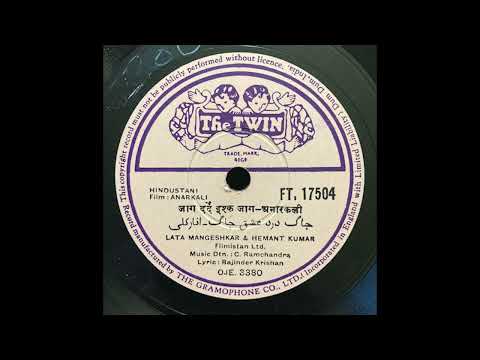
  • “Jaag Dard E Ishq Jaag” (जाग दर्द ए इश्क़ जाग) from Anarkali

    “Jaag Dard E Ishq Jaag” (जाग दर्द ए इश्क़ जाग) from Anarkali

    This song from the soundtrack of the Hindi film Anarkali (1953) is a duet written by C Ramachandra and sung by Lata Mangeshkar and Hemant Kumar.

    Anarkali is the tragic story of star-crossed lovers Prince Salim and court dancer Anarkali, who fall in love but are forbidden to marry by the Prince’s father, the Emperor.

    Released as The Twin FT. 17504 in 1953.

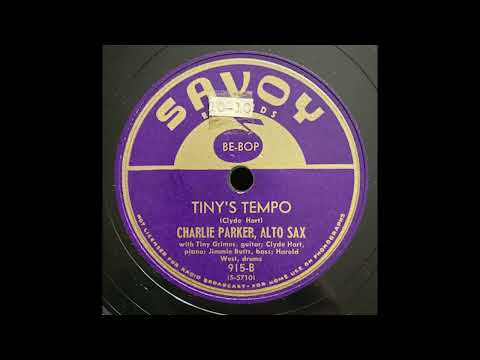
  • “Tiny’s Tempo” – Charlie Parker (1944)

    “Tiny’s Tempo” – Charlie Parker (1944)

    A very early recording of Bird on Savoy: “Tiny’s Tempo” was originally recorded and released in 1944 as Savoy 526 under the name “Tiny Grimes Quintette”. In 1948 this same take was reissued as Savoy 915 under Charlie Parker’s name.

    Credits
    Charlie Parker – alto sax
    Tiny Grimes – guitar
    Clyde Hart – piano
    Jimmie Butts – bass
    Harold West – drums

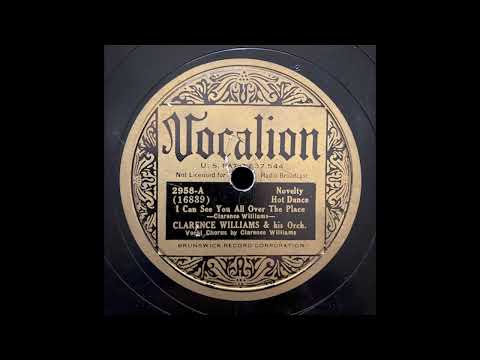
  • “I Can See You All Over The Place” – Clarence Williams (1935)

    “I Can See You All Over The Place” – Clarence Williams (1935)

    A lovely inverted label Vocalion that finds the charming Clarence Williams languidly singing a new tune that biographer Tom Lord notes seems to be based on a reworking of the chord structure of “Squeeze Me”, which he co-wrote with Fats Waller and first recorded nearly ten years before. While it isn’t the “hot dance” number the label claims, I find it quite enjoyable.

    “Oh If I’m dreamin’, please let me dream”

    Recorded in New York on February 9, 1935.
    Released as Vocalion 2958.

    Credits
    Clarence Williams – piano, vocals
    Ed Allen – cornet
    Cecil Scott – clarinet, tenor sax
    Roy Smeck (?) – guitar
    Cyrus St. Clair (or Richard Fullbright) – tuba