Jazz Crazy Records

An Archive of Early Jazz on 78 RPM

Category: African

  • “Ngilekowo” – Francis Humplick and his Sisters (late 1950s)

    “Ngilekowo” – Francis Humplick and his Sisters (late 1950s)

    Francis Humplick was a Tanzanian guitarist, singer, and songwriter who recorded extensively in the late 1950s for African labels such as Gallotone, Troubadour, and His Master’s Voice.

    Humplick’s gentle fingerstyle guitar technique and his almost conversational singing style are distinctive and immediately endearing. His two sisters Mary and Thecla provided lovely vocal harmonies and background vocals.

    Not much is known about this beautiful song delivered in Chaga.

    In 2020, Mississippi Records released a beautiful reissue of transfers which I highly recommend:
    https://mississippirecords.bandcamp.com/album/frank-and-his-sisters

    Recorded in the late 1950s.
    Released as Troubadour BZ.1243.

    Credits:
    Francis Joseph Humplick – guitar, vocals
    Mary Regina Humplick, Thecla Clara Humplick – vocals

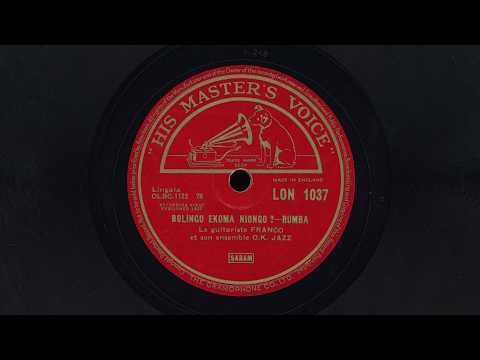
  • “Bolingo Ekoma Niongo ?” – Le Guitariste Franco et son ensemble O.K. Jazz (1957)

    “Bolingo Ekoma Niongo ?” – Le Guitariste Franco et son ensemble O.K. Jazz (1957)

    Well, it’s my birthday today so I decided to pick something to cheer me up amidst all the chaos in the world caused by the evil that men do.

    So here is a Congolese rumba record that is sure to brighten your day featuring Franco, the “guitarist who makes the hearst of women spin”, and accompanied by the renowned O.K. Jazz. Originally released on the Loningisa label, this reissue on the HMV label is a good example of the many excellent titles from the Loningisa catalog that the LON series made available.

    The title roughly translates to “Has love turned into suffering?”.

    At the end of 1956, O.K. Jazz member Henri Bowane had left the Loningisa label “feeling neglected”, and in January of 1957, he poached O.K. Jazz members Jean Serge Essous and Philippe “Rossignol” Lando, who represented a third of the band, to the rival Esengo label. The remaining members of O.K. Jazz regrouped around guitarist Franco, who also composed many of the group’s songs.

    Recorded in Léopoldville, Belgian Congo on June 21, 1957.
    Released as His Master’s Voice LON 1037.
    Originally released as Loningisa No. 182.

    Credits:
    Franco (François Engbondu) – guitar
    Vicky Longomba, Edo Ganga – vocals
    Brazzos – guitar
    De La Lune – bass
    Célestin Kouka – maracas
    Nicolas “Dessoin” Bosuma – drums

    Source:
    Rumba on the River: A History of the Popular Music of the Two Congos by Gary Stewart

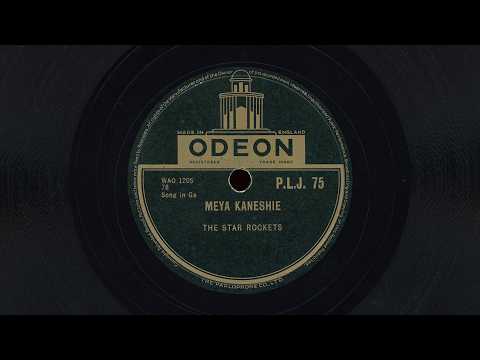
  • “Meya Kaneshie” – The Star Rockets (mid-to-late 1950s) Highlife from Ghana 🇬🇭

    “Meya Kaneshie” – The Star Rockets (mid-to-late 1950s) Highlife from Ghana 🇬🇭

    A recording made for the Union Trade Company (UTC), a Swiss trading company, in the Gold Coast of Africa. The PLJ series comprises recordings made for this company by EMI and released on the Odeon label. Recordings were made in the mid 1930s and mid 1950s. I believe this disc was from the mid to late 1950s. UTC was a well-known brand in Ghana and continued to operate there until its closure in 1999.

    This group, The Star Rockets, appears to be from Ghana based upon the language recorded in (Twi and Ga). Gentle rhythms – sounding a bit melancholy on this side – are punctuated by melodic horn riffs and a male vocalist. A plaintive guitar at 0:24 issues a clarion call that merits response from the rest of the band. A muted wah trumpet at 1:43 provides a moment of Latin-fused melody full of unhurried vitality.

    The title, “Meya Kaneshie” seems to reference a visit to the Kaneshie neighborhood in Accra, known for its market.

    Believed to have been recorded in Ghana in the mid-to-late 1950s.
    Released as Odeon PLJ 75.

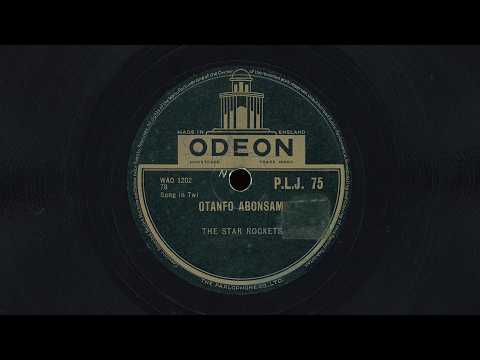
  • “Otanfo Abonsam” – The Star Rockets (mid-to-late 1950s) Highlife from Ghana 🇬🇭

    “Otanfo Abonsam” – The Star Rockets (mid-to-late 1950s) Highlife from Ghana 🇬🇭

    A recording made for the Union Trade Company (UTC), a Swiss trading company, in the Gold Coast of Africa. The PLJ series comprises recordings made for this company by EMI and released on the Odeon label. Recordings were made in the mid 1930s and mid 1950s. I believe this disc was from the mid to late 1950s. UTC was a well-known brand in Ghana and continued to operate there until its closure in 1999.

    This group, The Star Rockets, appears to be from Ghana based upon the language recorded in (Twi and Ga). Gentle upbeat rhythms are punctuated by melodic horn riffs and a female vocalist.

    The calm atmosphere created by this music stands in contrast to the title, “Otanfo Abonsam” seems to translate roughly as “My enemy is a demon”. Not a literal demon, but simply someone possessed by malevolence: a malicious rival or a former friend who has done you harm.

    Believed to have been recorded in Ghana in the mid-to-late 1950s.
    Released as Odeon PLJ 75.

  • “Bongo Mabe ?” – Laurent Batubenge (1956) Rumba Congolaise 🇨🇩

    “Bongo Mabe ?” – Laurent Batubenge (1956) Rumba Congolaise 🇨🇩

    A wonderful Congolese rumba by guitarist Laurent Batubenge on the immortal Ngoma label.

    The title roughly translates as “Is it really this bad?”.

    Recorded in Léopoldville, Belgian Congo on April 20, 1956.
    Released as Ngoma 1768.

    Credits:
    Laurent Batubenge – guitar, vocals
    Unknown artists – 2nd guitar, saxophone, maracas, bass, tam-tams, vocals

    The flip side of this record can be heard at:
    https://youtu.be/6y4ogH3hiIQ

    Sources:
    https://afrodisc.com/central-africa/ngoma-1000-2274-78-rpm/ngoma-1700-1799/

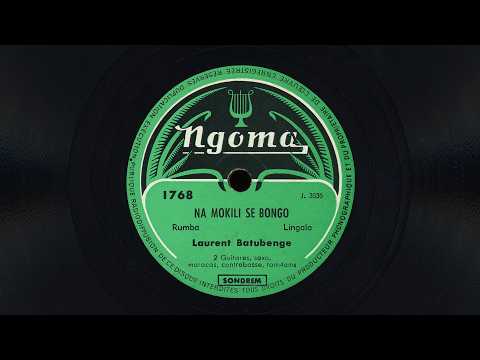
  • “Na Mokili Se Bongo” – Laurent Batubenge (1956) Rumba Congolaise 🇨🇩

    “Na Mokili Se Bongo” – Laurent Batubenge (1956) Rumba Congolaise 🇨🇩

    A wonderful Congolese rumba by guitarist Laurent Batubenge on the immortal Ngoma label.

    The title roughly translates as “Such is the way of the world”.

    Recorded in Léopoldville, Belgian Congo on April 20, 1956.
    Released as Ngoma 1768.

    Credits:
    Laurent Batubenge – guitar, vocals
    Unknown artists – 2nd guitar, saxophone, maracas, bass, tam-tams, vocals

    The flip side of this record can be heard at:
    https://youtu.be/AT2BseQZrSs

    Sources:
    https://afrodisc.com/central-africa/ngoma-1000-2274-78-rpm/ngoma-1700-1799/

  • “Via Laria” – Le Guitariste Cromwell (~1953)

    “Via Laria” – Le Guitariste Cromwell (~1953)

    Cameroonian guitarist Cromwell Nzié recorded this Marche with the Opika label in what is now called Kinshasa, Democratic Republic of the Congo.

    “Le Guitariste Cromwell”, is the brother of popular singer Anne-Marie Nzié, the “Golden Voice of Cameroon” ( “La Voix d’Or du Cameroun”). Cromwell reportedly taught Anne-Marie to play guitar while she was bedridden with a broken leg. In the 1950s, Cromwell was “widely popular and received a great deal of radio airplay.”

    In 1963, the two participated in a guitar contest organized by a German musician that included many popular guitarists of the time. Anne-Marie won the contest – a success that “restarted her musical career [and] led her to becoming the most popular female singer in the newly founded Republic of Cameroon.”

    This song is in the Ngoumba language, spoken by a population originating from Kribi and Lolodorf, in southern Cameroon. Unfortunately, this makes translation somewhat difficult, as Ngoumba is not a widely spoken language.

    Recorded in Léopoldville, Belgian Congo circa 1953-54.
    Released as Opika 1069.

    Credits:
    Cromwell Ndzie Moise – guitar, vocals

    Sources:
    BRUNNER, ANJA. “THE SINGER ANNE-MARIE NZIÉ AND THE SONG ‘LIBERTÉ’: ON POPULAR MUSIC AND THE POSTCOLONIAL STATE IN CAMEROON.” African Music, vol. 9, no. 3, 2013, pp. 40–58. JSTOR, http://www.jstor.org/stable/24877314. Accessed 4 Feb. 2026.

  • “Mekwa Mintunga” – Le Guitariste Cromwell (~1953)

    “Mekwa Mintunga” – Le Guitariste Cromwell (~1953)

    Cameroonian guitarist Cromwell Nzié recorded this Assiko with the Opika label in what is now called Kinshasa, Democratic Republic of the Congo.

    “Le Guitariste Cromwell”, is the brother of popular singer Anne-Marie Nzié, the “Golden Voice of Cameroon” ( “La Voix d’Or du Cameroun”). Cromwell reportedly taught Anne-Marie to play guitar while she was bedridden with a broken leg. In the 1950s, Cromwell was “widely popular and received a great deal of radio airplay.”

    In 1963, the two participated in a guitar contest organized by a German musician that included many popular guitarists of the time. Anne-Marie won the contest – a success that “restarted her musical career [and] led her to becoming the most popular female singer in the newly founded Republic of Cameroon.”

    This song is in the Ngoumba language, spoken by a population originating from Kribi and Lolodorf, in southern Cameroon. Unfortunately, this makes translation somewhat difficult, as Ngoumba is not a widely spoken language.

    The vocals on this track sound impassioned – as though they wish to urgently communicate a strong message.

    Recorded in Léopoldville, Belgian Congo circa 1953-54.
    Released as Opika 1069.

    Credits:
    Cromwell Ndzie Moise – guitar, vocals

    Sources:
    BRUNNER, ANJA. “THE SINGER ANNE-MARIE NZIÉ AND THE SONG ‘LIBERTÉ’: ON POPULAR MUSIC AND THE POSTCOLONIAL STATE IN CAMEROON.” African Music, vol. 9, no. 3, 2013, pp. 40–58. JSTOR, http://www.jstor.org/stable/24877314. Accessed 4 Feb. 2026.

  • “Pilipili Yasipo Kula” – Mwenda Jean Bosco – Beautiful African Guitar 🎸

    “Pilipili Yasipo Kula” – Mwenda Jean Bosco – Beautiful African Guitar 🎸

    Beautiful fingerstyle guitar work by the master of the style, Congolese artist Mwenda Jean Bosco.

    The title translates loosely to “If You Don’t Eat the Chili”, and the song seems to have a strong moral message about avoiding behavior that could have negative consequences.

    Pilipili yasipo kula inakuahana gani?
    If you don’t eat chili, how can it burn you?

    Believed to have been recorded circa 1958.
    Released as Gallotone CO.200.

    Credits:
    Mwenda Jean Bosco – guitar, vocals
    Unknown Artist – percussion

  • “Bembeleza Mapendo” – Mwenda Jean Bosco – Beautiful African Fingerstyle Guitar 🎸

    “Bembeleza Mapendo” – Mwenda Jean Bosco – Beautiful African Fingerstyle Guitar 🎸

    Beautiful fingerstyle guitar work by the master of the style, Congolese artist Mwenda Jean Bosco.

    The title translates loosely to “Soothing Love” and the lyrics give relationship advice and moral guidance to women that reflect gendered norms such as humility, emotional labor, and loyalty.

    Kama anasirika we mama humupeze
    If he is angry, calm him down.

    Kama ya panacheka we mama rudisha tena
    If he is not smiling, make him smile again

    Kama uko na kiburi kwa bwana hakuna pesa
    If you act proud to your man, there is no money

    Mbele za mapendo kwa bwana hupate pesa.
    Show acts of love to your man to get money

    Believed to have been recorded circa 1958.
    Released as Gallotone CO.200.

    Credits:
    Mwenda Jean Bosco – guitar, vocals
    Unknown Artist – percussion