Jazz Crazy Records

An Archive of Early Jazz on 78 RPM

Category: African

  • “Biso Oyo Bakepura Ya Leo” – Camille Mokoko and Friends (early 1950s) Rumba Congolaise

    “Biso Oyo Bakepura Ya Leo” – Camille Mokoko and Friends (early 1950s) Rumba Congolaise

    A record from the middle period of the Ngoma label – likely from around 1951. The title translates roughly to “We, the Proud Ones of Today.”

    Not much is known about the artist – but his music has been featured on a few compilations of Congolese music from this time period, including:

    • “Ngoma, The Early Years, 1948-1960” on Popular African Music (CD, 1996),
    • “Early Congo Music 1946-1962” on El Sur Records (CD set, 2019)
    • “Nostalgique Kongo” on Buda Musique (CD, 2019)

    Recorded in Léopoldville, Belgian Congo in 1950-51.
    Released as Ngoma 869

    The flip side, “Boni Yo Oyili Ngai,” can be heard at:
    https://youtu.be/iPt6bWeuhVg

  • “Boni Yo Oyili Ngai” – Camille Mokoko and Friends (early 1950s) Rumba Congolaise 🇨🇩

    “Boni Yo Oyili Ngai” – Camille Mokoko and Friends (early 1950s) Rumba Congolaise 🇨🇩

    A record from the middle period of the Ngoma label – likely from around 1951. The title of this song by Congolese artist Camille Mokoko translates to “Why Do You Refuse Me?”

    Not much is known about the artist – but his music has been featured on a few compilations of Congolese music from this time period, including:

    • “Ngoma, The Early Years, 1948-1960” on Popular African Music (CD, 1996),
    • “Early Congo Music 1946-1962” on El Sur Records (CD set, 2019)
    • “Nostalgique Kongo” on Buda Musique (CD, 2019)

    Recorded in Léopoldville, Belgian Congo in 1950-51.
    Released as Ngoma 869

  • “Mongai Rumba Mabe” – Jaccano Sukuma (1954)

    “Mongai Rumba Mabe” – Jaccano Sukuma (1954)

    A rare disc on the Congolese Opika label, one of a handful of labels that operated out of what was then called Léopoldville in Belgian Congo (Now Kinshasa). After reading King Leopold’s Ghost, I always cringe when calling the city by its colonial name, which honored such an evil personage.

    This delightful song’s title, “Mongai Rumba Mabe”, translates to “Memory of a Bad Rumba” and is credited to “Jaccano na baninga na ye”, or Jaccano and his friends. Not much is known about Jaccano Sukuma, however.

    They lyrics seem to describe the memory of a rumba (party) where the lamenting singer’s reputation is shattered due to gossip, rumors (“malibondo”), and social drama.

    This damaged disc was sent as a packer / freebie with a few other Opika titles I bought from a European seller. It has a radial crack that is hanging on for dear life – without TLC, soon to become an significant edge bite. On this side the break is clean and playable with tics that I can easily de-click away. The flip side has the worse of it, as the crack is not clean but ragged – with shards of the grooves broken off. This renders the first 30-40 seconds of the flip side unplayable. Fortunately, this is the better tune of the two.

    The catalog number of this one, S 45 C, is also odd – as most Opika releases are numbered from 1 to 2198.

    Recorded in Léopoldville, Belgian Congo circa 1954.
    Released as Opika S 45 C.

    Credits:
    Jaccano Sukuma – vocals
    Eugéne Moembo – lead guitar
    Adolphe Ngondo – guitar
    Congo Ubangi – ensemble vocals
    Unknown Artist – percussion

  • “የኦርበኛው · ያዘነሾም ፡ ታሪክ” – ፍቅረ ፡ ሥላሴ’እቍባዝጊ (1940)

    “የኦርበኛው · ያዘነሾም ፡ ታሪክ” – ፍቅረ ፡ ሥላሴ’እቍባዝጊ (1940)

    This extremely rare Eritrean record by Fecresellassie’ Ogbasghi (ፍቅረ ፡ ሥላሴ’እቍባዝጊ) was recorded and released while Eritrea and Ethiopia were under Italian occupation during WWII.

    Eritrea fell under Italian colonial control in the 1880s and it was used as a launching point for Mussolini’s brutal invasion of Ethiopia in 1936. British troops and resistance forces led by Haile Selassie liberated the country in 1941 and Italy finally signed an armistice in September, 1943.

    The East African records on Columbia’s AI series were pressed in Italy and sponsored by Eritrean business man Saleh Ahmed Checchia – whose last name can be seen on the right side of the label as “Commendatore Checchia”.

    The seal of the Italian East Africa government can be seen in the runout at the bottom of the record.

    This record features an instrumental accompaniment on the ክራር, translated on the label as a “Kirar” or “chitarra” on the label. This instrument is a traditional Eritrean lyre.

    The song title “የኦርበኛው · ያዘነሾም ፡ ታሪክ” literally translates to “Of the patriot: the story that saddened him” The label translates this into Italian as “Storia del Guerriero Henescim” or “Story of the Warrior Henescim”. It is possible that “Henescim” is a transliteration of the word “ያዘነሾም” (romanized as “Yazenesom”).

    I got this from an Ethiopian record collector who found a few in pristine condition with original sleeves. If you enjoy this, check out the other (much rougher) AI series Columbia in my collection:
    https://youtu.be/WDvGbhpKdck

    Recorded in Eritrea circa 1940.
    Released as Columbia AI. 605 (mx. AOI.211)

    Credits:
    Fecresellassie’ Ogbasghi – vocals, Krar (Eritrean lyre)

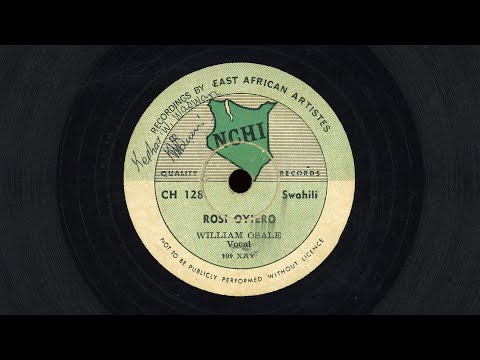
  • “Rosi Oyiero” – William Osale – Kenyan Guitarist

    “Rosi Oyiero” – William Osale – Kenyan Guitarist

    William Osale was a fingerstyle guitarist who performed and recorded in Kenya during the 1950s and 60s. Osale was a rural musician who played in the ‘sukuti’ style – a rhythmic style of finger-style playing invented by George Mukabi that results in a light, ‘bouncy’ sound.

    In his “A History of Kenyan Guitar Music: 1945-1980”, John Low writes, “Some rural finger-stylists like George Mukabi and William Osale also had success in the towns, providing Swahili versions of songs that they might sing in local languages back home. The appeal of their songs lay in the fact that many town dwellers had (and still have) strong links with the land, and the themes of these songs, often conservative and sometimes nostalgic, reminded them of the old values.”

    This beautiful record appears to be a love song written in a blend of Swahili and Luo languages about a person named Rosi Oyiero. Transcribing did not seem to be very successful – as the resulting translations were spotty.

    The best I can work out is toward the end of the song, we hear: “Rosi Oyiero ninulia sana” which translates to “Rosi Oyiero, I cry a lot for you.”

    If you speak Swahili/Luo and can help better translate, please comment!

    Recorded in late 1950s or early 1960s (that’s a total guess)
    Released as NCHI CH 128 (Matrix AMX 464)

    Credits:
    William Osale – guitar, vocals
    Unknown Artist – bottle, harmony vocal

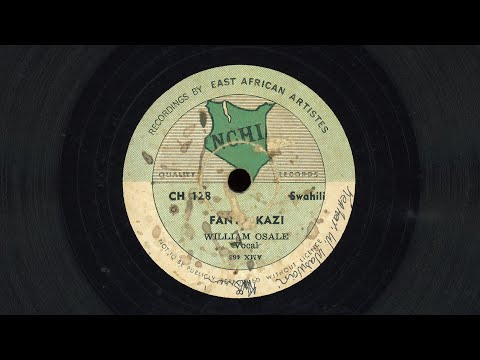
  • “Fany Kazi” – William Osale – Kenyan Guitarist

    “Fany Kazi” – William Osale – Kenyan Guitarist

    William Osale was a fingerstyle guitarist who performed and recorded in Kenya during the 1950s and 60s. Osale was a rural musician who played in the ‘sukuti’ style – a rhythmic style of finger-style playing invented by George Mukabi that results in a light, ‘bouncy’ sound.

    In his “A History of Kenyan Guitar Music: 1945-1980”, John Low writes, “Some rural finger-stylists like George Mukabi and William Osale also had success in the towns, providing Swahili versions of songs that they might sing in local languages back home. The appeal of their songs lay in the fact that many town dwellers had (and still have) strong links with the land, and the themes of these songs, often conservative and sometimes nostalgic, reminded them of the old values.”

    This lovely record by Kenyan guitarist William Osale is on a label for which I have found very little information – other than that it is a Kenyan label – very likely made in Nairobi.

    This song’s title “Fany Kazi” translates to “Get to Work” and I’ve used YouTube’s auto-captioning to transcribe the lyrics and then used translation tools to try to eke out the meaning. Please, native speakers, correct any mistranscription or mistranslation in the comments!

    Lyrics
    Ukitaka utachiri ukuwe na bibi wa nguvu.
    If you want to be rich, have a strong wife.

    Naona watu wengi wanapenda kukula lakini kwa kufanya kazi wanashindwa sana.
    I see many people love to eat, but when it comes to working, they really struggle.

    Ni uongo.
    It is a lie.

    Ni kweli.
    It is true.

    Ni vizuri fanya kazi tutapata chakula
    It is good to work—then we shall eat.

    Akishindwa na kazi anapenda kwao.
    When one fails at work, they run back home.

    Recorded in late 1950s or early 1960s (that’s a total guess)
    Released as NCHI CH 128 (Matrix AMX 463)

    Credits:
    William Osale – guitar, vocals
    Unknown Artist – bottle, harmony vocal

  • “Aymandjoua” – Aka Boi et son ensemble (~1950s)

    “Aymandjoua” – Aka Boi et son ensemble (~1950s)

    A Congolese artist about whom not much is known – Aka Boi recorded and released a total of eight sides on the Léopoldville-based Opika label in the mid 1950s. This was his last release.

    Recorded in Léopoldville, Belgian Congo in the mid-1950s.
    Released as Opika 1312.

  • “Mabelemou” – Aka Boi et son ensemble (~1950s)

    “Mabelemou” – Aka Boi et son ensemble (~1950s)

    A Congolese artist about whom not much is known – Aka Boi recorded and released a total of eight sides on the Léopoldville-based Opika label in the mid 1950s. This was his last release.

    Recorded in Léopoldville, Belgian Congo in the mid-1950s.
    Released as Opika 1312.

  • “Bibi Sultani” – Léon Bukasa f/ Papa Noël, Albino Kalombo (1957)

    “Bibi Sultani” – Léon Bukasa f/ Papa Noël, Albino Kalombo (1957)

    Léon Bukasa began his career in Lubumbashi in 1949, alongside Henri Kaseba (elder brother of Albino Kalombo). He began recording for the Ngoma label in 1950.

    The Dictionnaire Des Immortels de la Musique Congolaise Moderne notes: “A distinguished songwriter and composer, Léon Bukasa—whose voice was both captivating and emotionally stirring—left behind an impressive discography, remarkable both in quantity and quality.”

    Guitarist Papa Noël (Antoine Nedule Montswet) was only sixteen at the time of this recording.

    Albino Kalombo, who we hear on saxophone, was born in Élisabethville (now Lubumbashi) in Katanga. After playing clarinet in a brass band, he moved to Léopoldville (Kinshasa) in 1954, learned the saxophone, and was then recruited by Ngoma Records. It is said that he even taught Léon Bukasa himself how to play saxophone.

    This tune, with a title translated as “Lady Sultani”, appeared on the 1996 German CD release “Ngoma, The Early Years, 1948-1960”.

    Recorded in Léopoldville, Belgian Congo on October 28, 1957.
    Released as Ngoma 1824.

    Credits:
    Léon Bukasa – guitar
    Papa Noël – guitar
    Albino Kalombo – saxophone

    Sources:
    Dictionnaire Des Immortels De La Musique Congolaise Moderne, Jean-Pierre François Nimy Nzonga, Bruylant-Academia, 2010.

    The flip side can be heard at:
    https://youtu.be/lLVUwBlLS5Y

  • “Simplice Wa Bolingo” – Léon Bukasa w/ Papa Noël, Albino Kalombo (1957)

    “Simplice Wa Bolingo” – Léon Bukasa w/ Papa Noël, Albino Kalombo (1957)

    Léon Bukasa began his career in Lubumbashi in 1949, alongside Henri Kaseba (elder brother of Albino Kalombo). He began recording for the Ngoma label in 1950.

    The Dictionnaire Des Immortels de la Musique Congolaise Moderne notes: “A distinguished songwriter and composer, Léon Bukasa—whose voice was both captivating and emotionally stirring—left behind an impressive discography, remarkable both in quantity and quality.”

    Guitarist Papa Noël (Antoine Nedule Montswet) was only sixteen at the time of this recording.

    Albino Kalombo, who we hear on saxophone, was born in Élisabethville (now Lubumbashi) in Katanga. After playing clarinet in a brass band, he moved to Léopoldville (Kinshasa) in 1954, learned the saxophone, and was then recruited by Ngoma Records. It is said that he even taught Léon Bukasa himself how to play saxophone.

    Recorded in Léopoldville, Belgian Congo on October 28, 1957.
    Released as Ngoma 1824.

    Credits:
    Léon Bukasa – guitar, vocals
    Papa Noël – guitar
    Albino Kalombo – saxophone
    Unknown Artist – percussion

    Sources:
    Dictionnaire Des Immortels De La Musique Congolaise Moderne, Jean-Pierre François Nimy Nzonga, Bruylant-Academia, 2010.

    The flip side can be heard at:
    https://youtu.be/85VK8QTCfBg