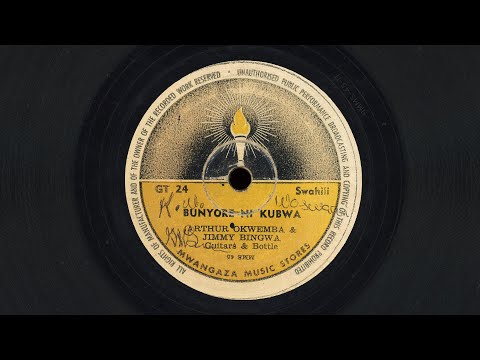
Kenyan musicians Arthur Okwemba and Jimmy Bingwa perform “Bunyore Ni Kubwa”.
Bunyore is a region in Western Kenya and “kubwa” is a Swahili word meaning “great” or “big”, so the title literally translates to “Bunyore is Great”.
Two harmonizing vocals accompanied by fingerstyle guitar and glass bottle – a classic combination.
Mwangaza was an independent Kenyan label launched by David Amunga in 1965. While Western record labels had stopped producing 78 rpm records in the late 1950s in favor of the smaller lighter vinyl 45 rpm format, 78s were still produced in other parts of the world, including Kenya, through the mid-1960s.
Recorded in Nairobi, Kenya circa 1966. Released as Mwangaza Music Stores GT 24 (mx. MMS 45).
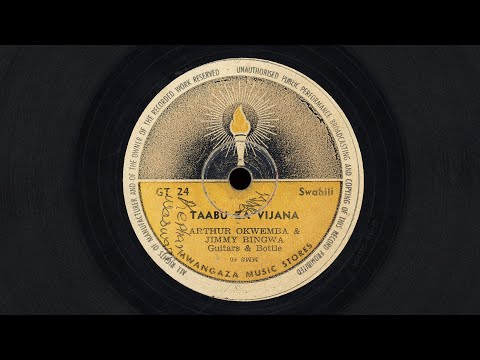
Kenyan musicians Arthur Okwemba and Jimmy Bingwa perform “Taabu Za Vijana”, roughly translated as “Troubles of the Youth” or “Problems of the Young People”.
Two harmonizing vocals accompanied by fingerstyle guitar and glass bottle – a classic combination.
Mwangaza was an independent Kenyan label launched by David Amunga in 1965. While Western record labels had stopped producing 78 rpm records in the late 1950s in favor of the smaller lighter vinyl 45 rpm format, 78s were still produced in other parts of the world, including Kenya, through the mid-1960s.
Recorded in Nairobi, Kenya circa 1966. Released as Mwangaza Music Stores GT 24 (mx. MMS 46).
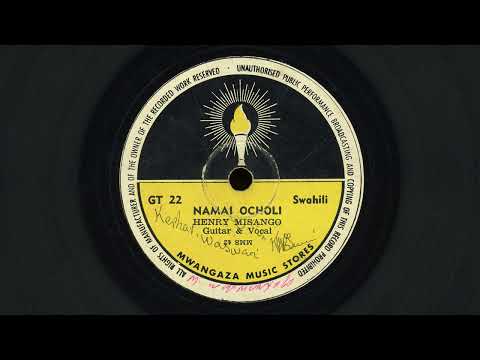
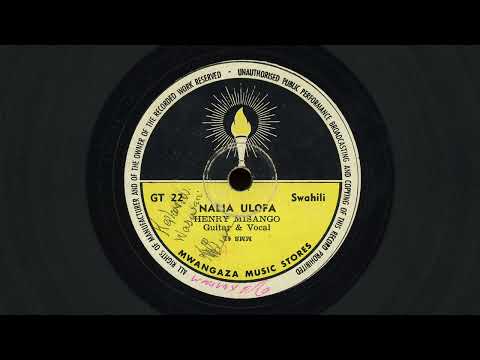
Henry Misango was a fingerstyle guitarist who played in the Omutibo style popularized by George Mukabi. After Mukabi’s untimely death in 1963, several Kenyan guitarists continued to play in this style – including Henry Misango, Herbert Misango, William Osale, Humphrey Eshitool, Peter Opwaka and Fanuel Ami- mo.
The title of this song seems to be a first name and last name – I do not know the significance of this name.
Recorded in Nairobi, Kenya circa 1966. Released as Mwangaza Music Stores GT 22 (mx. MMS 42).
Credits Henry Misango – guitar, vocals Unknown artist – percussion, vocals
Henry Misango was a fingerstyle guitarist who played in the Omutibo style popularized by George Mukabi. After Mukabi’s untimely death in 1963, several Kenyan guitarists continued to play in this style – including Henry Misango, Herbert Misango, William Osale, Humphrey Eshitool, Peter Opwaka and Fanuel Ami- mo.
The title of this song seems to be a first name and last name – I do not know the significance of this name.
Recorded in Nairobi, Kenya circa 1966. Released as Mwangaza Music Stores GT 22 (mx. MMS 41).
Credits Henry Misango – guitar, vocals Unknown artist – percussion, vocals
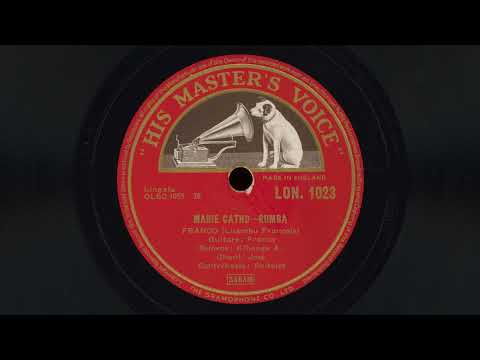
By the time the 17-year-old Luambo Franco cut this record in 1955, he had already been playing professionally for three years – both with Ebengo de Wayon in Group Watam and as a solo recording artist for the Loningisa label.
Upon hearing him play at a Loningisa recording session in 1953, Loningisa owner Basile Papadimitriou gave him a nice guitar and signed a 10 year contract with the young guitarist, remarking, « Mon petit bon- homme, tu es appelé à un grand avenir ».
By 1955, he had become a national sensation – and was performing frequently to packed bars. His band would “borrow” equipment from the Loningisa studio to play these gigs, then return it before morning. When Papadimitriou discovered this, he was angry at first – but quickly realized that supporting his stars should be his priority and he allowed the band to continue their nightly withdrawals of instruments and equipment.
This record was originally released on the Loningisa label for distribution within Belgian Congo. These LON series discs on the HMV label were then made for distribution outside of Congo. I believe they are master pressings and sound great!
Recorded in Léopoldville (now Kinshasa), Belgian Congo (now Democratic Republic of the Congo) on October 14, 1955. Released as His Master’s Voice LON. 1023. Originally released as Loningisa No. 129
Credits: Franco (Luambu François) – guitar Antoine Kibongué – organ (Hammond Solovox) Augustin Moniania “Roitelet”- bass José – vocals
By the time the 17-year-old Luambo Franco cut this record in 1955, he had already been playing professionally for three years – both with Ebengo de Wayon in Group Watam and as a solo recording artist for the Loningisa label.
Upon hearing him play at a Loningisa recording session in 1953, Loningisa owner Basile Papadimitriou gave him a nice guitar and signed a 10 year contract with the young guitarist, remarking, « Mon petit bon- homme, tu es appelé à un grand avenir ».
By 1955, he had become a national sensation – and was performing frequently to packed bars. His band would “borrow” equipment from the Loningisa studio to play these gigs, then return it before morning. When Papadimitriou discovered this, he was angry at first – but quickly realized that supporting his stars should be his priority and he allowed the band to continue their nightly withdrawals of instruments and equipment.
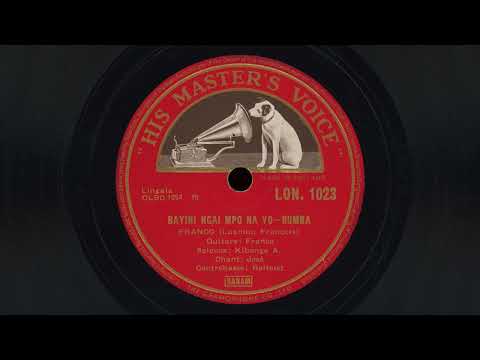
The song title translates as “They hate me because of you.”
This record was originally released on the Loningisa label for distribution within Belgian Congo. These LON series discs on the HMV label were then made for distribution outside of Congo. I believe they are master pressings and sound great!
Recorded in Léopoldville (now Kinshasa), Belgian Congo (now Democratic Republic of the Congo) on October 14, 1955. Released as His Master’s Voice LON. 1023. Originally released as Loningisa No. 129
Credits: Franco (Luambu François) – guitar Antoine Kibongué – organ (Hammond Solovox) Augustin Moniania “Roitelet”- bass José – vocals
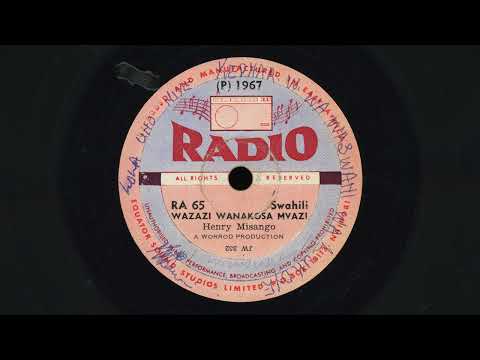
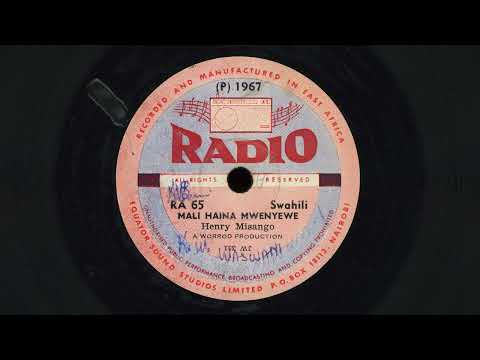
The Radio label seems to be a sublabel of Charles Worrod’s Equator Records, launched in 1960 from the acquired remains of East African Records – which owned the Jambo label.
I bought this record “as is” from a seller who warned me that the disc was cracked from the edge to the label. I stabilized and repaired the crack (you can see some of my glue to the upper left of the label) well enough that I was able to get a decent transfer from it.
Henry Misango was a fingerstyle guitarist who played in the Omutibo style popularized by George Mukabi. After Mukabi’s untimely death in 1963, several Kenyan guitarists continued to play in this style – including Henry Misango, Herbert Misango, William Osale, Humphrey Eshitool, Peter Opwaka and Fanuel Ami- mo.
The title of this song translates as: “Parents Lack Clothing”
Recorded in Nairobi, Kenya circa 1967. Released as Radio RA 65.
Credits Henry Misango – guitar, vocals Unknown artist – percussion, vocals
The Radio label seems to be a sublabel of Charles Worrod’s Equator Records, launched in 1960 from the acquired remains of East African Records – which owned the Jambo label.
I bought this record “as is” from a seller who warned me that the disc was cracked from the edge to the label. I stabilized and repaired the crack (you can see some of my glue to the upper left of the label) well enough that I was able to get a decent transfer from it.
Henry Misango was a fingerstyle guitarist who played in the Omutibo style popularized by George Mukabi. After Mukabi’s untimely death in 1963, several Kenyan guitarists continued to play in this style – including Henry Misango, Herbert Misango, William Osale, Humphrey Eshitool, Peter Opwaka and Fanuel Ami- mo.
The title of this song translates as “Wealth Has No Owner”.
Recorded in Nairobi, Kenya circa 1967. Released as Radio RA 65.
Credits Henry Misango – guitar, vocals Unknown artist – percussion, vocals
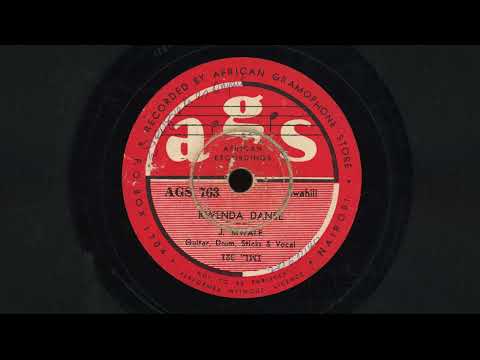
John Mwale was a Kenyan guitarist highly influenced by George Mukabi. He was born in 1925 in Western Kenya and was recording for the Nairobi-based Capitol Music Stores (CMS) label in the 1950s. The two business partners who owned CMS had a falling out and one then set up the competing label African Gramophone Store (AGS), which we see here.
AGS was producing 78 rpm records well into the 1960s – and this record is likely from the early 1960s, but unfortunately I have no exact recording date.
This disc was quite beat and has a particularly rough start – the noise floor seems to get progressively worse as the song progresses. Despite that – I hope you enjoy this lovely performance that stands out despite the shortcomings of the medium it is preserved into.
Released as AGS 763 Recorded in Nairobi, Kenya in the 1960s.