Jazz Crazy Records

An Archive of Early Jazz on 78 RPM

Category: African

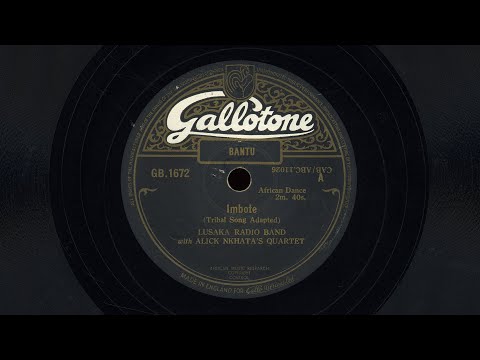
  • “Imbote” – Lusaka Radio Band with Alick Nkhata’s Quartet (1950)

    “Imbote” – Lusaka Radio Band with Alick Nkhata’s Quartet (1950)

    This record featuring Zambian artist Alick Nkhata has been waiting in the “to transfer” queue for a while – and with the release of “Radio Lusaka” on Mississippi Records, I thought it a good time to help their effort to promote Nkhata’s music.

    If you like this number, please check out the recent release produced by friend of the channel Cyrus Moussavi and Jamal Khadar:

    Radio Lusaka by Alick Nkhata
    “Vocalist, guitarist, and bandleader Alick Nkhata moved effortlessly between lonesome country slide, big band pop, and air-tight vocal harmonies, all with roots in Bemba and other African traditional songs and rhythms. It’s a dizzying, inclusive, expansive blend from an artist and music archivist who became the voice of his nation’s fight for freedom.”

    Available as digital download or as vinyl LP from:
    https://mississippirecords.bandcamp.com/album/radio-lusaka

    Recorded circa 1950.
    Released as Gallotone 1672.
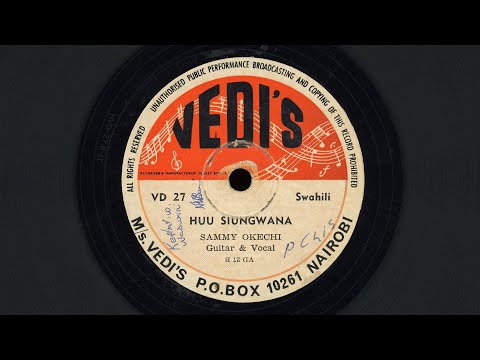
  • “Huu Siungwana” – Sammy Okechi – Kenyan Guitarist

    “Huu Siungwana” – Sammy Okechi – Kenyan Guitarist

    A virtually unknown Kenyan guitarist and singer recording for a small Nairobi label. Little information can be found on either the artist or the label.

    Guitarists like Okechi in Kenya were first inspired by Congolese fingerstyle guitarists such as Jean Mwenda Bosco. The Kenyan contribution to this style included the use of a second harmonizing vocal and glass bottle accompaniment. Fanta bottles were preferred due to their ribbed edging that could be scraped like a guiro.

    The title, Huu Siungwana, can be translated as “This Is Not Gentlemanly”, suggesting a critique of conduct seen as improper or impolite.

    The tuning of this one made it very difficult to pitch correctly – even more troublesome, the two different sides seem to have been recorded at different speeds.

    Recorded in Nairobi, Kenya – probably in the late 1950s or early 1960s.
    Released as Vedi’s VD 27.

    Sammy Okechi – guitar and vocal
    Unknown Artist – 2nd vocal, glass bottle

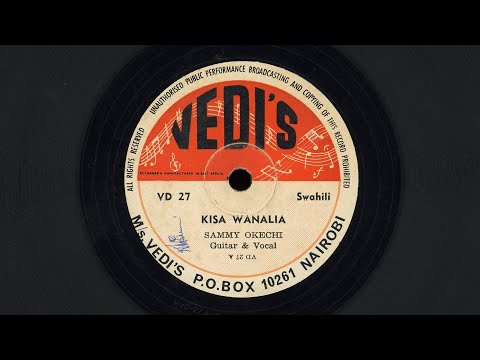
  • “Kisa Wanalia” – Sammy Okechi – Kenyan Guitarist

    “Kisa Wanalia” – Sammy Okechi – Kenyan Guitarist

    A virtually unknown Kenyan guitarist and singer recording for a small Nairobi label. Little information can be found on either the artist or the label.

    Guitarists like Okechi in Kenya were first inspired by Congolese fingerstyle guitarists such as Jean Mwenda Bosco. The Kenyan contribution to this style included the use of a second harmonizing vocal and glass bottle accompaniment. Fanta bottles were preferred due to their ribbed edging that could be scraped like a guiro.

    The title, Kisa Wanalia, can be translated as “The Story They Are Crying About.”

    The tuning of this one made it very difficult to pitch correctly – even more troublesome, the two different sides seem to have been recorded at different speeds.

    Recorded in Nairobi, Kenya – probably in the late 1950s or early 1960s.
    Released as Vedi’s VD 27.

    Sammy Okechi – guitar and vocal
    Unknown Artist – 2nd vocal, glass bottle

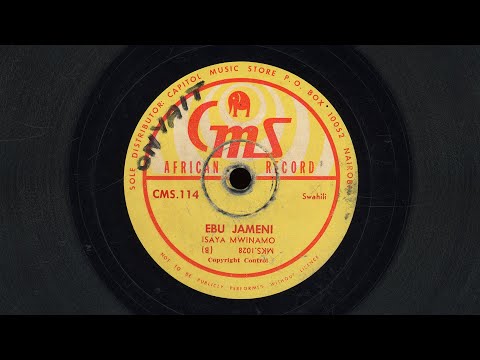
  • “Ebu Jameni” – Isaya Mwinamo (~1962) Kenyan Guitar

    “Ebu Jameni” – Isaya Mwinamo (~1962) Kenyan Guitar

    Isaya Mwinamo was a Kenyan guitarist and music producer born in Shinlayu township in Kakamega county in 1932. He moved to Nairobi in the 1950s and became a part of the music scene there. This is an early recording on the Capitol Music Store (CMS) label that prominently features his guitar sound

    Isaya later joined the Polydor label to record and produce many of Kenya’s top bands. He retired from music in 1985 and lived in his hometown until he passed away in 2005.

    Recording date is not known, however, on CMS 118, Isaya makes reference to a Kenyan political party started in 1960 and dissolving in 1964, so I’ve split the difference.

    The title “ebu jameni” is an exclamation that loosely translates as “Oh, Man!” or “Oh, My Goodness!”.

    Released as CMS 114 (mx. MKS.1028)

    Sources:
    Post by Rudent Obande
    https://www.facebook.com/photo.php?fbid=762876849172591&id=100063508488919&set=a.218720593588222

    Moving Pictures Kenya: Isaya Mwinamo – Legendary Kenyan Sound Engineer Who Recorded Africa’s Biggest Hits
    https://www.youtube.com/watch?v=-Vw-GpkE-bU

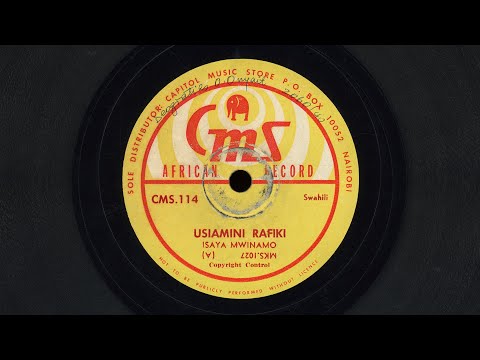
  • “Usiamini Rafiki” – Isaya Mwinamo (~1962) Kenyan Guitar

    “Usiamini Rafiki” – Isaya Mwinamo (~1962) Kenyan Guitar

    Isaya Mwinamo was a Kenyan guitarist and music producer born in Shinlayu township in Kakamega county in 1932. He moved to Nairobi in the 1950s and became a part of the music scene there. This is an early recording on the Capitol Music Store (CMS) label that prominently features his guitar sound

    Isaya later joined the Polydor label to record and produce many of Kenya’s top bands. He retired from music in 1985 and lived in his hometown until he passed away in 2005.

    Recording date is not known, however, on CMS 118, Isaya makes reference to a Kenyan political party started in 1960 and dissolving in 1964, so I’ve split the difference.

    The title loosely translates to: “Don’t believe it, friend”.

    Released as CMS 114 (mx. MKS.1027)

    Sources:
    Post by Rudent Obande
    https://www.facebook.com/photo.php?fbid=762876849172591&id=100063508488919&set=a.218720593588222

    Moving Pictures Kenya: Isaya Mwinamo – Legendary Kenyan Sound Engineer Who Recorded Africa’s Biggest Hits
    https://www.youtube.com/watch?v=-Vw-GpkE-bU

    Kentanza Vinyl
    https://kentanzavinyl.com/Kentanzavinyl/CMS.html

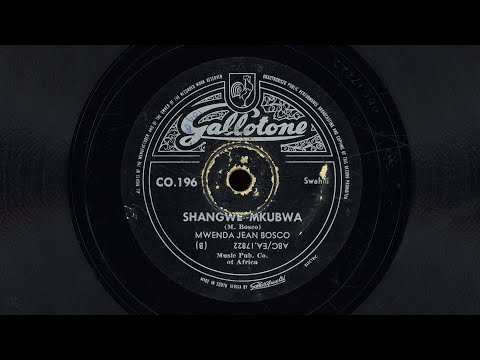
  • “Shangwe Mkubwa” – Jean-Bosco Mwenda (~1958)

    “Shangwe Mkubwa” – Jean-Bosco Mwenda (~1958)

    The great Congolese fingerstyle guitarist Jean-Bosco Mwenda.

    If you like this, I just discovered that Mwenda’s set at the 1969 Newport Folk Festival was recorded and is available online:
    https://www.wolfgangs.com/music/jean-bosco-mwenda/audio/20020427-50522.html

    Believed to have been recorded circa 1958.

    Released as Gallotone CO.196 (mx. ABC/EA.17822).

    Credits:
    Jean-Bosco Mwenda – guitar, vocals
    Unknown accompanist – glass bottle

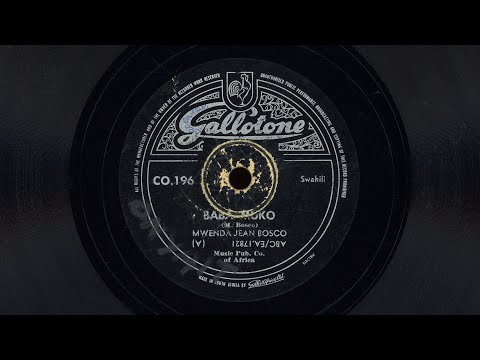
  • “Baba Moko” – Jean-Bosco Mwenda (~1958)

    “Baba Moko” – Jean-Bosco Mwenda (~1958)

    The great Congolese fingerstyle guitarist Jean-Bosco Mwenda.

    If you like this, I just discovered that Mwenda’s set at the 1969 Newport Folk Festival was recorded and is available online:
    https://www.wolfgangs.com/music/jean-bosco-mwenda/audio/20020427-50522.html

    Believed to have been recorded circa 1958.
    Released as Gallotone CO.196 (mx. ABC/EA.17821)

    Credits:
    Jean-Bosco Mwenda – guitar, vocals
    Unknown accompanist – glass bottle

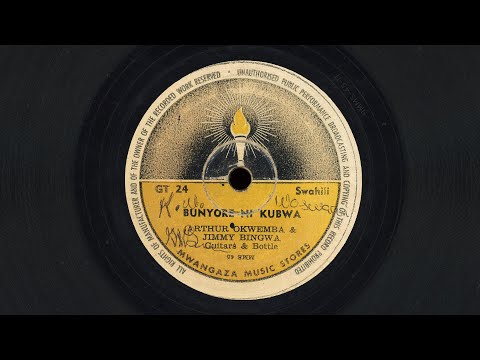
  • “Bunyore Ni Kubwa” – Arthur Okwemba & Jimmy Bingwa

    “Bunyore Ni Kubwa” – Arthur Okwemba & Jimmy Bingwa

    Kenyan musicians Arthur Okwemba and Jimmy Bingwa perform “Bunyore Ni Kubwa”.

    Bunyore is a region in Western Kenya and “kubwa” is a Swahili word meaning “great” or “big”, so the title literally translates to “Bunyore is Great”.

    Two harmonizing vocals accompanied by fingerstyle guitar and glass bottle – a classic combination.

    Mwangaza was an independent Kenyan label launched by David Amunga in 1965. While Western record labels had stopped producing 78 rpm records in the late 1950s in favor of the smaller lighter vinyl 45 rpm format, 78s were still produced in other parts of the world, including Kenya, through the mid-1960s.

    Recorded in Nairobi, Kenya circa 1966.
    Released as Mwangaza Music Stores GT 24 (mx. MMS 45).

    The flip side, “Taabu Za Vijana”, can be heard at:
    https://youtu.be/-m2tw2_00DA

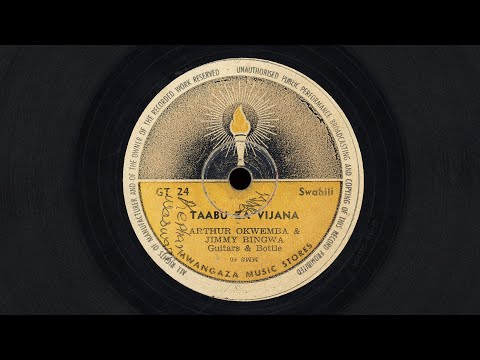
  • “Taabu Za Vijana” – Arthur Okwemba & Jimmy Bingwa (c. 1966) Kenyan Guitar

    “Taabu Za Vijana” – Arthur Okwemba & Jimmy Bingwa (c. 1966) Kenyan Guitar

    Kenyan musicians Arthur Okwemba and Jimmy Bingwa perform “Taabu Za Vijana”, roughly translated as “Troubles of the Youth” or “Problems of the Young People”.

    Two harmonizing vocals accompanied by fingerstyle guitar and glass bottle – a classic combination.

    Mwangaza was an independent Kenyan label launched by David Amunga in 1965. While Western record labels had stopped producing 78 rpm records in the late 1950s in favor of the smaller lighter vinyl 45 rpm format, 78s were still produced in other parts of the world, including Kenya, through the mid-1960s.

    Recorded in Nairobi, Kenya circa 1966.
    Released as Mwangaza Music Stores GT 24 (mx. MMS 46).

    The flip side, “Bunyore Ni Kubwa”, can be heard at:
    https://youtu.be/xpWoE2QEnBg

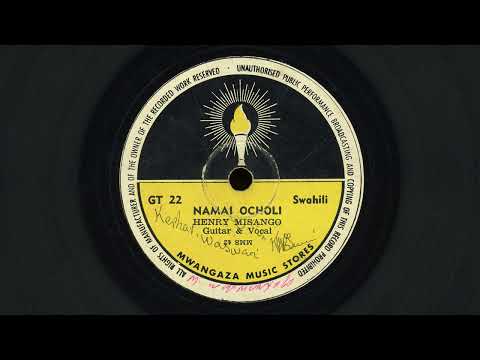
  • “Namai Ocholi” – Henry Misango (c. 1966) Kenyan Omutibo Guitar

    “Namai Ocholi” – Henry Misango (c. 1966) Kenyan Omutibo Guitar

    Henry Misango was a fingerstyle guitarist who played in the Omutibo style popularized by George Mukabi. After Mukabi’s untimely death in 1963, several Kenyan guitarists continued to play in this style – including Henry Misango, Herbert Misango, William Osale, Humphrey Eshitool, Peter Opwaka and Fanuel Ami- mo.

    The title of this song seems to be a first name and last name – I do not know the significance of this name.

    Recorded in Nairobi, Kenya circa 1966.
    Released as Mwangaza Music Stores GT 22 (mx. MMS 42).

    Credits
    Henry Misango – guitar, vocals
    Unknown artist – percussion, vocals

    The flip side can be heard at:
    https://youtu.be/rcqIA9MonIU

    More Henry Misango transfers:

    “Mali Haina Mwenyewe”
    https://youtu.be/3bTpR77moEw

    “Wazazi Wanakosa Mvazi”
    https://youtu.be/76mmoDTKtbs