Jazz Crazy Records

An Archive of Early Jazz on 78 RPM

Category: African

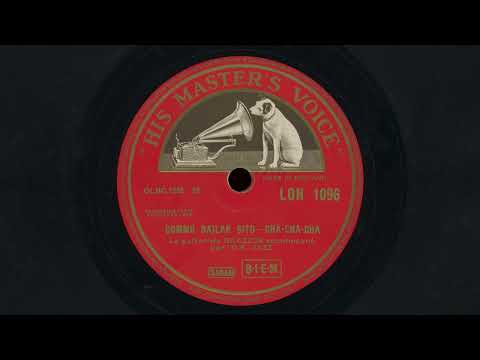
  • Commo Bailiar Sito – Le Guitariste Brazzos accompagné par l’O.K. Jazz (1959)

    Commo Bailiar Sito – Le Guitariste Brazzos accompagné par l’O.K. Jazz (1959)

    African jazz in what was then called Belgian Congo was equally inspired by American jazz and Cuban rumba. The very interesting combination is augmented by the unique perspective of the artists prospering in a hotbed of music across prolific record labels such as Ngoma, Opika, and Loningisa in Léopoldville, the capital of a dying colonial empire.

    Originally recorded for the Congolese Loningisa label, here we have the guitarist Armando Brazzos playing an infectious cha cha with O.K. Jazz reissued for wider distribution on the HMV LON series.

    This catchy dance tune hooks you from the very first few bars and never lets go. Around 1:50, Issac Musekiwa provides a wailing sax solo on top of the never-ending groove. Then at the exact three minute mark, everything comes to an abrupt halt.

    A real treat to listen to! But be warned – once the contagious cha cha rhythm gets in your head you may find yourself shaking your hips all day long as the groove goes on and on in your head.

    Recorded in Léopoldville (now Kinshasa), Congo on February 27, 1959.
    Originally released as Loningisa N° 252.
    Reissued as His Master’s Voice LON 1096.

    Credits (mostly based on personnel of O.K. Jazz in the late 50s)
    Armando Brazzos – guitar
    Issac Musekiwa (?) – saxophone
    Victor “Vicky” Longomba (?), Edouard “Edo” Ganga (?) – vocals
    Célestin Kouka (?) – maracas, vocals
    De La Lune (?) – Bass
    Nicolas “Dessoin” Bosuma (?) = percussion

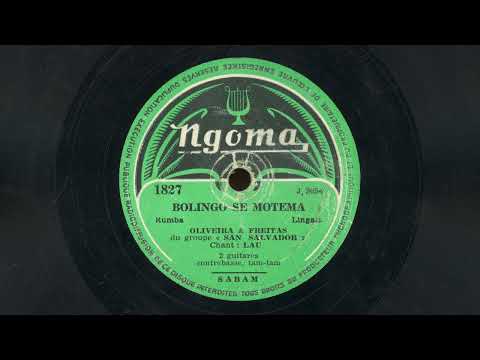
  • “Bolingo Se Motema” – Oliveira & Freitas du groupe San Salvador (c. 1957) – Ngoma 1827

    “Bolingo Se Motema” – Oliveira & Freitas du groupe San Salvador (c. 1957) – Ngoma 1827

    Congolese rumba in Lingala.

    Released as Ngoma 1827.

    The other side of this 78 rpm record can be found at:
    https://youtu.be/CJ8cdRGecJU

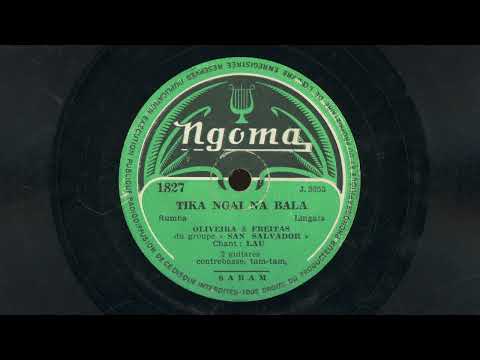
  • “Tika Ngai Na Bala” – Oliveira & Freitas du groupe San Salvador (1957) – Ngoma 1827

    “Tika Ngai Na Bala” – Oliveira & Freitas du groupe San Salvador (1957) – Ngoma 1827

    Released as Ngoma 1827.

    The other side of this 78 rpm record can be heard at:
    https://youtu.be/KCSfPBsQWxk

    Credits:
    Manuel Oliveira – guitar, vocals
    Henri Freitas – guitar, vocals
    Lau – vocals
    unknown performers – contrebasse, tam-tam

    Lingala. Rumba.

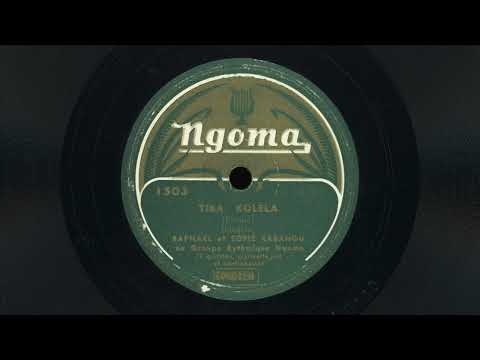
  • “Tika Kolela” – Raphael et Sofie Kabangu (1954) – Ngoma 1503

    “Tika Kolela” – Raphael et Sofie Kabangu (1954) – Ngoma 1503

    Recorded in Léopoldville (Kinshasa), Congo on May 19, 1954.
    Released as Ngoma 1503.
    Matrix J. 3009.

    Credits:
    Unknown performers – 3 guitares, clarinette, jazz & contrebasse

    The other side of this record can be heard at:
    https://youtu.be/We5MvJBwtYU

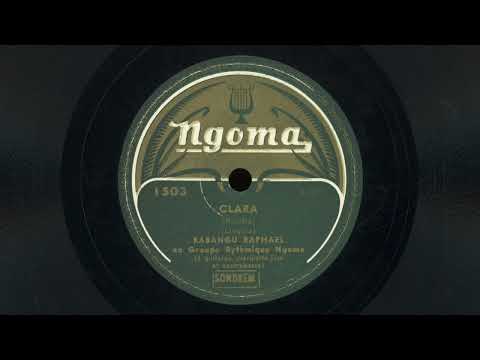
  • “Clara” – Kabangu Raphael na Groupe Rythmique Ngoma (1954) – Ngoma 1503

    “Clara” – Kabangu Raphael na Groupe Rythmique Ngoma (1954) – Ngoma 1503

    Recorded in Léopoldville (Kinshasa), Congo on May 19, 1954.
    Released as Ngoma 1503.
    Matrix J. 3010.

    Credits:
    Unknown performers – 3 guitares, clarinette, jazz & contrebasse

    The other side of this record can be heard at:
    https://youtu.be/tMWoPeoDyB8

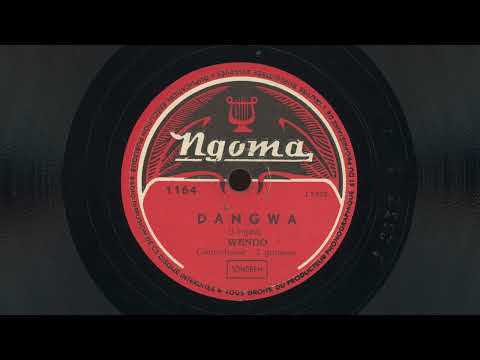
  • “Dangwa” – Wendo (c. 1951-52) – Ngoma 1164

    “Dangwa” – Wendo (c. 1951-52) – Ngoma 1164

    Wendo (Antoine Kolosoyi) sings and plays guitar on this Ngoma record from the early 1950s.

    Released as Ngoma 1164.
    Matrix J 2332

    The other side of this 78 rpm record can be found at:
    https://youtu.be/y5mVga4jNS4

    If you enjoyed this music, please check out my interview with Alastair Johnston, producer of the 3CD/3LP set “The Soul of Congo: Treasures of the Ngoma Label”:
    https://youtu.be/2BSsWpb49AA

  • “Tango Ya Bolingo” – Wendo (c. 1951-52)  – Ngoma 1164

    “Tango Ya Bolingo” – Wendo (c. 1951-52) – Ngoma 1164

    Wendo (whose real name was Antoine Kolosoyi) was born in the village of Mushie – about 150 miles upriver from Léopoldville in Congo. He worked as a riverboat mechanic and sometimes would play his guitar for audiences on his riverboat journeys.

    In the late 40s, he was introduced to Ngoma by his friend Henri Bowane and recorded their first big hit record: “Marie Louise”, a song which Gary Stewart writes “brought the spirits out of the cemetery to listen.” Wendo’s beautiful singing voice and guitar playing quickly made him a popular Ngoma recording artist.

    Here we hear a Wendo record from the early 1950s on Ngoma’s red label. Wendo was by then a big star in the Congolese music scene. The title roughly translates as “The Time of Love”.

    Released as Ngoma 1164.
    Matrix J 2331

    The other side of this 78 rpm record can be found at:
    https://youtu.be/qvzC0w2cnKo

    Credits
    Wendo (Antoine Kolosoyi) – vocals, guitar
    Unknown performers – guitar, contrebasse

    If you enjoyed this music, please check out my interview with Alastair Johnston, producer of the 3CD/3LP set “The Soul of Congo: Treasures of the Ngoma Label”:
    https://youtu.be/2BSsWpb49AA

  • “Wacheza Lada / Kwaheri Naja” – Hashima Bin Kilamata With Nyamwezi Men

    “Wacheza Lada / Kwaheri Naja” – Hashima Bin Kilamata With Nyamwezi Men

    Special transfer request from viewer @78s_TheArtists_AndTheHistory

    Gallotone GB.1318
    A – Wacheza Lada
    B – Kwaheri Naja

    Hiyari Ya Moyo – dance song with drums

    I’m afraid I don’t know much else about this record – though I hope to learn more in the future. It was released in the early 1950s.

  • “Mputulu” – Malongansomi et Namatani (~1956)

    “Mputulu” – Malongansomi et Namatani (~1956)

    These immediately lovable tunes make me want to dance!

    Listen for the Mbira – a type of lamellaphone similar to the Westernized kalimba – and what sounds like an early electric organ of some kind.

    The Opika label was active in what was then the Belgian Congo from 1950-1957.

    Malongansomi and Namatani were musicians and performers who recorded a number of sessions – including this one – for the Opika label circa 1956-57.

    Released as Opika 1790.

    Be sure to listen to the other side at:
    https://youtu.be/hwbKn38x6uE

  • “Tembela” – Malongansomi et Namatani (~1956)

    “Tembela” – Malongansomi et Namatani (~1956)

    These immediately lovable tunes make me want to dance!

    Listen for the Mbira – a type of lamellaphone similar to the Westernized kalimba – and what sounds like an early electric organ of some kind.

    The Opika label was active in what was then the Belgian Congo from 1950-1957.

    Malongansomi and Namatani were musicians and performers who recorded a number of sessions – including this one – for the Opika label circa 1956-57.

    Released as Opika 1790.

    Be sure to listen to the other side at:
    https://youtu.be/_PIHeu__TNI