Jazz Crazy Records

An Archive of Early Jazz on 78 RPM

Category: Jazz

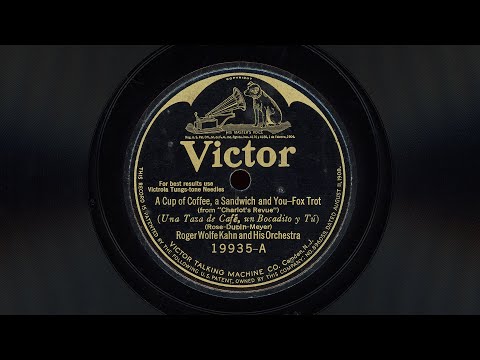
  • “A Cup of Coffee, a Sandwich and You” – Roger Wolfe Kahn and His Orchestra (1925)

    “A Cup of Coffee, a Sandwich and You” – Roger Wolfe Kahn and His Orchestra (1925)

    A dance band arrangement by the sophisticated Manhattan darlings led by banking scion turned jazz entrepreneur Roger Wolfe Kahn. A few flourishes of jazz interest in this one – You’ll hear Miff Mole on trombone and later on: Joe Venuti on violin – who states the melody at 1:49 and then launches into a hot solo starting at 2:07. Jazzers like Tommy Gott, Arthur Schutt, and Vic Berton also populate the band – as Kahn had an ear for talent and paid well for players.

    The song was written by Joseph Meyer with lyrics by Al Dubin and Billy Rose – the title an Americanized riff off a line from the Rubáiyát of Omar Khayyám involving a loaf of bread and jug of wine. It was performed by Jack Buchanan and Gertrude Lawrence as part of the original Broadway production of Charlot’s Revue of 1926 – which opened at the Selwyn Theatre on November 10, 1925 – just a month before this recording was made.

    Fun pop culture trivia: in the 1956 Warner Brothers cartoon “Broom-Stick Bunny”, Witch Hazel references this song by singing “A cup of Vosne, a spider, some glue. A lizard’s gizzard, a eel’s ear, or two.” when preparing a witch’s brew. Later, she brews a beauty potion intended for Bugs Bunny and when serving it, she happily sings “A cup of tea, a cookie, and you.”
    https://www.reddit.com/r/looneytunes/comments/1de9kyd/broomstick_bunny_1956/

    Recorded in New York City on December 15, 1925.
    Released as Victor 19935.

    Credits:
    Roger Wolfe Kahn – director
    Tommy Gott, Leo McConville – trumpet
    Miff Mole – trombone
    Arnold Brilhart, Owen Bartlett – clarinet, alto sax
    Harold Sturr – clarinet, tenor sax
    Joe Venuti, Joe Raymond – violin
    Arthur Schutt – piano
    Domenic Romeo – banjo, guitar
    Arthur Campbell – tuba
    Vic Berton – drums
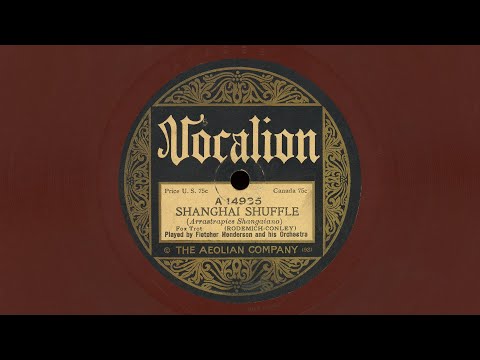
  • “Shanghai Shuffle” – Fletcher Henderson and his Orchestra (1924) f/Louis Armstrong

    “Shanghai Shuffle” – Fletcher Henderson and his Orchestra (1924) f/Louis Armstrong

    Henderson’s orchestra first recorded the Gene Rodemich song “Shanghai Shuffle” in October of 1924 for Pathé-Perfect, which was their second recording session with new cornetist Louis Armstrong, who had just moved to New York from Chicago, where he had been playing with King Oliver.

    Here we have a slightly later version of the tune from a November session with Vocalion. The title is an Eastern-inspired dance band number – but as soon as Armstrong enters the ring at 0:59, the whole center of gravity changes and for over thirty glorious seconds, we are taken on a wild melodic ride. It’s tough to imagine the shock of how good – and novel – Armstrong’s approach was when this first came out. It still sounds fresh over 100 years later!

    0:00 Intro
    0:25 Ensemble
    0:59 Trumpet solo (Armstrong)
    1:32 Clarinet trio
    1:50 Trombone solo (Green)
    2:05 “Whoopee Hey Hey” (Redman) and Coda

    An interesting bookend to this session is that the day before, on November 6, Armstrong recorded “Everybody Loves My Baby” with Clarence Williams’ Blue Five and on November 8, Armstrong recorded “Of All the Wrongs You Done to Me” with the Red Onion Jazz Babies.

    It should be noted that the original lyrics to this tune are cringe and awful. Thankfully, both Henderson versions are instrumentals.

    Recorded in New York City on November 7, 1924.
    Released as Vocalion 14935.

    Credits:
    Fletcher Henderson – piano, director
    Elmer Chambers, Howard Scott, Louis Armstrong – trumpet
    Charlie Green – trombone
    Buster Bailey – clarinet, alto sax
    Don Redman – clarinet, alto sax, arranger
    Coleman Hawkins – clarinet, tenor sax
    Charlie Dixon – banjo
    Ralph Escudero – tuba
    Kaiser Marshall – drums

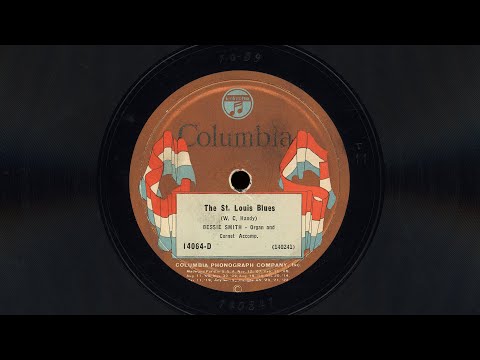
  • “St. Louis Blues” – Bessie Smith (1925) f/ Louis Armstrong

    “St. Louis Blues” – Bessie Smith (1925) f/ Louis Armstrong

    One of the most famous versions of the W.C. Handy classic “St. Louis Blues” was performed by blues Empress Bessie Smith accompanied by a young Louis Armstrong on cornet and Fred Longshaw on reed organ.

    The performances are extraordinary – and it is no wonder that this recording was inducted into the Grammy Hall of Fame in 1993.

    This surely must have been a big seller, as this copy is marked 1-G-39. I believe that the “G” means that it is a West Coast pressing and 39 meaning that this stamper has been through a lot! It looks like all subsequent reissues are dubs. My guess is that they wore the master out repressing it so many times!

    Recorded in New York City on January 14, 1925.
    Released as Columbia 14064-D.

    Credits:
    Bessie Smith – vocals
    Louis Armstrong – cornet
    Fred Longshaw – reed organ

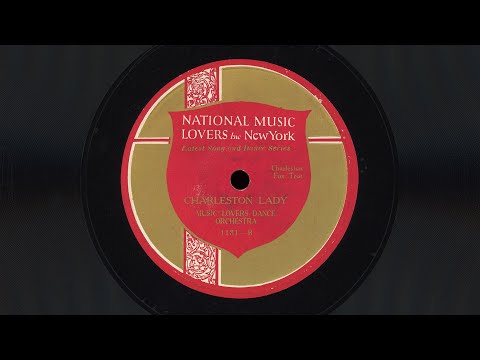
  • “Charleston Lady” – Music Lovers Dance Orchestra (1925)

    “Charleston Lady” – Music Lovers Dance Orchestra (1925)

    This one is a real mystery record. Even in the “National Music Lovers and New Phonic Records Discography” by Allan Sutton this band is labeled as an “unknown dance orchestra”. While some places attribute this to be an “Emerson studio band.”

    The source of the recording is said to be Grey Gull 1320, where the song is labeled “Sadie Salome” by the University Dance Orchestra, which 78discography.com notes is Nathan Glantz . The matrix for that side is listed as 3516-B – which is also attributed to a different Glantz side (“Oriental Nights” on Grey Gull 1248). Indeed, the sax on this number does sound reminiscent of Glantz’ style.

    But in the NML discography (and on the runout of this disc), this record’s matrix is 3703-2.

    In Grey Gull matrices (from 78discography.com):
    3701 Broadway Music Makers (GG 1301) 8/25
    3702 White Way Dance Orchestra (GG 1304) 8/25
    3703 This release (GG 1320)
    3704 Not found
    3705 Not found
    3706 White Way Dance Orchestra (GG 1306) 9/25
    3707 High Society Seven (GG 1305) 9/25

    But I’ve wasted your time on minutiae when the real story is at 1:05 when a muted trumpet solo turns this dance band number into a real growler!

    Now – who has got the goods on the identity of this performer?

    Recorded in New York City circa September 1925.
    Released as National Music Lovers 1131
    Originally released as Grey Gull 1320

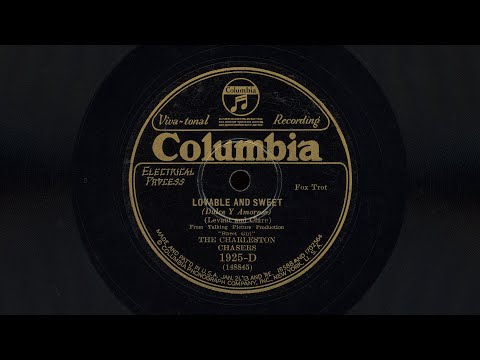
  • “Lovable and Sweet” – Charleston Chasers (1929)

    “Lovable and Sweet” – Charleston Chasers (1929)

    The Charleston Chasers were a studio band that recorded with the Columbia label that is most closely associated with Red Nichols and Miff Mole. However, this lovable number only features Miff. Red’s last session with the group was in 1928 and here we have Phil Napoleon on trumpet along with a second who is presumed to be Leo McConville.

    For me, the real standout of this track is Joe Tarto, whose very audible and prominent string bass playing really sets this recording apart from many 20s recordings that relied on the tuba or bass sax in the rhythm section. It is a harbinger of things to come! The Columbia Viva-tonal recording process really captures the acoustic bass sound here and the few hot bass breaks are quite vividly rendered.

    That said, we hear many fine solos throughout:
    0:00 Intro with bass
    0:11 Trombone solo (Mole)
    0:33 Ensemble
    0:45 Trombone solo (Mole)
    0:56 Ensemble
    1:07 Trumpet solo
    1:18 Muted trumpet solo
    1:40 Tenor sax solo (Pumiglio)
    1:52 Muted Trumpet solo
    2:03 Ensemble and Coda

    Recorded in New York City on July 24, 1929.
    Released as Columbia 1925-D.

    Credits:
    Phil Napoleon, Leo McConville (?) – trumpet
    Miff Mole – trombone
    Pete Pumiglio – clarinet, tenor sax
    Arthur Schutt – piano
    Joe Tarto – string bass
    Stan King – drums

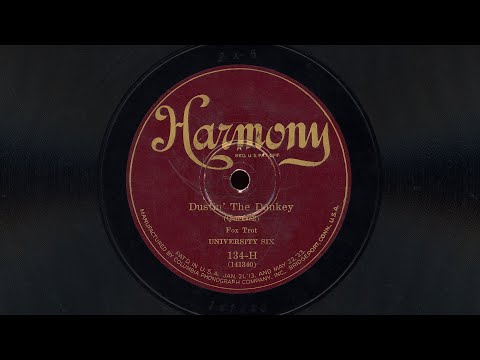
  • “Dustin’ the Donkey” – University Six (1925)

    “Dustin’ the Donkey” – University Six (1925)

    This Howdy Quicksell composition was recorded by the California Ramblers in May of 1925 for Pathé-Perfect. Then again by the Ramblers in an unissued session in October 1925 for Victor. Here, we have a final version for Columbia’s Harmony label under the University Six banner.

    Rollini and Davis takes center stage on this number. At 0:55 Rollini launches into an inspired extended bass sax solo. At 1:55 Davis takes a effervescent sax solo. Lest you think things were running out of steam, at 2:31 Abe Lincoln adds a trombone solo.

    Recorded in New York City on December 1, 1925.
    Released as Harmony 134-H

    Credits:
    Roy Johnston – trumpet
    Abe Lincoln – trombone
    Bobby Davis – clarinet, soprano sax, alto sax
    Sam Ruby – tenor sax
    Adrian Rollini – bass sax, goofus, xylophone
    Irving Brodsky – piano, arranger
    Tommy Felline – banjo
    Stan King – drums, kazoo

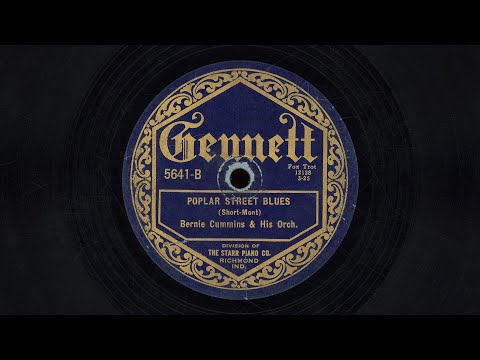
  • “Poplar Street Blues” – Bernie Cummins and his Orchestra (1925)

    “Poplar Street Blues” – Bernie Cummins and his Orchestra (1925)

    Another of my early Bernie Cummins Gennett discs. It gets off to a rough start, but worth hanging around for the pepped-up hot sax solo starting at 0:54, the intriguing muted trumpet hot break at 1:19, brief kazoo solo at 1:42, and a slightly-out-of-place languid clarinet coda at 2:14.

    Recorded in Richmond, Indiana on January 22, 1925.
    Released as Gennett 5641 and Claxtonola 40416.

    Credits:
    Bernie Cummins – drums, kazoo, director
    Paul Hasselburg (?) or Paul Roberts (?) – trumpet
    Buster Locks – trombone
    Jack King – clarinet, alto sax, soprano sax
    Karl Radlach – piano, arranger
    Walter Cummins – banjo
    Willis “Bill” Diehl – tuba
    Unknown Artists – trumpet, tenor sax

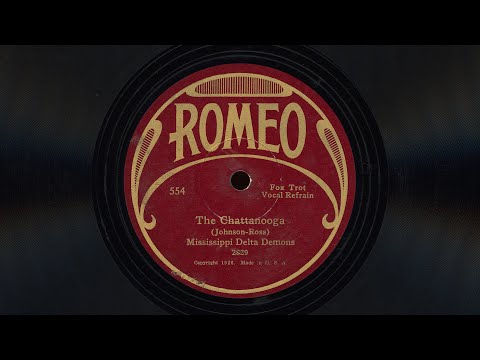
  • “The Chattanooga” – Mississippi Dixie Demons (1928)

    “The Chattanooga” – Mississippi Dixie Demons (1928)

    Here’s an oddball orchestra alias that is only used once – on this release. It’s a pleasant and perky dance tune that belies its Southern-fried heavy metal nomenclature.

    My guess is that this is very likely Bob Haring’s orchestra, as the other matrices recorded around this time include:

    Mx. Artist (Rec date)
    2827 Bob Haring (1/19)
    2828 Bob Haring (1/19)
    2829 Mississippi Dixie Demons (1/19 or 1/20)?
    2830 Society Nightclub Orchestra – a Bob Haring alias (1/20)
    2831 Boston Society Orchestra – a Bob Haring alias (1/20)
    2832 Bob Haring (1/20)

    Not clear why this alias was not noted in Rust’s relevant discographies.

    Mostly defly-performed dance music here, though there’s a melodically straightforward trumpet solo around 2:13 and an equally straight clarinet solo at 2:30. Not sure who the vocalist is, but he seems a pleasant chap – not demonic at all! 😈

    Recorded in New York City on January 19 or 20, 1928.
    Released as Romeo 554 and Cameo 8131.

    Credits:
    Bob Haring (?) – director
    Unknown artists – trumpet, clarinet, alto sax, banjo, tuba, drums

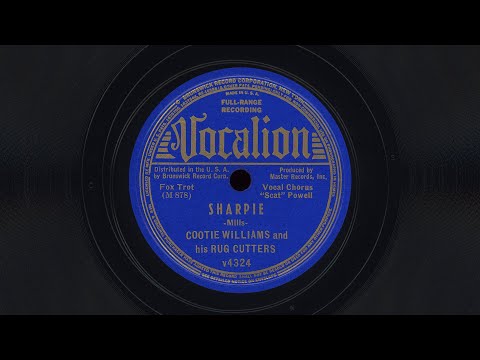
  • “Sharpie” – Cootie Williams and his Rug Cutters (1938)

    “Sharpie” – Cootie Williams and his Rug Cutters (1938)

    A sharp lil’ number by the Duke’s men led by lead growler Cootie Williams on trumpet. Vocals are smoothly handled by Scat Powell.

    Recorded in New York City on August 2, 1938.
    Released as Vocalion v4324.

    Credits:
    Cootie Williams – trumpet
    Johnny Hodges – soprano sax, alto sax
    Otto Hardwick – alto sax, bass sax
    Barney Bigard – clarinet, tenor sax
    Harry Carney – baritone sax
    Duke Ellington – piano
    Billy Taylor – string bass
    Sonny Greer – drums
    Scat Powell – vocals

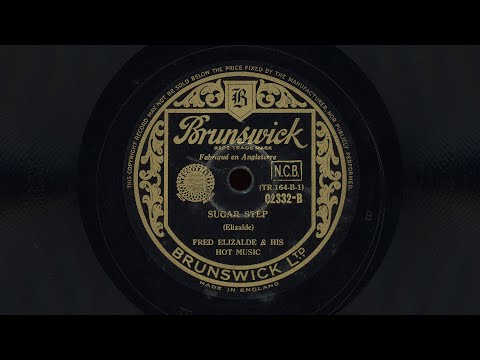
  • “Sugar Step” – Fred Elizalde & his Hot Music (1928)

    “Sugar Step” – Fred Elizalde & his Hot Music (1928)

    Often when Adrian Rollini’s bass sax would be heard, it was in the context of a rollicking hot number by the California Ramblers (or one of its many aliases or band-within-a-band variations). We hear it at the beginning of “Sugar Step” showcased clearly in a small combo setting. Rollini is able to spread out languidly from the get go – returning later for another moment in the spotlight. We hear him at a relaxed pace, with a fresh sense of inventiveness. Perhaps this is due to the relaxed environment of London and the respect and trust that bandleader Elizalde gave to Rollini.

    “Sugar Step” was an original composition of Fred Elizalde, the Manila-born Spanish pianist who led an orchestra at the Savoy Hotel in London. Elizalde was on a mission to give British dance music the syncopation and spark of American jazz. He hired Rollini and fellow Ramblers Chelsea Quealey and Bobby Davis – along with South African guitarist Len Fillis – to fill out the band.

    The tune features a variety of solos:

    0:00 Bass Sax Intro (Rollini)
    0:16 Ensemble (led by Quealey on trumpet)
    0:47 Alto Sax solo (Davis)
    1:05 Ensemble (led by Quealey on trumpet)
    1:17 Guitar Break (Fillis) followed by Piano solo (Elizalde)
    1:57 Muted trumpet solo (Quealey)
    2:10 Clarinet solo (Davis)
    2:25 Bass sax solo (Rollini)
    2:43 Ensemble (led by Quealey on trumpet)
    2:55 Coda

    When I first read the title, I thought: Is this a humorous riff on “Sugar Foot Stomp”? Not a stomp, but a softer ‘step’? Every instrument just feels so chill on this one – sounding quite modern for its time. Funny enough, later in 1928 a short film was produced called “The Sugar Step” featuring a couple demonstrating how to dance its steps while the Elizalde band performs in the background.

    Two weeks after this recording, Rollini would leave the UK for New York to say goodbye to his terminally ill father – who gave his blessing to Rollini’s intention to marry his sweetheart, Dixie. They were married on April 6 and Rollini’s father passed away on April 15. After sitting in on a session with the Dorsey brothers in NYC, Mr. and Mrs. Rollini headed back to London to rejoin Elizalde in early May.

    Recorded in London, UK on March 11, 1928.
    Originally released in the UK as Brunswick 164.
    Reissued as a dub on Brunswick 02332.

    Credits:
    Fred Elizalde – piano, arranger, director
    Chelsea Quealey – trumpet
    Bobby Davis – soprano sax, alto sax
    Adrian Rollini – bass sax, goofus, hot fountain pen
    Len Fillis – guitar
    Ronnie Gubertini – drums

    Sources:
    Jazz and Ragtime Records 1897-1942, 6th Ed. Brian Rust
    Adrian Rollini: The Life and Music of a Jazz Rambler, Ate van Delden