Jazz Crazy Records

An Archive of Early Jazz on 78 RPM

Category: Jazz

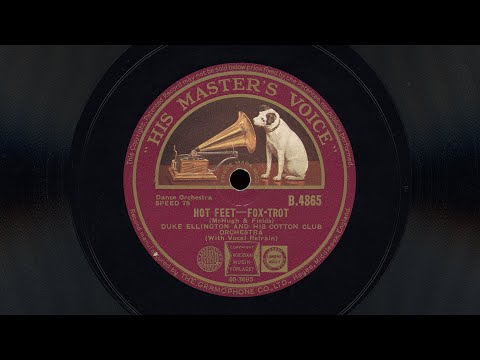
  • “Hot Feet” – Duke Ellington and his Cotton Club Orchestra (1929)

    “Hot Feet” – Duke Ellington and his Cotton Club Orchestra (1929)

    The scat vocals of Clarence Williams on “Candy Lips” I posted yesterday reminded me of a few other scatted choruses in early jazz – and when I put this record on I thought it made a nice companion piece to yesterday’s upload.

    This time, it is trumpeter Cootie Williams doing the vocalizing. Charles Melvin Williams had just joined the Ellington outfit a few weeks earlier, replacing the great growler Bubber Miley.

    The title of this one could refer to the Hot Feet Club – a downtown speakeasy in Greenwich Village that featured many black jazz and blues performers from 1928-1933.

    Recorded in New York City on March 7, 1929.
    Originally released as Victor V-38065.
    Released in the U.K. as His Master’s Voice B.4865.

    Credits:
    Duke Ellington – piano, arranger, director
    Cootie Williams, trumpet, vocals
    Arthur Whetsel, Freddy Jenkins – trumpet
    Joe Nanton – trombone
    Johnny Hodges – clarinet, soprano sax, alto sax
    Harry Carney – clarinet, alto sax, baritone sax
    Barney Bigard – clarinet, tenor sax
    Fred Guy – banjo
    Wellman Braud – string bass
    Sonny Greer – drums
  • “Candy Lips (I’m Stuck On You)” – Clarence Williams’ Washboard Four (1927)

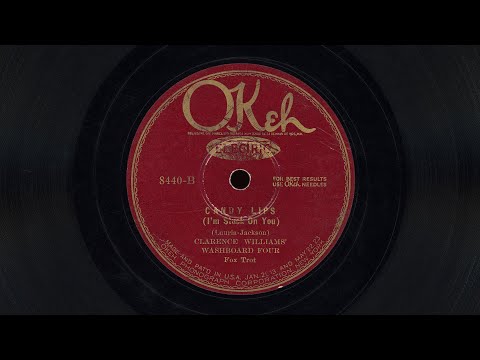
    “Candy Lips (I’m Stuck On You)” – Clarence Williams’ Washboard Four (1927)

    “Candy Lips” was originally recorded as a vocal performance by Eva Taylor, backed by Clarence Williams’ Blue Seven in late November of 1926 for Okeh, and then a second time as an instrumental by the debut of Clarence Williams’ Jazz Kings on the Columbia label in January of 1927 just four days before this session.

    I believe this is the first record under the “Washboard Four” moniker and it does not disappoint – there’s a lot of energetic fun on this number.

    It is a bit of a pastiche of instrumental version and vocal version, with Williams contributing a rousing scatted chorus in lieu of lyrics. The clarinet solo starts off a bit subdued and almost sorrowful – but injects the life back into the track with the help of Ed Allen’s carefully placed cornet growling.

    Interesting side note – the two sides on this record were master pressed by Parlophone in the U.K. and the band name was given as Louis Armstrong’s Original Washboard Beaters.

    Recorded in New York, January 29, 1927.
    Released as Okeh 8440.

    Credits:
    Ed Allen – cornet
    Benny Moten – clarinet
    Clarence Williams – piano, vocals
    Floyd Casey – washboard

  • “Nightmare” – Artie Shaw (1938)

    “Nightmare” – Artie Shaw (1938)

    Adding a few spooky-themed records to my 78 rpm Halloween playlist today:
    https://www.youtube.com/playlist?list=PLSwGgF5a3aa_-7YmPtE_8PS6hY96fGhEP

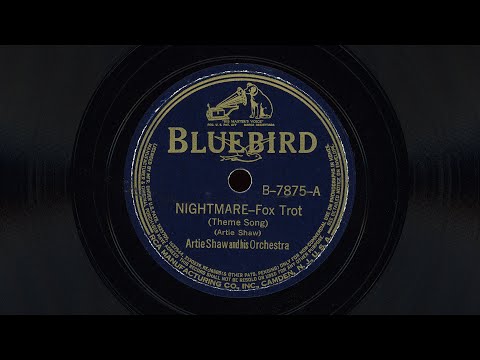
    Here we find an interesting composition penned by Artie Shaw and recorded by his orchestra. It was first played in 1936 and functioned as the band’s theme song that began and ended their radio appearances for nearly 20 years. Ironic that it was used as a theme song, as the tune is dark and eerie, creeping forward in a somewhat ominous fashion.

    The highlight is Shaw’s assertive yet imploring clarinet solo – which report was inspired by Stravinsky’s Firebird. Shaw was quoted as saying “I was trying to sound like a violin, especially like Jascha Heifetz.”

    According to one source, Bud Freeman played this record for Benny Goodman and after the record finished, Goodman (who had a healthy competitive streak with Shaw) just said “F**k” and immediately wanted to hear it again. After the second listen, Goodman dismissed it: “No one will ever listen to that – it’s got no melody.”

    Recorded in New York City on September 27, 1938.
    Released as Bluebird B-7875.
    This copy is a slightly later repressing on the Bluebird label.

    Credits:
    Artie Shaw – clarinet, director
    Chuck Peterson, John Best, Claude Brown – trumpet
    George Arus, Russell Brown, Harry Rodgers – trombone
    George Koenig, Hank Freeman – alto sax
    Tony Pastor, Ronnie Perry – tenor sax
    Les Burness – piano
    Al Avola – guitar
    Sid Weiss – string bass
    Cliff Leeman – drums

    Sources:
    A great writeup on “Nightmare” by Mike Zirpolo can be found at Swing & Beyond: https://swingandbeyond.com/2025/04/28/nightmare-1938-artie-shaw/
    Lost Chords, Richard Sudhalter

  • “Lake George Blues” – Three Jolly Miners (1925)

    “Lake George Blues” – Three Jolly Miners (1925)

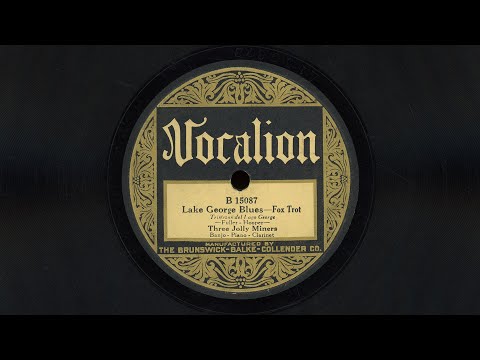
    Here’s one for fans of the bluesy gaspipe clarinet style of Bob Fuller, who recorded many sides with variously-named trios that included Louis Hooper and Elmer Snowden.

    Lake George is a lovely little town in upstate New York at the edge of the Adirondacks. Years ago I spent a weekend with friends at a country house there and remember it fondly. It would be curious to know the history behind the Lake George blues, but I fear that story has likely been lost to the ages.

    The recordings of the Three Jolly Miners and other Fuller trios have only been partially reissued on a single vinyl LP release by Historical Records in 1967. That collection did not include this track.

    Bob Fuller stopped playing music in the 1930s and faded into jazz obscurity – likely in part due to the style of gaspipe clarinet falling into disfavor and relegated a mere novelty effect in the juvenilia of early jazz.

    I find it quite compelling as an exploration of both the instrument and the expressiveness of the blues form itself. Bob Fuller and other overlooked artists such as Wilton Crawley and Douglas Williams deserve more credit for their contributions to early jazz and blues.

    What’s your take? Let me know in the comments.

    Recorded in New York City on August 8, 1925.
    Released as Vocalion 15087.

    Credits:
    Bob Fuller – clarinet
    Louis Hooper – piano
    Elmer Snowden – banjo

  • “Pretty Trix” – Joe Venuti’s Blue Four (1928)

    “Pretty Trix” – Joe Venuti’s Blue Four (1928)

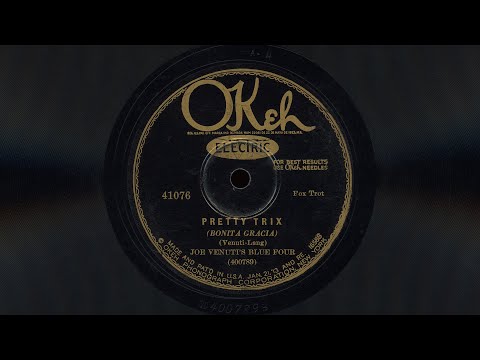
    A lovely number by Venuti and Lang joined by Don Murray on baritone sax and pianist Rube Bloom (who even sings a number on the flip side).

    Richard DuPage, writing in the liner notes for the Columbia Stringing the Blues collection, wrote that Venuti and Lang were “founders of jazz in the chamber music category” who could “develop excitement through quiet and restraint as well as swing out with the best jazzmen.” We hear that on this track, with gentle passages that are delightful as well as bouncy passages that swing.

    After a soft intro, Venuti commands the first minute or so. at 1:15, Bloom takes a few short solo breaks and at 1:56 Lang steps forward and trades licks with Don Murray before the ensemble comes back together, reaching a crescendo in the final bars.

    Recorded in New York City on June 14, 1928.
    Released as OKeh 41076.

    Credits:
    Joe Venuti – violin
    Don Murray – baritone sax
    Rube Bloom – piano
    Eddie Lang – guitar
    Paul Graselli (?) – drums

  • “Smile, Darn Ya, Smile” – Roy Fox and his Band f/ Al Bowlly (1931)

    “Smile, Darn Ya, Smile” – Roy Fox and his Band f/ Al Bowlly (1931)

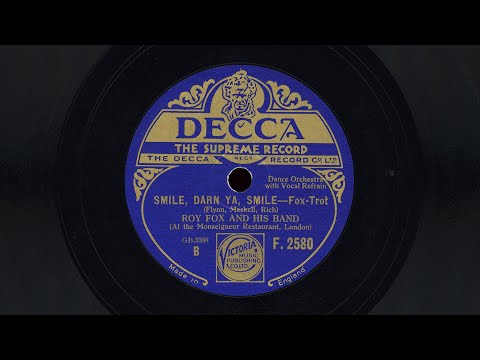
    It’s been a rough year over here in the USA, and today I needed some cheering up. So here’s a lovely tune recorded in London by Colorado-born Roy Fox’s orchestra to bring a smile to your face. Features vocals by one of everyone’s favorite jazz crooners, Al Bowlly.

    Enjoy, darn ya, enjoy!

    Recorded in London, UK at the Monseigneur Restaurant on October 7, 1931.
    Released as Decca F. 2580.

    Credits:
    Roy Fox – cornet, director
    Nat Gonella, Sid Buckman – trumpet
    Joe Ferrie – trombone
    Jim Easton, Ernest Ritte – clarinet, alto sax, baritone sax
    Harry Berly – tenor sax
    Lew Stone – piano, arranger
    Al Bowlly – guitar, vocals
    Don Stuteley – string bass
    Bill Harty – drums

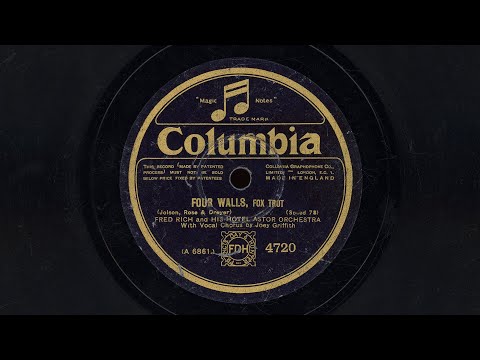
  • “Four Walls” – Fred Rich and his Hotel Astor Orchestra (1928)

    “Four Walls” – Fred Rich and his Hotel Astor Orchestra (1928)

    In January of 1928, Fred Rich and his Hotel Astor Orchestra travelled to London and recorded eight tunes over three sessions before returning to the states in April.

    This record is from the first session, which included Sylvester Ahola on trumpet. The flip side, Baltimore, is a little hotter but this one, “Four Walls” has a fun arrangement and does not appear online anywhere so I thought I’d do a transfer of this one. If you want to hear Baltimore too let me know.

    Recorded in London, U.K. on January 26, 1928.
    Released as Columbia 4720.

    Credits:
    Fred Rich – piano, director
    Sylvester Ahola, Benny Bloom – trumpet
    Lloyd Turner – trombone
    Ted Klein, Benny Fairbanks – clarinet, soprano sax, alto sax
    Phil Walzer – clarinet, tenor sax
    Al Duffy – violin
    Unknown Artists – banjo, tuba
    Ray Baduc – drums
    Joey Griffith – vocals

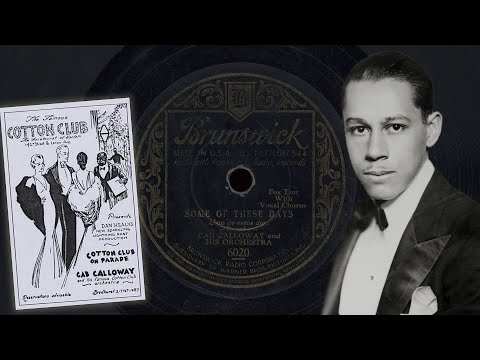
  • “Some of These Days” – Cab Calloway and his Orchestra (1930)

    “Some of These Days” – Cab Calloway and his Orchestra (1930)

    Can’t recall where but I recently overheard two jazz collectors discuss this as being their favorite Cab Calloway record. After posting “Some of these Days” by the Fletcher Henderson band yesterday, I decided to dig this one out to give it a fresh listen.

    And wow! This one is a rompin’ stompin’ good time! The hot insistent playing, driving beat, and feverish vocal performance by Calloway all make for a very hot side! Excellent solos, ensemble playing, and inspired vocal by Mr. Calloway.

    This disc actually looked pretty beat – almost as though someone had put it through a cement mixer with a bag of sand. I was expecting the surface to sound grainy and noisy and wasn’t planning on trying to make a transfer from it. But somehow the grooves were still pretty solid and the transfer came out WAY better than I thought it might. Good ol’ Brunswick shellac for the win!

    Recorded in New York City on December 23, 1930.
    Released as Brunswick 6020.

    Credits:
    Cab Calloway – director, vocals
    R. Q. Dickerson, Lammar Wright, Reuben Reeves – trumpet
    De Priest Wheeler (and Harry White?) – trombone
    William Thornton Blue – clarinet, alto sax
    Andrew Brown – bass clarinet, tenor sax
    Walter Thomas – alto sax, tenor sax, baritone sax, flute
    Earres Prince – piano
    Morris White – banjo
    Jimmy Smith – tuba
    Leroy Maxey – drums

    Image of Cab Calloway circa 1931
    Courtesy of the National Museum of American History – Duncan P. Schiedt Photograph Collection.
    https://edan.si.edu/slideshow/viewer/?eadrefid=NMAH.AC.1323_ref1976

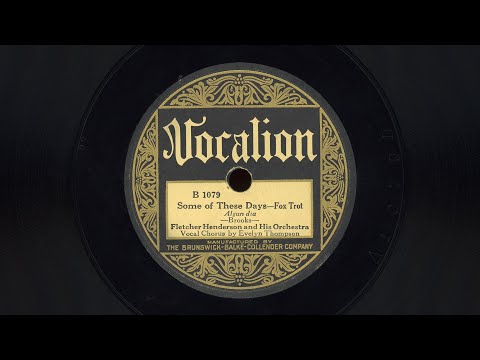
  • “Some of These Days” – Fletcher Henderson and his Orchestra f/ Evelyn Preer (1927)

    “Some of These Days” – Fletcher Henderson and his Orchestra f/ Evelyn Preer (1927)

    By request, the flip side of a scarce Henderson record featuring vocalist Evelyn Preer on the Vocalion 1000 series that I posted earlier this year (“Baby Won’t You Please Come Home” – https://youtu.be/7LZTfu4F4sQ ).

    Recorded in New York City on January 19, 1927.
    Released as Vocalion 1079 (mx. E-4397).

    Credits:
    Fletcher Henderson – director, piano
    Russell Smith, Joe Smith, Tommy Ladnier – trumpet
    Benny Morton, Jimmy Harrison – trombone
    Buster Bailey – clarinet, alto sax
    Don Redman – clarinet, alto sax, arranger
    Coleman Hawkins – clarinet, tenor sax
    Charlie Dixon – banjo, guitar
    June Cole – tuba
    Kaiser Marshall – drums
    Evelyn Preer Thompson – vocals

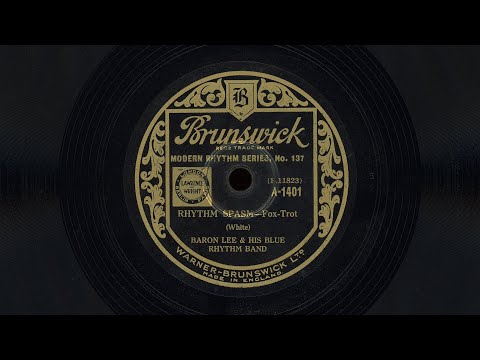
  • “Rhythm Spasm” – Baron Lee & his Blue Rhythm Band (1932) πŸ”₯πŸ”₯πŸ”₯

    “Rhythm Spasm” – Baron Lee & his Blue Rhythm Band (1932) πŸ”₯πŸ”₯πŸ”₯

    A deep depression cut from the Mills Blue Rhythm Band – a band so named for manager Irving Mills, who also famously managed Duke Ellington’s orchestra from 1926 – 1939. The Blue Rhythm Band recorded under a host of pseudonyms and here bandleader Baron Lee gets the credit.

    Listening to this uber-hot track, it’s hard to understand how this band did not break out to a larger degree like Ellington and Calloway’s orchestras, who also performed at the Cotton Club with the Mills Blue Rhythm Band. Some blame Mills, who is said to have seen this band as a sort of relief band for his headliner acts. Others say the lack of a consistent leader hurt their image.

    Notwithstanding – this track jumps to life quickly and swings hard throughout. Highlights for me are Hayes Alvis’ slapped bass solo at 1:47 and again at 2:08, Edgar Hayes’ hot piano break at 2:02, and the many excellent horn and reed section solos and breaks. Full of aural excitement and a spasm of rhythm that don’t quit, this surely was a popular number with the more energetic dancers when played live.

    Recorded in New York City on May 12, 1932.
    Released in the UK as Brunswick 1401.
    Originally issued in the US as Melotone M-12418, Perfect 15629, and Romeo 1874.

    Credits:
    Baron Lee – director
    Wardell Jones, Shelton Hemphill, Ed Anderson – trumpet
    Harry White – trombone, arranger
    Henry Hicks – trombone
    Charlie Holmes – clarinet, alto sax
    Crawford Washington – alto sax, baritone sax
    Joe Garland – clarinet, tenor sax, baritone sax
    Edgar Hayes – piano
    Benny James – banjo, guitar
    Hayes Alvis – string bass
    O’Neil Spencer – drums