Jazz Crazy Records

An Archive of Early Jazz on 78 RPM

Category: Postwar Jazz

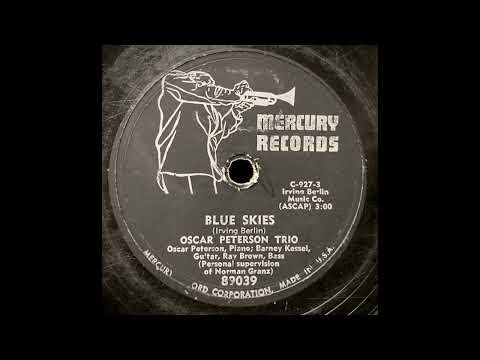
  • “Blue Skies” – Oscar Peterson Trio (1952)

    “Blue Skies” – Oscar Peterson Trio (1952)

    A blazingly fast Oscar Peterson attacks Irving Berlin’s “Blue Skies” supported by Barney Kessel and Ray Brown keeping down the rhythm.

    This particular record has no business sounding as good as it does – the surface was trashed with scratches and scuffs and I fully expected it to be a placeholder copy until something better comes along. Sure there are some clicks and tics – but on the whole, it sounds quite enjoyably listenable!

    The moment at the 0:08 mark when the bass and guitar kick in is quite good when listening on headphones.

    Fans of the 20s versions of “Blue Skies” are gonna spit out their coffee at the screen hearing the manic Peterson bop it up – but you have to admire his furious playing full of zest and stylish panache. A great recording and performance!

    Recorded in Los Angeles, CA in early December, 1952.
    Released as Mercury 87039 in early 1953.

    Credits:
    Oscar Peterson – piano
    Barney Kessel – guitar
    Ray Brown – bass
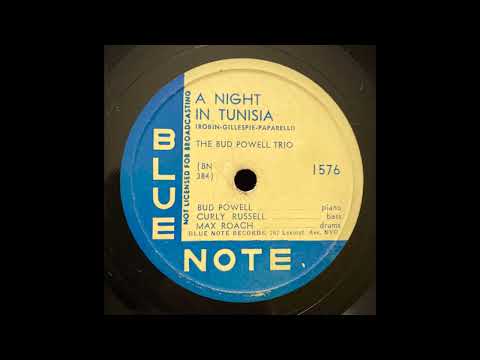
  • “Night in Tunisia” – The Bud Powell Trio (1951)

    “Night in Tunisia” – The Bud Powell Trio (1951)

    An exciting performance of Dizzy Gillespie’s bop standard “Night in Tunisia” by the Bud Powell Trio featuring drummer Max Roach and bassist Curly Russell.

    If you listen closely you can faintly hear Powell’s hummed vocalizations during his playing.

    Recorded in New York on May 1, 1951.
    Released as Blue Note 1576.
    Later included on the 10″ ep “The Amazing Bud Powell” (Blue Note LP 5003)

    Credits:
    Bud Powell – piano
    Curly Russell – bass
    Max Roach – drums

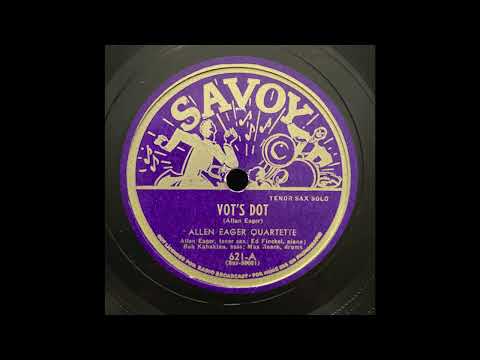
  • “Vot’s Dot” – Allen Eager Quartette (1946)

    “Vot’s Dot” – Allen Eager Quartette (1946)

    Great early bebop tune by a quartet led by saxophonist Allen Eager that featured drummer Max Roach.

    Recorded in NYC on March 22, 1946
    Released as Savoy 621

    Credits:
    Tenor Saxophone – Allen Eager
    Piano – Edwin Finckel
    Bass – Bob Carter
    Drums – Max Roach

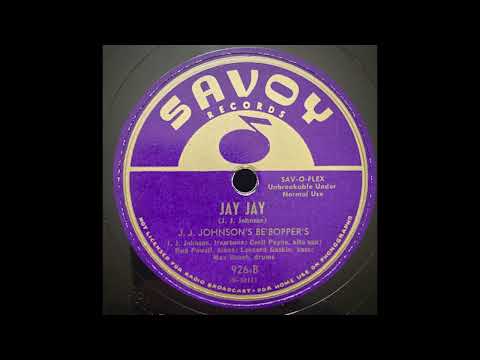
  • “Jay Jay” – J.J. Johnson’s Be Boppers (1946)

    “Jay Jay” – J.J. Johnson’s Be Boppers (1946)

    “Jay Jay” by J. J. Johnson’s Be-Boppers features a young Bud Powell on piano, Cecil Payne on alto sax, and Max Roach on drums.

    Recorded on June 26, 1946.

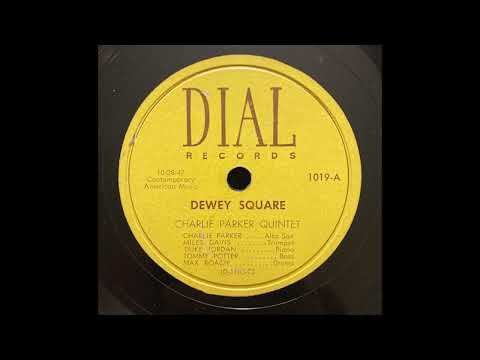
  • “Dewey Square” – Charlie Parker Quintet

    “Dewey Square” – Charlie Parker Quintet

    A classic side from Parker’s Golden era on the Dial label.

    Recorded in WOR Studios, NYC on October 28, 1947.
    Released as Dial 1019.

    Credits
    Charlie Parker – Alto Sax
    Miles Davis – Trumpet
    Duke Jordan – Piano
    Tommy Potter – Bass
    Max Roach – Drums

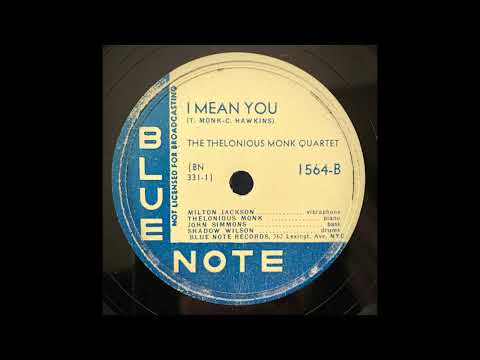
  • “I Mean You” – Thelonious Monk

    “I Mean You” – Thelonious Monk

    Monk attacks the keyboard with an impassioned insistence on the excellent “I Mean You” from a 1948 Blue Note session with Milt Jackson on vibes.

    The slight blasting distortion on this beat disc makes his piano sound even more aggressive and insistent.

    “I Mean You” (T. Monk – C. Hawkins)
    Blue Note 1564
    Recorded on July 2, 1948 at Apex Studios, New York City

    Credits
    Thelonious Monk – piano
    Milton Jackson – vibraphone
    John Simmons – bass
    Shadow Wilson – drums

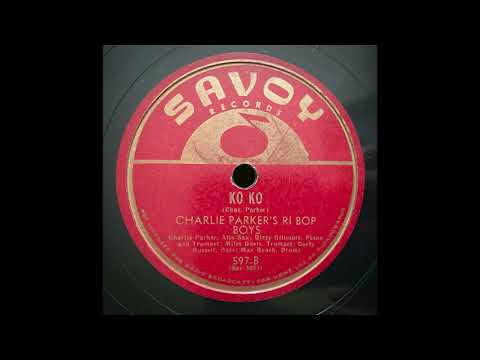
  • “Ko Ko” – Charlie Parker

    “Ko Ko” – Charlie Parker

    Bird bursts on the scene: the fantastic “Ko Ko” on the Savoy label recorded in New York City on November 26, 1945. One of the first bebop recordings and Charlie Parker’s first session as a bandleader.

    Pianist Bud Powell couldn’t make the session and alternate Sadik Hakim didn’t have a union card – so Dizzy Gillespie wound up playing both trumpet and piano on this revolutionary track.

    Miles Davis gets a trumpet credit but wrote later that he didn’t play on this date, feeling that he wasn’t ready to play complex changes at this hyperfast tempo of 300 bpm.

    This copy originally belonged to novelist and poet Robley Wilson, who I was lucky enough to briefly correspond with in 2018 before he passed away. He was a fan of big band but bought his first Charlie Parker record, “Billie’s Bounce” in the late 40s. He started collecting the records of Bird and Diz and wrote: “Those old labels, Savoy and Dial and Musicraft, I can still see in my mind’s eye.”

    After retiring from teaching creative writing at @northern_iowa, Robley moved to Florida. He gave his 78s to one of the movers, and they ended up at a local record store. Robley had put stickers with his name and address on every record – so I took a chance and looked him up. It’s nice when records can tell their story.

    Released as Savoy 597 in 1945.

    More on “Ko Ko”:

    “The Story Of Charlie Parker’s ‘Ko Ko’” (NPR)
    https://www.npr.org/2000/08/27/1081208/-i-ko-ko-i

    “Charlie Parker’s Koko – the Sound of a Revolution” (The Culture Club blog)
    http://www.thecultureclub.net/2007/06/12/charlie-parkers-koko-the-sound-of-a-revolution/

    “Ko Ko” (Wikipedia)
    https://en.wikipedia.org/wiki/Ko-Ko

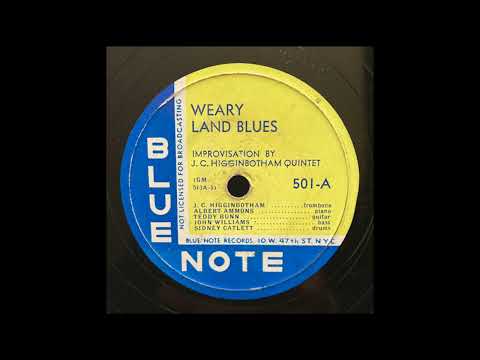
  • “Weary Land Blues” – J. C. Higginbotham Quintet

    “Weary Land Blues” – J. C. Higginbotham Quintet

    For all who have been working hard in stressful times – pour yourself a drink, sit right down, and dig “Weary Land Blues” – the chillest cool jam from 1939 by J.C. Higginbotham Quintet on @bluenoterecords

    Featuring guitarist Teddy Bunn, pianist Albert Ammons, and trombonist J. C. Higginbotham, this quiet unassuming little improvisation slowly builds its story – and by the end leaves you wishing it wasn’t over. Certainly, at the time it was recorded, the world was about to change irrevocably.

    Bunn’s understated guitar drips with weariness yet manages to capture a feeling we’ve all felt, setting the tone for the band. Ammons shows us that a fast and loud boogie-woogie player can bring it down to a quiet whisper. Higginbotham deftly demonstrates the beauty and soul that the trombone is capable of delivering.

    Recorded in New York on April 7, 1939.
    Released as Blue Note 501 – this pressing is slightly later – probably from 1940-41.

    Credits:
    J. C. Higginbotham – trombone
    Albert Ammons – piano
    Teddy Bunn – guitar
    John Williams – bass
    Sidney Catlett – drums

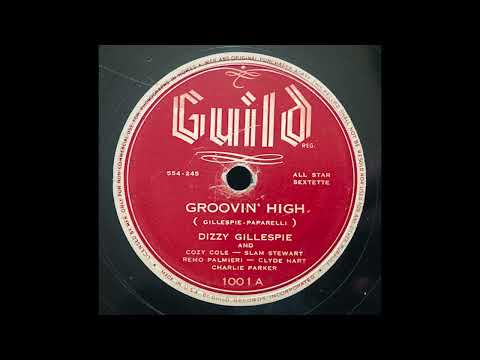
  • “Groovin’ High” – Dizzy Gillespie All-Star Sextette

    “Groovin’ High” – Dizzy Gillespie All-Star Sextette

    Early Diz and Bird on the Guild label – a short-lived NYC label. In these two clips we hear the solos of Charlie Parker, Slam Stewart, Dizzy Gillespie, and Remo Palmieri.

    Recorded in New York City on February 28, 1945. Released as Guild 1001.

    Credits:
    Dizzy Gillespie – trumpet
    Charlie Parker – alto sax
    Clyde Hart – piano
    Remo Palmieri – guitar
    Slam Stewart – bass
    Cozy Cole – drums

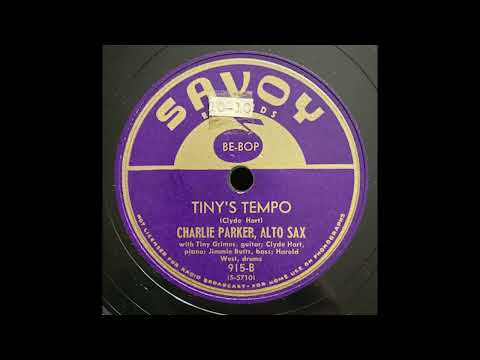
  • “Tiny’s Tempo” – Charlie Parker (1944)

    “Tiny’s Tempo” – Charlie Parker (1944)

    A very early recording of Bird on Savoy: “Tiny’s Tempo” was originally recorded and released in 1944 as Savoy 526 under the name “Tiny Grimes Quintette”. In 1948 this same take was reissued as Savoy 915 under Charlie Parker’s name.

    Credits
    Charlie Parker – alto sax
    Tiny Grimes – guitar
    Clyde Hart – piano
    Jimmie Butts – bass
    Harold West – drums