Jazz Crazy Records

An Archive of Early Jazz on 78 RPM

Author: Professor M

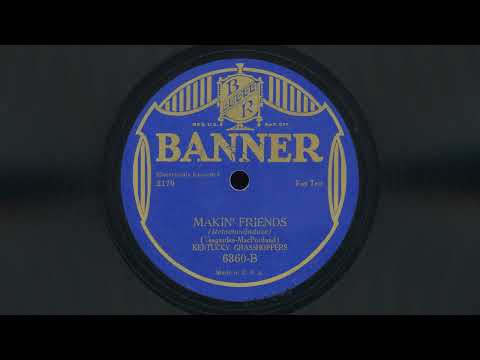
  • “Makin’ Friends” – Kentucky Grasshoppers (1929)

    “Makin’ Friends” – Kentucky Grasshoppers (1929)

    A slow burner from Irving Mills and his musical clowns using the hilarious pseudonym Kentucky Grasshoppers.

    Irving Mills was famously Duke Ellington’s manager from 1925 to 1939 but also led studio groups in recording sessions starting with the “Hotsy Totsy Gang” in 1928. He sometimes sang but to my knowledge did not play an instrument.

    After a brief and somber intro, Jack Teagarden’s trombone kicks us off – as my friend Terry will appreciate. His mournful solo is quite beautiful – and leads us to a more hopeful bluesy cornet solo by Jimmy McPartland.

    In addition to his trombone performances, Teagarden often took on vocal duties, and here after an initial verse, we also hear him scat a few choruses.

    In any case – a real gem.

    Recorded in New York City on April 4, 1929.
    Released as Banner 6360, Challenge 999, Domino 4322, Columbia 36010, Jewel 5569, Oriole 1537, and Regal 8768

    Credits
    Jimmy McPartland – cornet
    Tommy Thunen (?) – trumpet
    Jack Teagarden – trombone, vocals
    Jimmy Dorsey – clarinet, alto sax
    Gil Rodin – alto sax
    Larry Binyon – tenor sax
    Vic Breidis – piano
    Dick Morgan – banjo, guitar
    Harry Goodman – tuba, string bass
    Ray Bauduc – drums
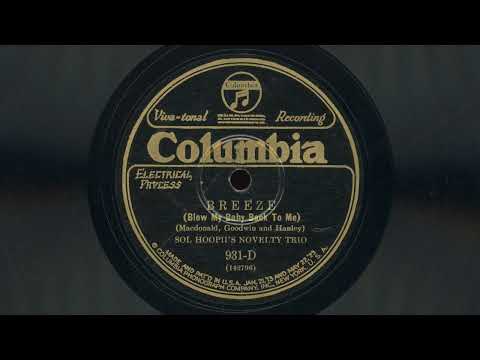
  • “Breeze (Blow My Baby Back To Me)” – Sol Hoopii’s Novelty Trio (1926)

    “Breeze (Blow My Baby Back To Me)” – Sol Hoopii’s Novelty Trio (1926)

    By request from one of my Instagram followers: A disc featuring the Hawaiian steel guitar of Sol Hoopii.

    This one is interesting for a few reasons: Firstly, this tune has been played by many jazz bands, including the Synco Jazz Band (1919), Ford Dabney (1919), Clarence Williams (1929 and 1933), Willie “The Lion” Smith (1935), and Andy Kirk (1938).

    Sol Hoopii also recorded a number of other jazz standards such as Tin Roof Blues, Singin’ the Blues, Stack O Lee Blues, and even Fascinating Rhythm. Sadly, this is the only one of his records in my collection.

    Secondly, this Hawaiian record also features a lovely vocal harmony which complements the tune quite well. Hope you enjoy.

    If you have requests – hit me up. I might not have it, but if I do, I’ll post it for you.

    Recorded in Los Angeles on October 19, 1926.
    Released as Columbia 931-D

    Credits:
    Sol Hoopii – steel guitar
    Lani McIntire – guitar
    Glenwood Leslie – ukulele

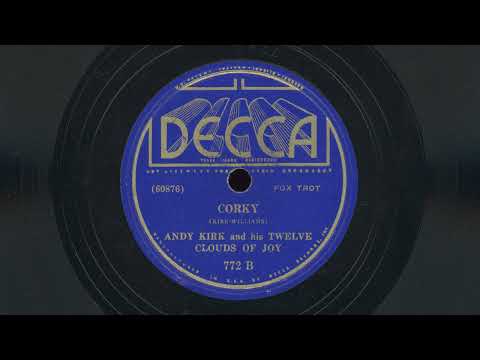
  • “Corky” – Andy Kirk and his Twelve Clouds of Joy (1936)

    “Corky” – Andy Kirk and his Twelve Clouds of Joy (1936)

    The Great Depression caused many jazz acts to call it quits – but Andy Kirk and his Twelve Clouds of Joy were able to keep working throughout the early 1930s in the thriving dance halls of Kansas City.

    Though they recorded a total of nine sessions in 1929-1930, they did not record at all from 1931 – 1935. When they finally got back into the studio in March of 1936, they recut two tunes from their very first 1929 session – “Froggy Bottom” and this one. It’s interesting to hear the differences (and similarities) that a little over six years could make.

    Ross Russell, in his “Jazz Style in Kansas City and the Southwest” found the new Decca version of “Corky Stomp” to be a “fresh and superior version.” The Decca version does swing pretty hard – but I think which version you prefer depends greatly on whether your overall jazz preferences tend toward the hotter 20s style or refined 30s swing style.

    In the new Decca recording, the tune’s title is cut to simply “Corky”. There’ll be no stomping in this version. Also cut is the ensemble introduction. Instead, we open affably with a immediately charming clarinet delivering the melodic head. Noticeably backed by the new combination of bass and guitar in the rhythm section. While there is some ensemble playing – it is more structured and syncopated, with fewer overlapping instruments. After a brief clarinet solo, Mary Lou still takes a piano solo, albeit a little shorter than the 1929 version. Next, a jaunty sax solo spills forward – and we end with a brief clarinet reprise and tightly arranged ending.

    Listen to the 1929 version here:
    https://youtu.be/L_8ibeX7DgQ

    Take a listen to both versions – tell me what you think in the comments.

    Recorded in New York City on March 7, 1936.
    Released as Decca 772.

    Andy Kirk – bass saxophone, director
    Harry Lawson, Paul King, Earl Thomson – trumpet
    Ted Donnelly, Henry Wells – trombone
    John Harrington – clarinet, alto sax, baritone sax
    John Williams – alto sax, baritone sax
    Dick Wilson – tenor sax
    Mary Lou Williams – piano, arranger
    Ted Robinson – guitar
    Booker Collins – string bass
    Ben Thigpen – drums

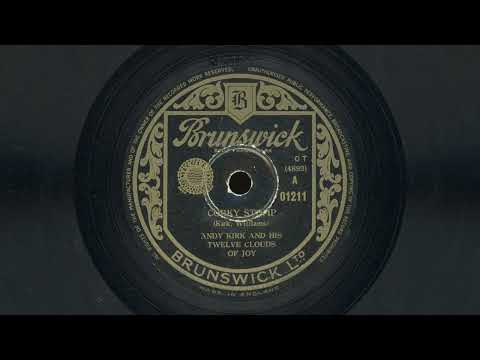
  • “Corky Stomp” – Andy Kirk and his Twelve Clouds of Joy (1929)

    “Corky Stomp” – Andy Kirk and his Twelve Clouds of Joy (1929)

    One thing that is always interesting to me is to listen to different recordings of the same tune by different jazz bands – or in this case, different recordings of the same tune by the same band that were recorded several years apart.

    Here we have a 1929 recorded version of “Corky Stomp”, a tune written by pianist Mary Lou Williams. The lead melody is played by Durham’s trombone. The rhythm section includes the banjo and tuba/bass sax that were more common in 20s jazz. In the middle of the tune, we get a brief hot trumpet solo followed by a delightful extended piano solo from Mary Lou Williams. The coda is marked by ensemble playing.

    The 1936 version of “Corky” can be heard here:
    https://youtu.be/Xna8W_dus7w

    Take a listen to both versions – tell me what you think in the comments.

    Recorded in Kansas City, Missouri on November 11, 1929.
    Originally released in the U.S. as Brunswick 4893.
    Released in the U.K. as Brunswick 01211 (master pressing).

    Credits:
    Andy Kirk – bass saxophone, tuba, director
    Gene Prince, Harry Lawson – trumpet
    Allen Durham – trombone
    John Harrington – clarinet, alto sax
    John Williams – alto sax, baritone sax
    Lawrence Freeman – tenor sax
    Claude Williams – violin
    Mary Lou Williams – piano, arranger
    William Dirvin – banjo, guitar
    Edward McNeil – drums

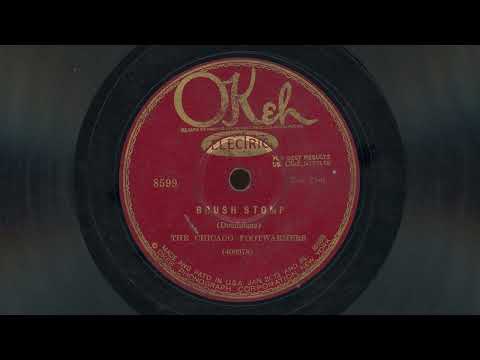
  • “Brush Stomp” – The Chicago Footwarmers (1928)

    “Brush Stomp” – The Chicago Footwarmers (1928)

    Forgive the rough start on this one – the grooves on the first few seconds of this hot number seem to be a bit beat.

    Getting past that, we hear some hot New Orleans jazz by way of Chicago: “Brush Stomp”, a number penned by cornetist Natty Dominique, as performed by The Chicago Footwarmers – featuring a hall of fame lineup.

    0:00 Intro – Cornet (Natty Dominique)
    0:25 Ensemble
    0:58 Trombone solo (Kid Ory)
    1:31 Piano solo (Jimmy Blythe)
    1:47 Clarinet solo (Johnny Dodds)
    2:19 Ensemble Coda

    Recorded in Chicago, Illinois on July 2, 1928.
    Released as Okeh 8599.

    Credits:
    Natty Dominique – cornet
    Johnny Dodds – clarinet
    Kid Ory – trombone
    Jimmy Blythe – piano
    Bill Johnson – string bass
    Baby Dodds – washboard

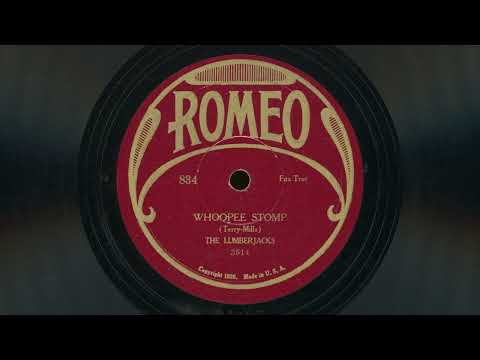
  • “Whoopee Stomp” – The Lumberjacks (1928)

    “Whoopee Stomp” – The Lumberjacks (1928)

    A rousing bit of hot jazz on a dime store label courtesy of a group from Ben Pollack’s orchestra, who went by a variety of pseudonyms such as The Whoopee Makers, Goody’s Good Timers, Mills’ Musical Clowns, and the Lumberjacks.

    The Pollack Orchestra’s Victor output felt restricted and “hidebound” to band members compared to their high-spirited live sets – where long hot solos running late into the evening were common. In contrast, their recording sessions were led by Victor executives who dictated the material that was to be cut – often with only one or two run-throughs before making the final recording. Jimmy McPartland complained, “It was no better than sight-reading.”

    Recording under pseudonyms for dime store labels was one way the band could let off some steam with material they had already mastered and knew sounded great. Listening to “Whoopee Stomp”, one can get a glimpse of what the Pollack band must have sounded like in their live performances.

    0:00 Intro
    0:22 Trumpet
    0:43 Reeds
    1:01 Sax solo
    1:19 Clarinet solo (Benny Goodman)
    1:37 Trombone solo (Jack Teagarden)
    1:58 Trumpet solo (Jimmy McPartland)
    2:20 Coda

    NewYork, c. November 23, 1928.
    Released as Romeo 834, Cameo 9030, and Lincoln 3059.

    Credits:
    Jimmy McPartland, Al Harris – trumpet
    Jack Teagarden – trombone
    Benny Goodman – clarinet, alto sax
    Gil Rodin – alto sax
    Larry Binyon – tenor sax
    Vic Breidis – piano
    Dick Morgan – banjo
    Harry Goodman – tuba
    Ben Pollack – drums

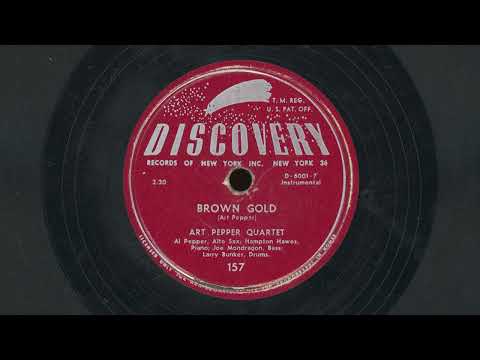
  • “Brown Gold” – Art Pepper Quintet (1952)

    “Brown Gold” – Art Pepper Quintet (1952)

    Time for a cool breeze of West Coast jazz from the Art Pepper Quartet.

    This affable tune was released as a 78 rpm 10″ and 45 rpm 7″ single in 1952 and then appeared on both Pepper’s self-titled debut EP on Discovery in 1953 and then later on the 1957 LP Surf Ride on the Savoy label.

    1952 was a year of accomplishment for Pepper, who came in at #2 in the Downbeat reader’s poll in the Alto Sax category that year – right behind Charlie Parker who took top honors.

    Unfortunately, a drug bust in 1954 would see him behind bars for two years – putting a temporary pause on his career until 1956.

    Recorded in Los Angeles, California on March 4, 1952.
    Released as Discovery 157.

    Credits
    Art Pepper – alto sax
    Hampton Hawes – piano
    Joe Mondragon – bass
    Larry Bunker – drums

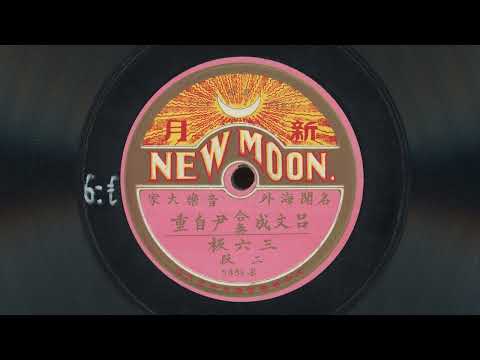
  • 三六板 – 吕文成, 尹自重《1930》江南丝竹

    三六板 – 吕文成, 尹自重《1930》江南丝竹

    A prewar Chinese disc I recently picked up in very nice condition. I’m no expert on this music, but here is what I was able to piece together about it:

    The content is a Chinese folk ensemble playing a three six (三六) piece, one of the “eight great pieces” (八大曲) in a type of traditional Chinese music called Jiangnan sizhu (江南丝竹).

    The label attributes the music to Lü Wencheng (吕文成) and Yin Zizhong (尹自重), two of the “four heavenly kings” of Cantonese music.

    Yin Zizhong was a Cantonese violinist who emigrated to the U.S. in 1961 and lived in San Francisco and Boston, where he died in 1985.

    Lü Wencheng was a Cantonese opera actor, musician, and composer who could play a variety of instruments. He was also a craftsman of musical instruments who was credited with helping to invent the Gaohu – a treble erhu with a clear and bright tone.

    LIkely recorded in Hong Kong circa 1929-1930.
    Released as New Moon 5884

    Both sides of the record (頭段 and 二段) are included in this video.

    Please let me know if you have any information to add (or corrections to what I have written).

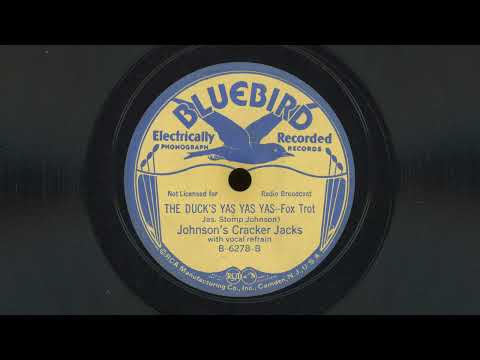
  • “The Duck’s Yas Yas Yas” – Johnson’s Cracker Jacks (1932)

    “The Duck’s Yas Yas Yas” – Johnson’s Cracker Jacks (1932)

    Last week I attended the Bix Jazz Festival in Davenport, Iowa (which was wonderful) and heard the wonderful T.J. Muller and his Arcadia Dance Orchestra do a set featuring the music of St. Louis, Missouri bands and composers.

    One baudy number he performed was a tune written by St. Louis pianist and composer James “Stump” Johnson, who recorded the first version on the QRS label in 1928.

    As luck would have it, I found this fine record by Eddie Johnson’s Cracker-Jacks the next day. This is a Bluebird buff reissue of an original Victor release from 1932. The Cracker Jacks were from St. Louis – formed from the remnants of Oliver Cobb and his Rhythm Kings (who also recorded an outstanding version of the tune) after Cobb tragically drowned in the Mississippi near Davenport, Iowa in 1930.

    The tune’s folksy humor and Rabelaisian surrealism are quite infectious – and if you don’t know what a “yas” is, as T.J. Muller put it: “You’re sitting on one.”

    “Mama bought a rooster and she thought it was a duck
    put him on the table with his legs sticking up.
    In steps sister with a spoon and a glass
    to stir the gravy from his yas yas yas.”

    Recorded in Atlanta, Georgia on February 25, 1932.
    Originally released as Victor 23329.
    Reissued as Bluebird B-6278.

    Credits
    Eddie Johnson – piano, director
    Harold Baker, James Talphy – trumpet
    Winfield Baker – trombone
    Fred Martin, Walter Martin – alto sax
    Chick Franklin – tenor sax
    Benny Jackson – banjo, guitar, v
    Singleton Palmer – tuba
    Lester Nichols – drums
    The Crackerjacks – vocals

    @TJMullerMusic

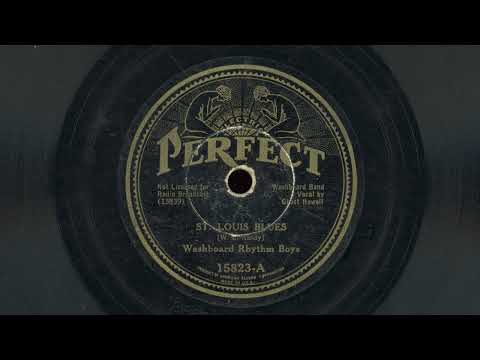
  • “St. Louis Blues” – Washboard Rhythm Boys (1933)

    “St. Louis Blues” – Washboard Rhythm Boys (1933)

    Wow – a red hot version of W.C. Handy’s “St. Louis Blues” as you’ve never heard it played by the Washboard Rhythm Kings (here using the name variation “Washboard Rhythm Boys”).

    Ghost Howell brings it (as he always does) and the driving energy of the band is apparent from the first few bars. A wild and joyful ride!

    This wonderful track is from one of their last recording sessions after a marvelous run of records released in the deep depression years of 1931-1933.

    Recorded in New York City on August 19, 1933.
    Released as Perfect 15823, Banner 32867, Domino 145, Melotone M-12794, Oriole 2763, Romeo 2136, Vocalion 2688, and Brunswick A-86013.

    Credits:
    Unknown Artists – trumpet
    John Haughton – trombone
    Ben Smith, Jerome Carrington (?) – alto sax
    Carl Wade – tenor sax
    Unknown Artist – p
    Unknown Artist – banjo
    Ghost Howell, string bass, vocals
    Unknown Artist – wb