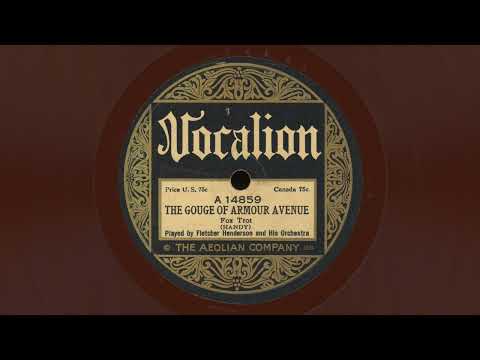
One of my favorite of Henderson’s Red Vocalions: the first recording of W. C. Handy’s “The Gouge of Armour Avenue” that features one of the most inspired and legendary trombone solos of early jazz by Big Charlie Green.
In it, we learn that “gouge” is pronounced as in “price gouging” – not “googe” as in “Scrooge” – and that Green’s solo was likely not an improvisation at all but was pre-composed. By who, we may never know.
In any case, it is massive, epic, and sounds fresh every time I hear it.
Recorded in New York City on July 31, 1924. Released as Vocalion 14859
Credits: Fletcher Henderson – piano, arranger, director Elmer Chambers Howard Scott – cornet Charlie Green – trombone Don Redman – clarinet, alto sax Coleman Hawkins – clarinet, tenor sax, baritone sax Charlie Dixon – banjo Ralph Escudero – tuba Kaiser Marshall – drums
Kenrick Reginald Hijmans Johnson was a unique figure in the British jazz scene in the 1930s. He was born in Guyana and educated in the U.K. After leaving law school to pursue a career in dancing, Johnson spent time in New York City studying tap dancing styles and Harlem jazz.
Back in London in 1936, encouraged by Fletcher Henderson and inspired by Cab Calloway, Johnson began to recruit an all-black jazz band who could swing like the American big bands popular at the time.
Johnson was not a musician – so teamed up with trumpeter Leslie Thompson to help lead the band. The band’s name came from the fact that it was made up of members who were or were descendants from many parts of the British Commonwealth in the Caribbean – with members representing Guyana, Trinidad, and Jamaica. Interestingly – they had trouble finding black trombonists and ended up using white trombonists – who sometimes performed in blackface to maintain the band’s identity.
The band became very popular and influential due to a run of BBC broadcasts starting in 1938 and regular club appearances at Willerby’s and Café de Paris in London. The band made a number of recordings for Decca and HMV from 1938-1940 and the British Library Sound Archive has a sizeable collection of radio transcription discs from their BBC performances.
Johnson tragically was killed *during a performance* at the Café de Paris by a bomb dropped during a WWII London air raid by the German Luftwaffe. Thirty-four other jazz fans died in the bombing that night – and dozens more were injured.
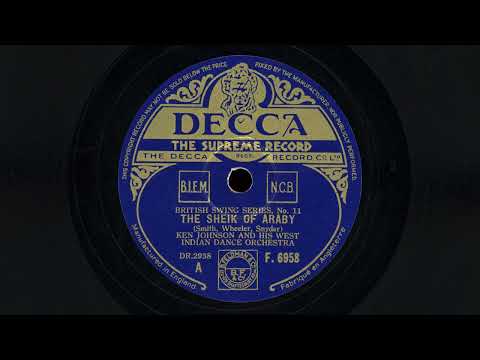
Recorded in London, U.K. on September 22, 1938. Released as Decca F.6958.
Credits Ken Johnson – director Dave Wilkins, Leslie “Jiver” Hutchinson, Wally Bowen – trumpet Lad Busby – trombone Carl Barriteau, Bertie King – clarinet, alto sax George Roberts, David Williams – alto sax, tenor sax Errol Barrow – piano Joe Deniz – guitar Pops Clare – bass Tom Wilson – drums
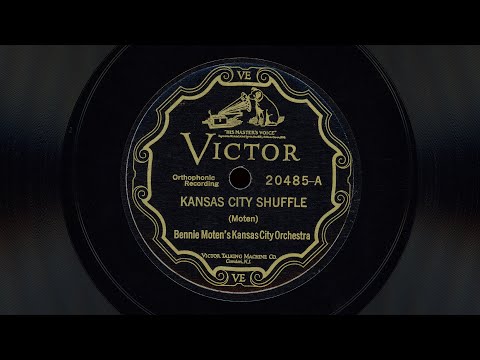
After recording extensively and exclusively for the Okeh label from 1923-25, Bennie Moten’s Kansas City Orchestra switched to Victor in 1926. This popular side is from their first session with Victor in Chicago – recording ten sides over a two day period.
Victor talent scout Ralph Peer (who had initially worked for Okeh) was a big proponent of Moten’s band, writing in early 1927 that these first sides for Victor “the best [they] ever made.” He offered Moten an exclusive contract with Victor and signed the band. Moten and his band were featured in Victor catalogs next to white bands such as Kansas City’s own Coon-Sanders Orchestra.
Side note – after these records were released in early 1927, Moten and trombonist Thamon Hayes went into business together and opened a music store on 18th St. in downtown Kansas City that sold phonographs, sheet music, and records from the Victor, Columbia, Okeh, and Paramount labels. Now there’s a record store I would love to have been able to experience!
Aside from “South” (which continued to be pressed on 78 rpm and 45 rpm until the mid 1950s), this is probably the most plentiful Moten disc that one can find on the market today. Due to its popularity there were a lot of copies of this one pressed.
The tune features an extended banjo solo by Sam Tall accompanied by Moten on piano.
Recorded in Chicago Illinois on December 13, 1926. Released as Victor 20485.
Credits: Bennie Moten – piano, director Lammar Wright – cornet Thamon Hayes – trombone Harlan Leonard – clarinet, alto sax LaForest Dent – alto sax, baritone sax Woody Walder – clarinet, tenor sax Sam Tall – banjo Vernon Page – tuba Willie McWashington – drums
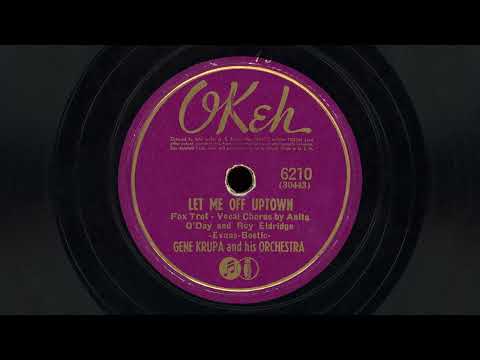
Some of my favorite Gene Krupa records feature singer Anita O’Day and trumpet virtuoso Roy Eldridge – and this one showcases them both to maximum effect. It was a huge hit and put O’Day on the map – by 1942 she was vote fourth most popular female jazz vocalist in the annual poll by Downbeat magazine.
Recorded in New York City on May 8, 1941 Released as Okeh 6210.
Credits: Gene Krupa – drums, director Anita O’Day – vocals Roy Eldridge – trumpet, vocals Graham Young, Torg Halten, Norman Murphy – trumpet Babe Wagner, Jay Kelliher, John Grassi – trombone Mascagni Ruffo, Clint Neagley – alto sax Sam Musiker, Walter Bates – tenor sax Bob Kitsis – piano Ray Biondi – guitar Biddy Bastien – bass
Imagine you’re the sixteen year old son of a millionaire who just caught the jazz bug in New York City circa 1923. What do you do? You buy an orchestra! Not just any orchestra, but the Arthur Lange Orchestra, a hot dance band that played at the Cinderella Ballroom on Broadway and featured Earl Oliver and Tommy Gott.
Kahn’s orchestra rehearsed in the family mansion on 5th Avenue and began playing gigs in 1924. His first recordings for Victor took place in 1925. In late 1925, Kahn brought on hot trombonist Miff Mole, drummer Vic Berton, and violinist Joe Venuti, who was occasionally joined by guitarist Eddie Lang. The addition of these all-star performers made for a supergroup.
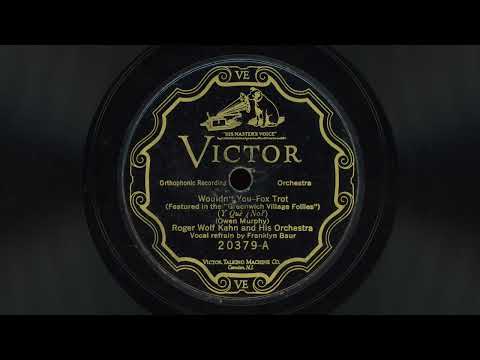
This recording of the tune “Wouldn’t You” coincided with Kahn’s opening of a night club, Le Perroquet de Paris, in New York City – which featured his orchestra as regular performers. The tune starts as a straightforward dance band number, but at 0:53, Miff Mole begins takes the temperature up with a trombone solo. After the vocals delivered by Franklyn Baur (accompanied by Eddie Lang), Joe Venuti and Lang perform a real gem of a hot duet starting at 2:35. All in all, an ornate affair, with just enough jazz interest for Brian Rust to concede they had a place in his famous Jazz and Ragtime Records discography.
Recorded in New York City on November 24, 1926. Released as Victor 20379
Credits: Roger Wolfe Kahn – director Tommy Gott, Leo McConville – trumpet Miff Mole – trombone Arnold Brilhart – clarinet, alto sax Alfie Evans – clarinet, alto sax, baritone sax Harold Sturr – clarinet, tenor sax Joe Venuti, Joe Raymond – violin Abe Borodkin – cello Irving Brodsky – piano Eddie Lang – guitar Arthur Campbell – tuba Vic Berton – drums Franklyn Baur – vocals
I recently acquired a large number of Storyville magazine issues – a London-based jazz publication that began in the mid 1960s. I’m reading them in order, one at a time, and it’s quite fun! In issue 6 from August 1966, a writer named Sandy Brown writes on the Isham Jones Orchestra:
“Isham Jones was one of the leading musical figures in the 1920s, as composer, bandleader, musician, and A&R man. As a composer he was most prolific, having something over two hundred of his numbers published, no mean feat when we consider that he also played in and lead one of the most successful dance bands of all time – in itself a time consuming occupation.”
He goes on to note that “All of Jones’ best tunes were written by 1924; three of them (‘The one I love belongs to somebody else’, ‘Spain’, and ‘It had to be you’) in one night!”
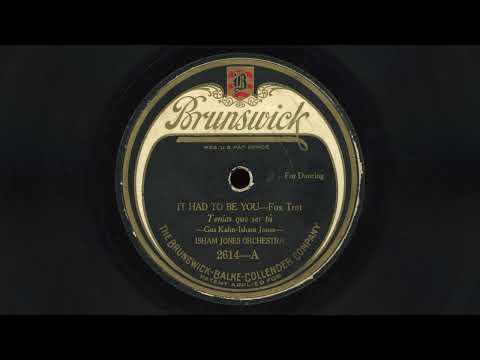
After reading that, I had to go pull a few Isham Jones records out while this fact was fresh in my mind. The one that struck me as most interesting musically was “It Had To Be You”, as we can hear cornetist Louis Panico blowing along with the main melody starting at 0:25, getting in one of his trademark “laughing” effects along with some wah wah effects (well before Clyde McCoy).
At 1:30, a sax states the main melody while trombonist Carroll Martin improvises along. At 2:14, Panico joins back in – and at 2:36, we hear a series of unique call and responses between Panico’s cornet and the rest of the band.
Throughout, the music just flows – and you can easily imagine a ballroom full of dancers effortlessly enjoying themselves.
It wasn’t the first recording of this tune – Marion Harris had recorded a vocal version a month earlier in March of 1924.
At the time of its publication, this popular tune was covered by many popular dance bands such as Paul Whiteman, California Ramblers, Bailey’s Lucky Seven, Ben Selvin, and Sam Lanin, among others. It rapidly became a standard in the great American songbook and has since been covered by a wide range of performers in jazz and popular music from Django Reinhardt to Frank Sinatra.
In August of 1924 Isham Jones wrote an article for Etude magazine’s infamous “The Jazz Problem” issue entitled “American Dance Music Is Not Jazz”, in which he declared “Because a song is successful and played by practically every dance orchestra, it is called jazz; but that is not my idea of jazz… I believe the term of jazz would only be applied to its rightful type of music, and that the dance music as played today would be known as American Dance Music.”
So perhaps Mr. Jones would find himself mischaracterized by having his records appear on my jazz-obsessed YouTube channel. Or perhaps our understanding of jazz and how it influenced American music has evolved. From my perspective, Isham Jones, like many early dance band leaders, certainly did play a role in the history and development of jazz.
So Isham – let’s be real – It had to be you.
🎺💃🕺🎶
Recorded in Chicago, Illinois on April 24, 1924. Released as Brunswick 2614
Credits: Isham Jones – tenor sax, leader Louis Panico – cornet Carroll Martin – trombone Al Mauling – clarinet, alto sax Artie Vanasec – soprano sax, violin Leo Murphy – violin Roy Bargy – piano Charles McNeill – banjo John Kuhn – tuba Joe Frank – drums
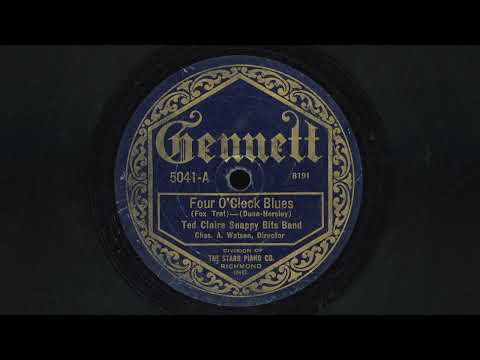
Imagine the exasperation of Charles Matson – his recorded output as a leader can be counted on two hands – and on both of his major Gennett sides they misspell his name as “Watson”!
I feel for you, Chas. They done you wrong.
The name “Ted Claire”, however, is correctly spelled – and is from a vaudeville performer whose relationship to Matson is unclear. Claire died in Chicago on December 9, 1960 and in his New York Times obituary, it notes he was a “former Broadway song-and-dance man” who was “a veteran of the Florenz Ziegfeld and Earl Carroll productions of the Nineteen Twenties and Thirties. He did comedy specialties in musicals and composed several show songs.”
So perhaps the Ted Claire Snappy Bits Band moniker was a lark – much like Sgt. Pepper’s Lonely Hearts Club Band or Mellon Collie and the Infinite Sadness. Or perhaps Claire worked with Matson on aspects of his live show and the name was a tribute to him. I suppose we may never have an answer to that, and it’s just left to our imagination.
I’m also a little miffed that the Times gave Claire an obit – but not Matson. Seems like he is a good candidate for their “Overlooked” series of obituaries about remarkable people whose deaths went unreported in The Times.
In any case, “Four O’Clock Blues” begins with the tolling of a bell. Thankfully, the bell helped me get this track in tune, as it chimes in B flat throughout the tune. The clarinet and alto sax seem to be having the most fun on this one – and the ensemble playing is lively.
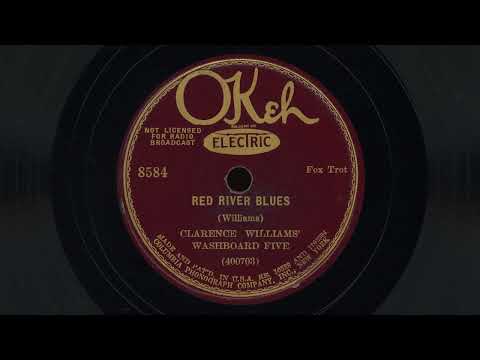
“Red River Blues” is a downtempo blues by Williams’ Washboard Five – a lineup that includes the legendary King Oliver on cornet.
The tune was penned by Williams himself – and features a lengthy clarinet solo by Arville Harris starting at 1:06 followed by a cornet solo by the King starting at 1:41.
Recorded in New York City on May 23, 1928. Issued as Okeh 8584 on July 5, 1928.
Credits Ed Allen, King Oliver – cornet Arville Harris – clarinet Clarence Williams – piano Floyd Casey – washboard
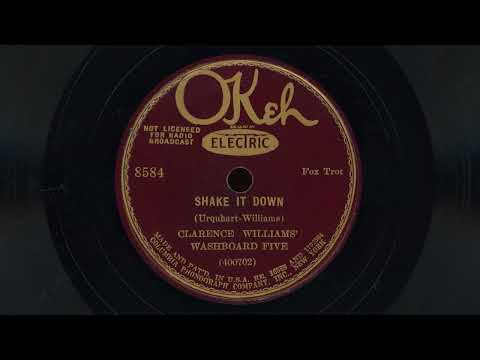
The first of many collaborations in 1928 between Clarence Williams and Joe Oliver, who had been playing out east in the summer of 1927. In July Oliver headed for NYC, after his group broke up. He had turned down a long-term contract at the Cotton Club (which instead went to Duke Ellington) earlier in the year and now found himself without a band. Instead, he collaborated with others as a featured sideman.
On “Shake it Down”, Oliver doesn’t get a full solo – but contributes several two-bar hot breaks. He went on to play on many other Clarence Williams sessions that year. Williams even directed a session released under Oliver’s name to fulfill part of his contract with Brunswick (released as Vocalion 1189 and 1190). In late 1928, Oliver signed a contract with Victor and began the last phase of his recording career.
This happens to be the first Clarence Williams record I ever heard – and from the first skritch of Floyd Casey’s washboard I was hooked. Since then I’ve really become a huge fan of his music – and learned a lot about his role in promoting and publishing jazz in the 20s. I posted an Instagram video of this record playing years ago – but never made a proper transfer.
Williams’ washboard band repertoire is always full of joy and is loads of fun – this track is no different. While other bands at this time aimed for a more ‘sophisticated’ modernistic sound, Williams’ use of the washboard showed a more informal and warmly rustic approach. It always sounds immediately accessible to my ears – and never disappoints.
Recorded in New York City on May 23, 1928. Issued as Okeh 8584 on July 5, 1928.
Credits Ed Allen, King Oliver – cornet Arville Harris – clarinet Clarence Williams – piano Floyd Casey – washboard