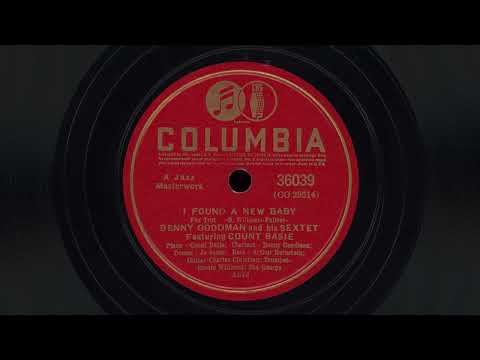
Here’s a fun challenge if you’re new to collecting 78s: Try to collect all the Benny Goodman records that feature Charlie Christian guitar solos. Goodman was so popular in the early 1940s, most of these records are not too hard to track down – and they are all outstanding!
This old standard also happens to be a tune I’m working on with my guitar instructor – so I am enjoying learning Charlie Christian’s solo.
This recording also features some other standout players: including Count Basie on piano and the great Cootie Williams (who had just left the Duke Ellington band a few months before) on trumpet.
Recorded in New York City on January 15, 1941. Released as Columbia 36039
Credits: Count Basie – piano Benny Goodman – clarinet Cootie Williams – trumpet George Auld – tenor sax Charlie Christian – guitar Arthur Bernstein – bass Jo Jones – drums
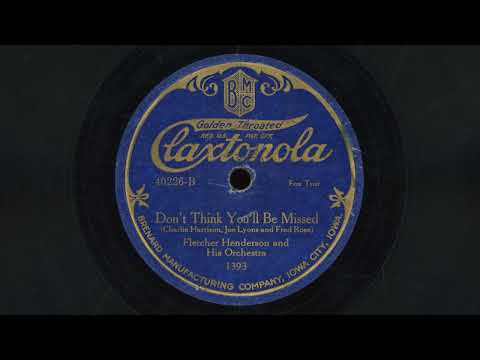
In March-April of 1923, Fletcher Henderson recorded his last session with the Black Swan label, which had given him his start as a recording artist in 1921. He began a short period in 1923 of recordings for the Paramount label, which were usually also pressed on the Puritan, Famous, and Claxtonola labels.
As a Iowan, the Claxtonola label has always been special to me because of its connection between early jazz and the state I call home. As valued as Paramount records are – I’d sooner have it on Clax.
This record has some great Don Redman playing both on alto sax and clarinet.
Recorded in New York City on May 1-2 ,1923. Released as Claxtonola 40226. Originally released as Paramount 20226.
Credits: Fletcher Henderson – piano, arranger, director Russell Smith, Elmer Chambers – trumpet George Brashear – trombone Don Redman – clarinet, alto sax Unknown artist – tenor sax Charlie Dixon – banjo
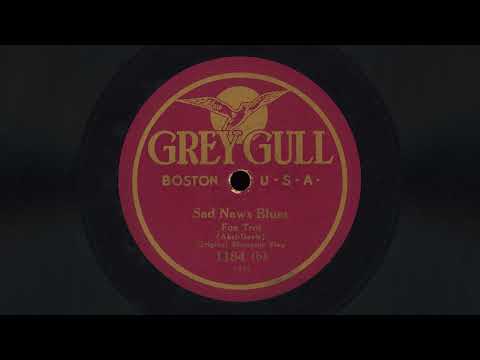
“Bad News Blues” was a tune published in 1923 composed by Harry Akst with lyrics by Benny Davis. It was recorded by Original Memphis Five (as Ladd’s Black Aces) in June of 1923 for Gennett, and also that same month for Pathé / Perfect (as “Sad News Blues”).
It is not clear why the song title was changed – but when they recorded it a third time, in September of 1923 for Plaza Music Company (who then likely licensed the master to Grey Gull), it was also released as “Sad News Blues”.
In any case, it’s a real treat – neither sad nor bad at all! Thankfully, even on dime store shellac, the sound quality is quite good.
Recorded in New York City on September 6, 1923. Released as Grey Gull 1184.
Credits Phil Napoleon – trumpet Miff Mole – trombone Jimmy Lytell – clarinet Frank Signorelli – piano Jack Roth – drums
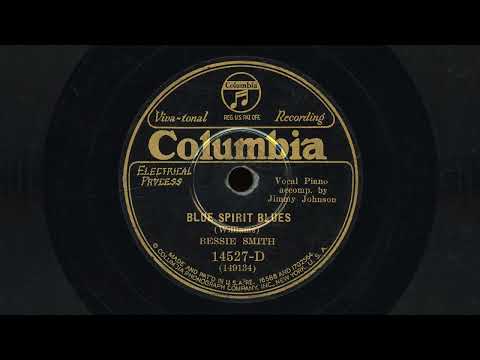
Because today is Dia De Los Muertos (Day of the Dead), I’m sharing a record with an appropriate theme: the amazing “Blue Spirit Blues” by Bessie Smith with piano accompaniment by James P. Johnson.
A real slow burn, Bessie paints a scene worthy of Dante’s Inferno:
“Had a dream last night that I was dead Evil spirits all around my bed The devil came and grabbed my hand Took me way down to that red hot land Mean blue spirits stuck their forks in me Made me moan and groan in misery Fairies and dragons spitting out blue flame Showin’ their teeth – for they was glad I came Demons with their eyelash dripping blood Draggin’ sinners through that brimstone flood This is hell I cried, cried with all my might Oh my soul, I can’t bear the sight Start runnin’ ’cause it is my cup Run so fast ’til someone woke me up.”
These later electrical recordings of Bessie Smith really sound fantastic! Her commanding voice just projects right out of the speaker through the years and confronts you with its real presence!
Recorded in New York City on October 11, 1929. Released as Columbia 14527-D.
Credits: Bessie Smith – vocals James P. Johnson – piano
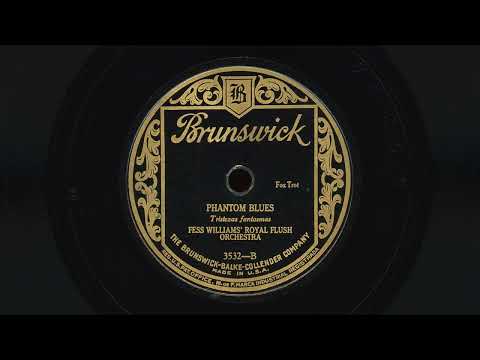
Today on Halloween, we have Fess Williams’s Royal Flush Orchestra performing the excellent “Phantom Blues”.
Williams himself arranged this composition by Al Handler and Len Riley – and it is full of great playing. If this is what phantoms are listening to, well, maybe we have some fun to look forward to in the afterlife!
The Royal Flush Orchestra had opened at the Savoy Ballroom in Harlem a year earlier and was the veritable house band there until 1928.
Williams himself was originally from Kentucky – and studied at the Tuskegee Institute in Cincinnati. He moved to New York in 1924 and formed the Royal Flush Orchestra a year later.
His birth name was Stanley Rudolph Williams, but when he taught students in Winchester, OH, after he graduated from Tuskegee, his pupils called him “Fess” – short for Professor.
Recorded in New York City on March 28, 1927. Released as Brunswick 3532.
Credits: Fess Williams – clarinet, alto sax, director, arranger George Temple, Kenneth Roane – trumpet David “Jelly” James – trombone Otto Mikell – alto sax Perry Smith – clarinet, tenor sax Henry Duncan – piano Ollie Blackwell – banjo Clinton Walker – baritone brass Ralph Bedell – drums
During the winter of 1933, Fletcher Henderson was negotiating via John Hammond with British bandleader Jack Hylton to bring his orchestra to London for a series of engagements there and in Europe. Plans were made for Hylton to hear the band at the Roseland – but he didn’t show up. A new date was set and he arrived two hours late – but left promising to make arrangements to bring the whole outfit to Europe. Henderson’s band had been through some lean depression years, so this was a big morale booster.
Unfortunately, Hylton never made good on his promise. He did, however, negotiate a personal contract with Coleman Hawkins – and this Victor session was his last with the band – after eleven years with Henderson. Hawkins sailed for Europe right after this recording session, where he stayed for five years.
This European let-down – coupled with accusations of non-payment by band members – gradually led to the breakup of the band. By November of 1934, all but three had quit the Henderson band to play with Benny Carter’s orchestra. He didn’t record another session until March of 1936.
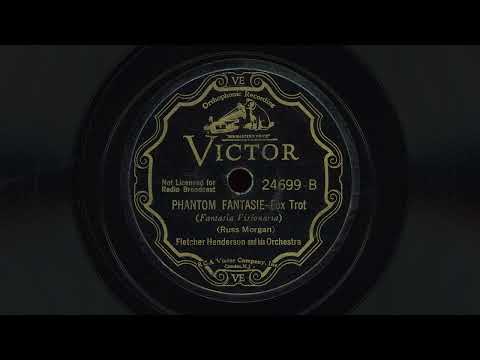
This Victor session included some of my favorite late-period Henderson works: This tune, Hocus Pocus, Harlem Madness, and Tidal Wave. “Phantom Fantasie” is a quasi-symphonic composition by Russ Morgan played with a chill groove by the Henderson band.
In it, we are serenaded by a piano solo from Mr. Henderson himself, as well as a tenor solo from the Hawk. Two takes were recorded – the first was unissued, though it is said to exist as a test pressing.
Recorded in New York City on March 6, 1934. Released as Victor 24699.
Fletcher Henderson – piano, director Russell Smith, Joe Thomas, Henry Allen – trumpet Claude Jones, Keg Johnson – trombone Buster Bailey – clarinet Russell Procope, Hilton Jefferson – clarinet, alto sax Coleman Hawkins – tenor sax Bernard Addison – guitar John Kirby – string bass Vic Engle – drums Russ Morgan – arranger
Sources: Hendersonia, Walter C. Allen Jazz and Ragtime Records, Brian Rust, 6th Ed.
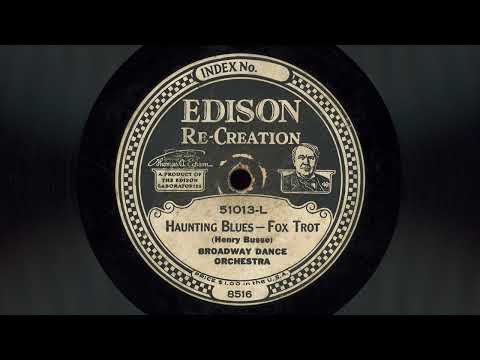
The Halloween playlist continues with a haunting number by Vincent Lopez and his Hotel Pennsylvania Orchestra, performing as Broadway Dance Orchestra on the Edison label.
Recorded in New York City on June 30, 1922. Released as Edison 51013.
Credits: Vincent Lopez – director, piano Bob Biers, Bob Effros – trumpet, flugelhorn, mellophone Harold Geiser – trombone, euphonium Billy Hamilton – clarinet, alto saxophone, oboe, sarrusophone Harry Brown – tenor saxophone Ernest Holst – violin Dave Berend – banjo Hank Waak – tuba Eddie Shearer – drums
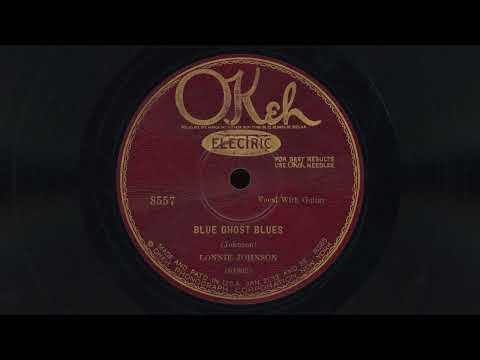
Continuing on the Halloween theme this week… we have the excellent “Blue Ghost Blues” by Lonnie Johnson.
From the first line, you can tell it’s gonna be a scary tale:
“MMmmm – I feel myself sinkin’ down. My body is freezin’ I feel something cold creepin’ around. My windows is rattlin’, my doorknob turnin’ round and round. This haunted house blues is killin’ me – I feel myself sinkin’ down.”
A later verse seems to possibly indicate that the “blue ghost” perhaps has a more material presence:
“The blue ghost is got the house surrounded – Lord! And I can’t get away They got shotguns and pistols standin’ all around my door. They haunt me all night long so I can’t sleep no more. The blue ghost haunts me all night, the nightmare rides me all night long. They worry me so in this haunted house, I wish’d I were dead and gone.”
Johnson was a New Orleans jazzman who worked the riverboats with Charlie Creath out of St. Louis in the early 20s. In 1925 he won a blues contest and the prize was a contract with Okeh records – so he followed destiny and became a blues guitarist. His singing and playing made him one of the most popular Okeh artists of the late 20s.
Thankfully, he continued to also also play jazz guitar, recording with Louis Armstrong and his Hot Five, Duke Ellington, and Eddie Lang, among others.
This was one of my first big wantlist records – which eluded me for years. Funny story – when I was new to 78 collecting, I bought a copy of this tune on the Decca label, only to find out that Lonnie had re-recorded this tune in the late 30s with piano and bass accompaniment. Same tune but something was missing. It took me a while longer to find this original Okeh recording.
Recorded on November 9, 1927. Released as Okeh 8557
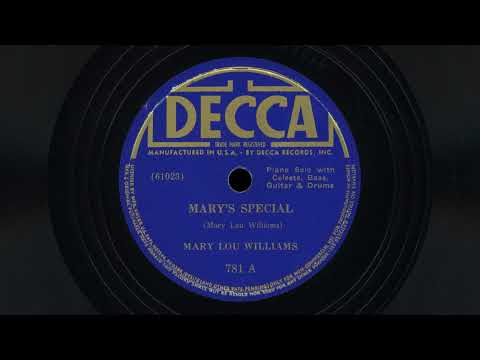
Longtime viewers of the channel know that I love Mary Lou Williams and her work with Andy Kirk and his Twelve Clouds of Joy – and that I love it when jazzers play the celesta. This record has both in copious amounts!
A small combo of guitar, bass, and drums (all compatriots of Mary’s in the Kirk band) accompanies Mary Lou on her composition “Mary’s Special”. While she starts off on piano, At 0:46 she switches to celesta – and switches back-and-forth throughout the rest of the song!
An absolutely delightful number!
Recorded in New York City on April 9, 1936. Released as Decca 781.
Credits: Mary Lou Williams – piano, celesta Ted Robinson (?) – guitar Booker Collins – string bass Ben Thigpen – drums
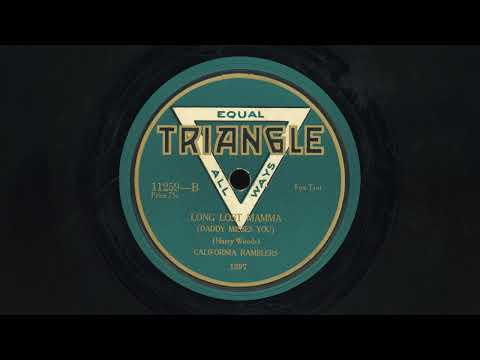
A fun early record by the California Ramblers, who seemed to record on virtually every label in the 1920s under one of 1,000 pseudonyms. This one was from a Paramount session that also was released on Puritan, Broadway, Triangle, and Famous labels.
A muted trumpet solo with some light growling and wah effects starting at 0:50 is followed by hot breaks featuring Lloyd Olsen on trombone and Rollini on bass sax. A second trumpet solo begins at 2:04 and leads us to the ensemble close.
Recorded in New York City on May 3, 1923. Released as Triangle 11259. Original released as Paramount 20232.
Arthur Hand – violin, director Frank Cush, Bill Moore – trumpet Lloyd “Ole” Olsen – trombone Jimmy Duff – clarinet, alto sax Freddy Cusick – tenor sax Adrian Rollini – bass sax Irving Brodsky – piano, arranger Ray Kitchingman – banjo Fred Henry – drums