Jazz Crazy Records

An Archive of Early Jazz on 78 RPM

Category: Jazz

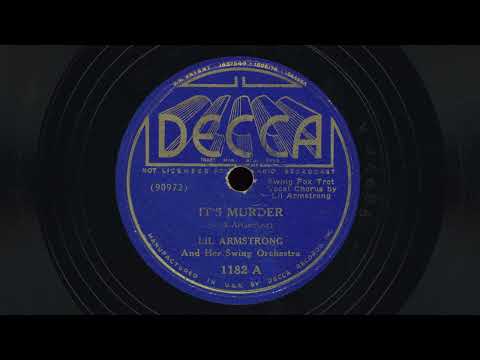
  • “It’s Murder” – Lil Armstrong and her Swing Orchestra (1936)

    “It’s Murder” – Lil Armstrong and her Swing Orchestra (1936)

    Even before Lil Hardin Armstrong made jazz history by co-founding the Hot Five with husband Louis Armstrong, she was playing with King Oliver’s Creole Jazz Band in Chicago and San Francisco. Her work with the Hot Five and Hot Seven is the stuff made of legends – but equally impressive was her work to help Louis Armstrong grow more confident as a performer and more astute as a manager of his own destiny. They parted ways in 1929.

    In the late 1930s, Armstrong recorded over 25 sides for Decca as a bandleader and vocalist – and this recording, “It’s Murder” is from her first session for Decca in 1936. It’s a swingin’ tune and it’s hard to imagine another song so bright and upbeat whose title contains the word “murder”. Murder ballad this is not. Armstrong is strong and seasoned as a vocalist – with real stage presence that can be sensed just from listening. It’s nice to see her in the spotlight – she’s a natural.

    Teddy Cole takes a solo on piano, followed by Chu Berry on tenor sax. Buster Bailey turns in a lively clarinet solo, followed by a short one by Joe Thomas on trumpet. Armstrong wraps things up with a scatted outro.

    Recorded in Chicago, Illinois on October 27, 1936.
    Released as Decca 1182.

    Credits:
    Joe Thomas – trumpet
    Buster Bailey – clarinet
    Chu Berry – tenor sax
    Teddy Cole – piano
    Huey Long – guitar
    John Frazier – string bass
    Lil Armstrong – vocals
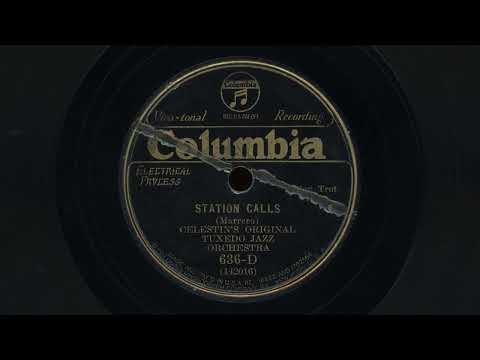
  • “Station Calls” – Celestin’s Original Tuxedo Jazz Orchestra (1926)

    “Station Calls” – Celestin’s Original Tuxedo Jazz Orchestra (1926)

    Louisiana-born cornetist Oscar Phillip Celestin moved to New Orleans in 1904 and by 1910 was leading a band at the Tuxedo Dance Hall in Storyville. Their first recording session did not take place for a full 15 years – until an Okeh session in 1925. Can you imagine if they had been recorded earlier? When I think of all the lost jazz of the “unrecorded period” before 1917, it is quite depressing indeed.

    This record is from their second recording session for Columbia in 1926 – and it almost didn’t make it to its upcoming 100th birthday. As you can see, it suffered the same fate as the Grey Gull I posted earlier this week – a near-fatal crack across the entire record due to recklessly inadequate packing job by a seller. Luckily it did not break completely and with some stabilization (and the help of de-clicking software to remove the tics) I was able to coax a decent transfer from it.

    Whenever you buy from a seller new to shipping 78s, you take a gamble. Though there is a tried-and-true method to ship these fragile discs with near 100% success, some new sellers decide it is best to ignore entreaties to ship safely and throw caution to the wind with a thin pizza box and a few sheets of bubble wrap. Let us not dwell on this – suffice to say it was injured and has convalesced to a point where it can still have a useful life.

    This tune, composed by banjo player John Marrero, has a languorous spirit throughout that is simultaneously calming and invigorating. A lengthy mid-section features a duet between Marrero and the talented female pianist Jeanette Salvant (who became Jeanette Kimball after marrying banjoist Narvin Kimball in 1929). She played on all of Celestin’s subsequent recordings in the 1920s and again with him in the 1950s when his career was revived.

    Celestin’s cornet brings us back to the ensemble – and he takes an extended solo that brings us home – the piercing tone of his muted trumpet offers a sharp contrast with the relaxed mood established.

    Recorded in New Orleans, Louisiana on April 13, 1926.
    Released as Columbia 636-D.

    Credits
    Oscar Celestin – cornet, director
    August Rousseau – trombone
    Paul Barnes – clarinet, alto sax
    Earl Pierson – tenor sax
    Jeanette Salvant – piano
    John Marrero – banjo
    Abby Foster – drums

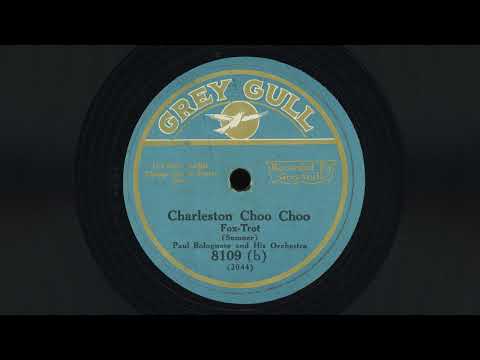
  • “Charleston Choo Choo” – Paul Bolognese and his Orchestra (1926)

    “Charleston Choo Choo” – Paul Bolognese and his Orchestra (1926)

    Releases by the Grey Gull label were low-priced records sold from job racks from newsstands, cigar stores, and drug stores. Along with their associated labels (Madison, Radiex, Globe, etc) these labels are often called “dime store” labels by collectors.

    Their cheap prices were attractive to consumers but the pressing quality of these labels is often inferior – and surface noise with some degree of graininess is common.

    There is a seemingly wide variety of different bands and orchestras recording for these labels, however many recordings were performed by their in-house orchestra featuring Mike Mosiello and Andy Sannella under a varied number of pseudonyms.

    Paul Bolognese was the musical director and house conductor for Emerson Records starting in 1922 – and he moved to Grey Gull in January 1926. This change coincided with Grey Gull moving its offices to New York City from Boston this same year.

    This release does not appear in either of Brian Rust’s comprehensive discographies that cover Jazz and Dance Band records.

    The record starts out with a peppy – but straightforward – sound. Things get hot once the trumpet solo kicks in around 0:57. This is followed by some highly arranged passages punctuated by hot banjo breaks – which lead to a xylophone solo at 1:49 by who I believe to be is George Hamilton Green.

    This 98-year-old record nearly met an ignoble end, as it was shipped to me by a seller who felt that loosely wrapping 10 fragile shellac records with bubble wrap in a thin “pizza box” would suffice for a cross-country journey. All records arrived cracked or broken. Luckily, I was able to repair and stabilize most of the cracked records to at least get transfers from them.

    “Charleston Choo Choo” – Paul Bolognese and his Orchestra
    Recorded in New York City circa May 1926.
    Released as Grey Gull 8109.
    Also released under the same catalog number on the Supertone and Radiex labels.

    Credits (no definitive source here – pretty much guesses):
    Paul Bolognese – director
    Mike Mosiello (?) – trumpet
    Andy Sannella (?) – clarinet, alto sax
    George Hamilton Green (?) – xylophone
    Unknown Artists – banjo, tuba, drums

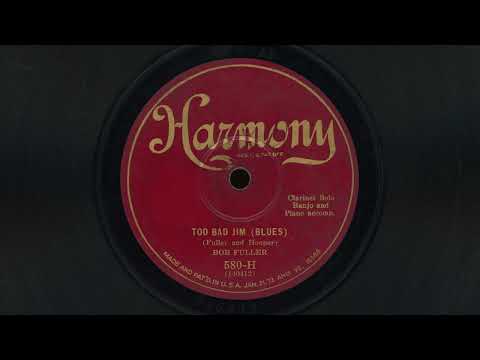
  • “Too Bad Jim” – Bob Fuller (1925)

    “Too Bad Jim” – Bob Fuller (1925)

    A bluesy number from a trio led by Bob Fuller on clarinet. Love the slow drawling pacing of this plaintive blues.

    This tune – co-written by Fuller and pianist Louis Hooper – was later re-recorded for Vocalion in June 1925 (under the name Three Jolly Miners) and for Pathé / Perfect in July 1925 (under the name Three Hot Eskimos).

    Recorded in New York City on March 4, 1925.
    Released as Harmony 580-H.

    Credits
    Bob Fuller – clarinet
    Louis Hooper – piano
    Elmer Snowden – banjo

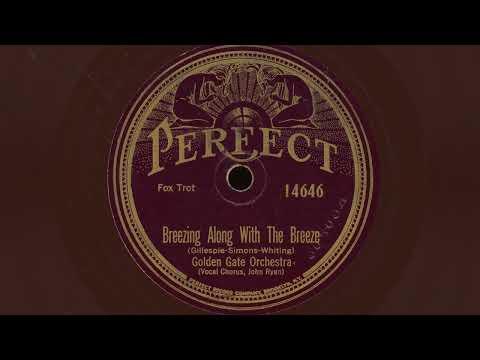
  • “Breezing Along With the Breeze” – California Ramblers (1926)

    “Breezing Along With the Breeze” – California Ramblers (1926)

    A peppy classic by the California Ramblers using one of their many aliases: Golden Gate Orchestra. Great ensemble playing, hot breaks, and solos throughout.

    As with many Perfect discs, this one has some shortcomings – surface noise notwithstanding, the bass rolloff seems to be around 200 Hz so Rollini’s bass sax is not as prominent in the rhythm section as it is on other recordings.

    Recorded in New York City, June 9, 1926.
    Released as Perfect 14646.

    Credits:
    Roy Johnston – trumpet
    Abe Lincoln – trombone
    Bobby Davis – clarinet, soprano sax, alto sax
    Bunny Drown – tenor sax
    Adrian Rollini – bass sax
    Jack Russin – piano
    Tommy Felline – banjo
    Herb Weil – drums
    John Ryan – vocals

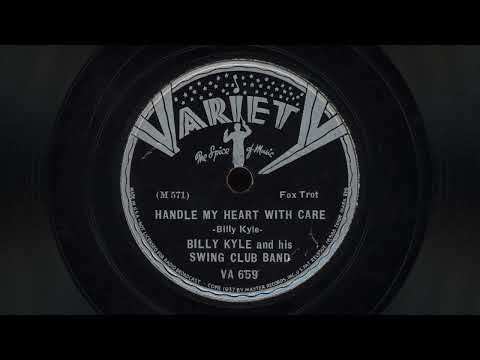
  • “Handle My Heart With Care” – Billy Kyle and his Swing Club Band (1937)

    “Handle My Heart With Care” – Billy Kyle and his Swing Club Band (1937)

    This tune is jumpin’! A real upbeat tune with lots of fine solos. If you haven’t heard of Billy Kyle, you’re not alone. But don’t let that stop you from giving this disc a listen!

    Part of the joy of collecting 78s is discovering labels and artists you’d be hard pressed to find any other way. Ever since I learned about the excellent (but short-lived) Variety label, I always am on the lookout for their releases.

    A local record store owner who knows I collect 78s let me know a crate had just come in – and I found this one among an otherwise unremarkable collection of postwar pop and country.

    Billy Kyle is a pianist who was a prolific sideman in the 1930s, playing with the Mills Blue Rhythm Band and Lucky Millinder. After the war, he had a long gig playing with Louis Armstrong’s All Stars. He worked as a bandleader only a few times – and a handful of sides for the Variety label represent perhaps over half of those sessions.

    Charlie Shavers is on point throughout – and Billy Kyle’s piano sounds fantastic. Danny Barker’s rhythm guitar is four-to-the-floor Freddie Green style but later in the tune he gets a short chord melody break.

    Nice record all around – Enjoy!

    Recorded in New York City on July 23, 1937.
    Released as Variety VA 659.

    Credits
    Charlie Shavers – trumpet
    Tab Smith – alto sax
    Ronald Haynes – tenor sax
    Billy Kyle – piano, leader
    Danny Barker – guitar
    John Williams – string bass
    Fran Marx – drums

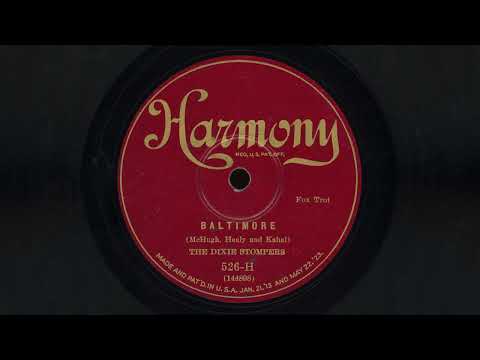
  • “Baltimore” – The Dixie Stompers (1927)

    “Baltimore” – The Dixie Stompers (1927)

    A Jack Purvis arrangement of the Jimmy McHugh tune “Baltimore” by Fletcher Henderson and his Orchestra, recording for the Harmony label under the alias “The Dixie Stompers”.

    This lineup of the Henderson orchestra performs with the excellent trumpeter Tommy Ladnier, who gets a short solo in. Coleman Hawkins’ solo is also worthy of note.

    0:00 Trumpet (Ladnier) + intro
    0:28 Tenor sax (Hawkins)
    0:52 Trombone (Harrison)
    1:04 Trumpet (Ladnier)
    1:26 ensemble
    2:39 Clarinet (Bailey)

    Recorded in New York City on October 24, 1927.
    Released as Harmony 526-H.

    Credits
    Fletcher Henderson – piano, director
    Russell Smith, Tommy Ladnier – trumpet
    Jimmy Harrison – trombone
    Buster Bailey, Jerome Pasquall – clarinet, alto sax
    Coleman Hawkins – clarinet, tenor sax
    Charlie Dixon – banjo
    Jack Purvis – arranger

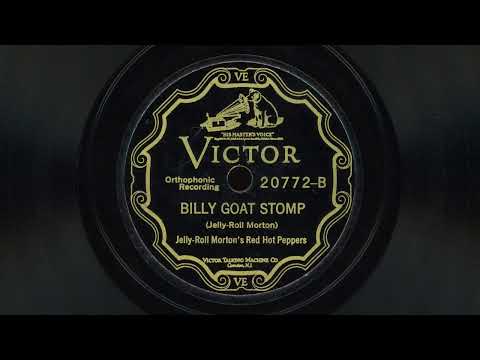
  • “Billy Goat Stomp” (take 1) – Jelly Roll Morton’s Red Hot Peppers (1927)

    “Billy Goat Stomp” (take 1) – Jelly Roll Morton’s Red Hot Peppers (1927)

    It is not known how or why Morton decided to include Lew LeMar, the Master of Entertainment at the Cafe de Paris in Chicago, on both sides of this record for vocal effects. On the flip side, “Hyena Stomp”, LeMar laughs throughout the song – echoing a novelty tradition going back to George W. Johnson’s “Laughing Song” and the Okeh laughing record.

    This side, “Billy Goat Stomp”, opens with LeMar bleating like the eponymous billy goat – followed by a band member shouting: “Man, get that goat outta here!” LeMar continues to bleat at irregular intervals throughout the song – as though a goat really had invaded the recording session and was wreaking havoc around the studio while being chased by staffers while the band plays on! As jarring as his bleats can be, I have to say, I find the whole thing to be hilarious – and pretty punk rock.

    Sadly, in an interview in 1936 with Kenneth Hulsizer (Jazz Music magazine, Feb-Mar 1944) Morton apparently told Hulsizer that “he wasn’t proud of the record. I think he was sorry he had made it.” Despite this, every time I hear a band cover the tune – and leave out the bleating goat sounds – it somehow feels diminished. Imagine leaving the bugle part out of the “Bugle Call Rag”! Thus, my message for today is: Respect the GOAT! Baaaaaa-aaaa-aaa!

    Once the music starts in earnest, we hear a series of starts and stops punctuated with inventive percussive effects by Baby Dodds – leading into call and responses between band members while goat bleats comedically fill the air. A series of solos follow, each ending with the ensemble joining in. It’s a fun romp that ends up being musically engaging and flippantly challenging simultaneously.

    Baby Dodds was playing a trap kit with Chinese Tom-Toms and cymbals – and his solo work here is quite interesting for the time.

    Interestingly, Morton had originally composed this tune as a solo piano piece. Baaaaaa-aaaa-aaa!

    0:00 intro
    0:23 cornet (Mitchell)
    0:42 clarinet (Dodds)
    1:00 percussion (Baby Dodds)
    1:18 ensemble
    1:37 alto sax (Evans)
    1:55 guitar (Scott)
    2:14 trombone (Reeves)
    2:32 piano (Morton)
    2:51 ensemble
    3:10 clarinet (Dodds)

    Recorded at Oak Street studio in Chicago, Illinois on June 4, 1927.
    Released as Victor 20772.

    Credits:
    Jelly Roll Morton – piano, director
    George Mitchell – cornet
    Gerald Reeves – trombone
    Johnny Dodds – clarinet
    Stump Evans – alto sax
    Bud Scott – guitar
    Quinn Wilson – tuba
    Baby Dodds – drums
    Lew LeMar – goat imitation effects

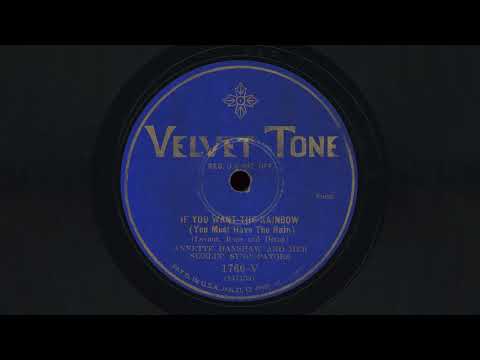
  • “If You Want the Rainbow (You Must Have The Rain)” – Annette Hanshaw and her Sizzlin’ Syncopators

    “If You Want the Rainbow (You Must Have The Rain)” – Annette Hanshaw and her Sizzlin’ Syncopators

    A pleasant song from long ago.

    Recorded in New York City on October 19, 1928.
    Released as Velvet Tone 1766-V.

    Credits:
    Annette Hanshaw – vocals
    Ben Selvin – violin
    John Cali – violin, guitar
    Rube Bloom, Irving Brodsky – piano

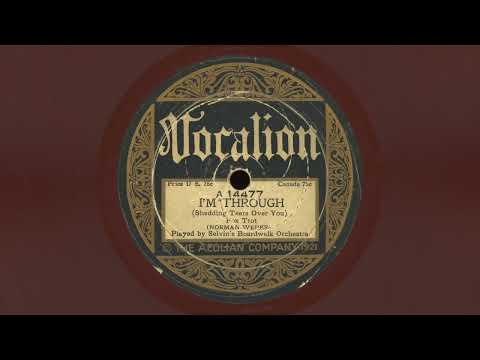
  • “I’m Through (Shedding Tears Over You)” – Selvin’s Boardwalk Orchestra (1922)

    “I’m Through (Shedding Tears Over You)” – Selvin’s Boardwalk Orchestra (1922)

    Ben Selvin grew up on Ludlow Street on the Lower East Side of Manhattan. It is said that he couldn’t afford violin lessons as a boy so he started playing harmonica. He eventually learned the violin – along with several other instruments – and at age 15 began playing in night clubs, restaurants, hotels, and dance halls in New York.

    Selvin hit it big with the hit “Dardanella” in 1919, recorded for Victor with his Novelty Orchestra. He also performed under names such as the Bar Harbor Society, the Harmonians, and the Frisco Syncopators. He quickly became one of the most prolific artists of the 78 rpm era. The New York Times estimated in 1964 that Selvin had “played, made, or otherwise produced more than 9,000 records.”

    By the time this side was recorded for Vocalion in late 1922, Selvin had already recorded just short of 200 sides for a variety of labels, including Victor, Paramount, Emerson, Arto, Grey Gull, Lyric, Okeh, Vocalion, Pathé Actuelle, Brunswick, Banner, Regal, Broadway, Perfect, and Puritan.

    There’s some great solo and ensemble playing on this record – starting with the growling trumpet at the 0:12 mark. Throughout the song, the interplay between the trumpet and the swooning reeds is excellent. Though the solo sections seem to closely follow the melody – they do so with a nod to the hot and expressive side – and only seem to truly improvise during certain short hot breaks.

    Despite this, or perhaps because of it, this tune was left out of Rust’s Jazz and Ragtime Records discography. Some great playing on this one! Certainly with plenty of “jazz interest” in my book!

    Recorded in New York City in November, 1922.
    Released as Vocalion 14477.

    Credits:
    Ben Selvin – violin, director
    Jules Levy, Jr. (?), Hymie Farberman (?) – trumpet
    Eph Hannaford – trombone
    Bernie Daly – alto sax
    Joe Winshup – tenor sax
    Norman Spencer – piano
    John Cali – banjo
    Jack Helleberg – tuba
    Unknown Artist – drums